That’s why they call this thing bloodsport, kid! ‘Black Panther’ actress to write and direct A24’s ‘Bloodsport’ remake

A remake of Newt Arnold’s 1988 film Bloodsport, the martial arts extravaganza that launched Jean-Claude Van Damme to superstardom, has been in development-hell for well over 14+ years.

Director Phillip Noyce (Salt) and screenwriter Robert Mark Kamen (Taken) were once attached. Then the project came into the hands of James McTeigue (Ninja Assassin) and Craig Rosenberg (The Uninvited), who would re-shape the “Frank Dux” narrative into the lives Continue reading

Posted in News |

Deal on Fire! The Final Master | Blu-ray | Only $10.13 – Expires soon!

The Final Master | Blu-ray & DVD (Well Go USA)

The Final Master | Blu-ray & DVD (Well Go USA)

Today’s Deal on Fire is the Blu-ray for Haofeng Xu’s highly-anticipated, award-winning martial arts film, The Master, re-titled as The Final Master (read our review) from Well Go USA Entertainment.

Xu made a name for himself by penning the screenplay for Wong Kar-Wai’s The Grandmaster. But it was 2011’s The Sword Identity, his directorial debut, which showed Xu’s true talent. Then came his acclaimed second film, 2012’s Judge Archer (aka Arrow Arbitration).

Xu’s trend in both films was presenting the martial arts in a less stylized and more realistic manner, perhaps not unlike the 2007 Japanese film Black Belt or David Mamet’s 2008 MA-themed Redbelt.

The Final Master stars Continue reading

Posted in Deals on Fire!, News |

ANOTHER BRICK IN THE WALL! ‘Twilight of the Warriors: Walled In’ sequel begins production in April

Two years ago, director Soi Cheang Pou Soi (SPL II: A Time for Consequences), alongside producers Wilson Yip (Paradox) and John Chong (Paradox), revealed plans for both a prequel and a sequel to 2024’s Twilight of the Warriors: Walled In.

Now, those plans are finally moving forward. The follow-up to the hit Hong Kong thriller is set to begin filming in April, with a massive recreation of Kowloon Continue reading

Posted in News, Top 4 Featured |

Who wants food? Eureka announces 4K Ultra HD for ‘Wheels on Meals’ starring Jackie Chan, Sammo Hung and Yuen Biao

"Wheels on Meals" Japanese Poster

“Wheels on Meals” Japanese Poster

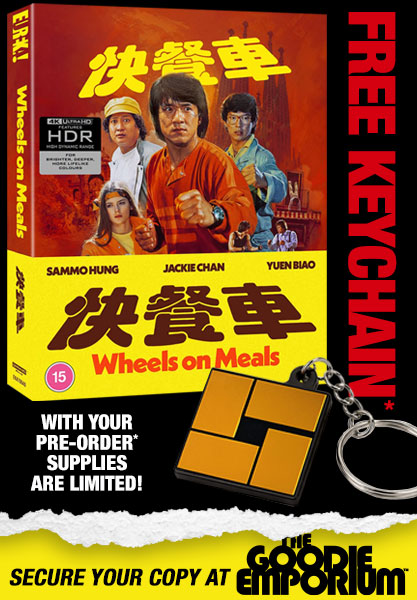
Later this year, Eureka will be releasing a 4K Ultra HD for Wheels on Meals (aka Spartan X), a 1984 Golden Harvest classic directed by and starring Sammo Hung (Eastern Condors).

From a brand new 4K restoration comes Wheels on Meals, starring Hung, Jackie Chan, and Yuen Biao as the most exciting triple act in action-comedy movie history!

Fast food chefs Thomas (Chan) and David (Biao) find themselves cooking up trouble when detective Moby (Hung) involves them in the case of a missing heiress. The three friends need all of their daring and physical dexterity when they find themselves Continue reading

Posted in News |

More CG animal mayhem? Jackie Chan set for ‘Pawfect Agents’ and has joined the in-development film ‘Retired Cop’

Legendary martial arts icon Jackie Chan (The Shadow’s Edge, The Foreigner) will soon begin work on Pawfect Agents, an upcoming action-comedy that re-teams Jackie with his Bleeding Steel director, Leo Zhang (Chrysanthemum to the Beast). Following the footsteps of 2024’s Panda Plan and its sequel, Pawfect Agents will be a live-action/CG hybrid feature.

The film – from LinKEY Sanxing and Zhang’s Shangjia Film companies, with Cappu Films handling sales – follows a veteran agent (Chan) on the verge of retirement who is pulled back into the field after the Sanxingdui Golden Mask – one of China’s most prized Continue reading

Posted in News |

Deal on Fire! Ninja Trilogy | 4K Ultra HD | Only $58.99 – Expires soon!

Today’s Deal on Fire is for the 4K Ultra HD collection for Kino Lorber’s Ninja Trilogy, consisting of Menahem Golan’s Enter the Ninja (1981), Sam Firstenberg’s Revenge of the Ninja (1983), and Ninja III: The Domination (1984)

Though not connected in story, these three films popularized the image of the ninja in Western pop culture (known as the 80s “ninja boom” or “ninja craze”) with Continue reading

Posted in Deals on Fire!, News |

Dolph Lundgren DIES HARD in the Trailer for ‘Straight Shot’ also starring Rachael Leigh Cook and Tyrese Gibson

"Straight Shot" Poster

“Straight Shot” Poster

Iconic action star Dolph Lundgren (Hellfire, Castle Falls) is back in Straight Shot, a Die Hard-esque thriller from writer/director Gabriel Sabloff (Beckman).

The film is headlined by David A.R. White, an actor, producer and director who is perhaps best known for 2025’s A Line of Fire, 2022’s Nothing is Impossible and 2020’s Beckman.

A bodyguard past his prime (White) fights through a skyscraper full of mercenaries to save his ex-fiancée trapped in an experimental coffin.

Lundgren is part of an ensemble cast that also includes Rachael Leigh Cook (She’s All That), Tyrese Gibson (2 Fast 2 Furious) and William Continue reading

Posted in News, Top 4 Featured |

NO NEW WARS… unless ninjas are involved! Watch the Trailer for ‘Ninja Wars’ featuring Kane Kosugi and Yasuaki Kurata

"Ninja Wars: Blackfox vs Shogun's Ninja" Poster

“Ninja Wars: Blackfox vs Shogun’s Ninja” Poster

Craving some ninja action? Then today’s your lucky day. There’s a lot to unpack, so we’ll let the film’s official press release take it from here…

Nihon Eiga Broadcasting Corp. has unveiled the first visual and teaser trailer for Ninja Wars: Blackfox vs Shogun’s Ninja, a new action period film from internationally renowned director Koichi Sakamoto (Power Rangers, Ultraman, Kamen Rider).

The film stars Chihiro Yamamoto (Alice in Borderland Season 2), Kanon Miyahara (Ninja vs Shark), Nashiko Momotsuki (Mashin Sentai Kiramager Spin-Off: Yodonna), Kane Kosugi (Bang), Miki Mizuno (Guilty of Romance), and legendary martial arts actor Yasuaki Kurata (Eastern Condors), bringing together some of Japan’s leading action performers.

The project unites Continue reading

Posted in News |

Born a Ninja & Commando the Ninja | Blu-ray (Visual Vengeance)

Born a Ninja

On May 12, 2026, Visual Vengeance is releasing the Blu-ray for Born a Ninja and Commando the Ninja (aka American Commando Ninja), two martial arts films from 1988 that star Meng Fei (Face Behind the Mask) – secure your copy today from Goodie Emporium!

This shot-on-video martial-arts double feature from Joesph Lai and IFD Films unleashes pure 1980s ninja chaos as two unlikely heroes are dragged into a war over stolen germ-warfare secrets. Featuring disappearing ninja assassins, endless waves of Continue reading

Posted in Asian Titles, DVD/Blu-ray New Releases, Martial Arts Titles, News | Tagged |

Mexicali (2026) Review

"Mexicali" Theatrical Poster

“Mexicali” Theatrical Poster

Director: Luke LaFontaine
Cast: Bren Foster, Tania Raymonde, Plutarco Haza, Kris Van Damme, Louis Mandylor
Running Time: 99 min. 

By Z Ravas

Mexicali is a movie that knows precisely what its audience wants and decides to give it to them without delay. It’s been two short years since Bren Foster broke out on the international action scene with Life After Fighting, and the filmmakers behind Mexicali understand that fans are likely curious if that movie was a one-off or if Foster will continue to cement his status as a rising star in the martial arts world; therefore, Mexicali opens with Foster in the ring for not one, not two, not three, but four fights in a row. Befitting a movie with a former stuntman in the director’s chair, the fight choreography here is top notch, and Foster very quickly proves that Life After Fighting was no fluke, as the man seems incapable of not going Beast Mode whenever a scene calls for him to throw a punch or kick.

Needless to say, the wait for Bren Foster’s follow-up to Life After Fighting was worth it. Mexicali arrives from Luke LaFontaine, the aforementioned former stuntman and second unit director with past credits on many Direct to Video action efforts like Jesse V. Johnson’s Savage Dog and The Mercenary. It’s likely no coincidence, then, that Jesse V. Johnson wrote the script Continue reading

Posted in All, Asian Related, News, Other Movies, Reviews | Tagged , , |

Forbidden City, The (2025) Review

“The Forbidden City” Poster

Director: Gabriele Mainetti
Cast: Yaxi Liu, Enrico Borello, Marco Giallini, Sabrina Ferilli, Shanshan Chunyu, Elisa Wong
Running Time: 139 min.

By Paul Bramhall

Is there another city in Europe that has more connection to the kung-fu genre than Rome? I’m going to say no. From providing the classic backdrop to Bruce Lee’s directorial debut Way of the Dragon in 1972, it would go on to inspire several other productions to film in its historical streets. Seasonal Films founder Ng See-Yuen would team up with Bruce Leung for 1974’s double bill of Kidnap in Rome and Little Godfather from Hong Kong. See-Yuen would return again for the Bruce Lee biopic Bruce Lee: The Man, The Myth in 1975. The 1982 Bruceploitation production Bruce Strikes Back would film there, swapping out Bruce Lee and Chuck Norris for Bruce Le and Hwang Jang Lee in an epic colosseum showdown. So it’s perhaps fitting that, in 2025, Italy decided to film its very own kung-fu movie there, in the form of The Forbidden City.

Following his superhero themed feature length debut with 2015’s They Call Me Jeeg Robot, and similarly themed sophomore production Freaks Out from 2021, The Forbidden City marks the 3rd outing for director Gabriele Mainetti. Turning his attention to a more grounded style of action, with the casting of Yaxi Liu as the lead it would seem he means business when it comes to having genuine martial arts talent onscreen. Continue reading

Posted in All, Asian Related, News, Other Movies, Reviews, Top 4 Featured |

Deal on Fire! Heart of the Dragon | Blu-ray | Only $19.99 – Expires soon!

Heart of Dragon | Blu-ray (Arrow)

Heart of Dragon | Blu-ray (Arrow)

Today’s Deal on Fire is the Blu-ray for Sammo Hung’s 1985 action-drama, Heart of the Dragon (aka First Mission).

Jackie plays a good-hearted cop looking after his learning-disabled brother Danny, played by Sammo, but doesn’t always succeed in keeping him out of trouble. When Danny is taken as a hostage, his brother will risk everything – his career and even his life – to rescue him, throwing it down as only Jackie Chan can.

Made the same year as Police Story, Heart of Dragon was a change of pace for the great action artists, giving them a chance to show of their acting chops as well as their stunt skills – even if they don’t ignore the latter!

The film also stars Continue reading

Posted in Deals on Fire!, News |

How Action Directors Create High-Stakes Tension in Every Scene

Image Source

Great action scenes aren’t just about explosions or fast movement. They’re about tension. The kind that makes you lean forward, hold your breath, and feel like something could go wrong at any second. The best directors don’t rely on chaos. They control it. Every cut, every pause, every movement is intentional.

Filmmakers like John Woo and Tsui Hark understand that action only works when the stakes feel real. It’s not just what’s happening on screen. It’s how it’s built. In this piece, we break down how great action directors create that pressure and keep viewers engaged from start to finish.

Setting the Stakes: Why Tension Comes First

Tension is what makes an action scene work. Without it, all you’re left with is noise. Fast cuts, loud sounds, and movement that lacks meaning. Great directors understand this, so they build tension before anything escalates.

Think about high-risk settings like casinos, where every decision carries immediate consequences. That’s why scenes built around thrilling online casinos feel so intense even before anything goes wrong, because the outcome is uncertain and often tied to significant loss or gain. The pressure exists from the start.

This same principle applies to other high-stakes moments. A standoff, a chase, or even a quiet conversation on the edge of conflict. The tension comes from what could happen, not just what is happening.

From a filmmaking perspective, tension is deliberately engineered through stakes, uncertainty, and timing. Directors design scenes so that the audience anticipates consequences before they unfold.

At its core, tension is not about spectacle. It is about emotional investment. When the audience understands what is at risk, every second carries more weight, which keeps viewers engaged.

The Masters of Controlled Chaos: John Woo and Tsui Hark

John Woo and Tsui Hark are widely regarded as masters of action, but what sets them apart is precision. Their scenes may appear chaotic, yet every element is carefully constructed.

John Woo is known for slow-motion sequences, dual-wielding gunplay, and emotionally driven storytelling. His action scenes extend beyond visual spectacle. They emphasise loyalty, sacrifice, and character conflict, which heightens tension.

Tsui Hark approaches action through movement and visual energy. His camera rarely remains static, and his scenes often feature multiple layers of action unfolding simultaneously. Despite this complexity, the viewer is never disoriented. The visual language remains clear and intentional.

Both directors demonstrate a core principle of action filmmaking: clarity must be preserved even at peak intensity. Without spatial and narrative clarity, tension collapses into confusion.

Their influence continues to shape modern action cinema. From Hollywood productions to international films, their techniques remain foundational for building and sustaining tension.

Editing: Where Tension Is Really Built

Editing is where tension is ultimately constructed. What appears on screen is not only defined by what was filmed, but by how those shots are assembled.

The rhythm of cuts plays a crucial role. Fast cuts create urgency and chaos, while slower cuts extend moments and build anticipation. The timing of each cut determines how the audience processes information and emotion.

Holding a shot slightly longer than expected can create unease. The viewer begins to anticipate change, even in stillness. That anticipation is a key component of tension.

Cross-cutting is another essential technique. By shifting between characters or parallel situations, directors reveal connections and raise stakes simultaneously. This structure allows tension to build across multiple layers of the narrative.

In professional editing practice, tension is shaped through pacing, shot selection, and continuity. Each decision influences how the audience experiences time, pressure, and emotional escalation.

Pacing: Knowing When to Slow Down

Continuous action may seem engaging, but without variation, it loses impact. When intensity remains constant, it becomes predictable.

Effective pacing relies on contrast. Moments of quiet create space for tension to grow. A pause, a glance, or even silence can signal that something significant is about to occur. These moments prepare the audience for impact.

Stretching time before a key event increases anticipation. When the action finally unfolds, it feels more powerful because the audience has been prepared for it.

Directors intentionally structure scenes to alternate between tension and release. This contrast ensures that high-intensity moments retain their effect rather than becoming visually overwhelming.

Without controlled pacing, even well-executed action can feel flat. Balance is what gives action its weight.

Choreography: Action That Tells a Story

Effective action choreography goes beyond visual appeal. It communicates character, intention, and conflict.

A disciplined fighter moves differently from a reckless one. These differences are reflected in posture, timing, and decision-making during a scene. The audience understands character through movement.

Spatial awareness is equally important. Viewers need to understand where characters are positioned and how they interact with their environment. When spatial relationships are clear, the action becomes more immersive and believable.

Action sequences are also designed to escalate. Each movement builds on the previous one, increasing stakes and intensity. This progression keeps the audience invested.

In action design, choreography functions as a narrative tool. It reveals character traits while advancing the story, rather than serving as an isolated spectacle.

When choreography, clarity, and escalation work together, action becomes meaningful rather than decorative.

Tension Is What Makes Action Stick

Great action is not defined by speed or volume. It is defined by emotional impact. The most effective directors build tension with intention and precision.

When the stakes are clear and every element is purposeful, the audience remains engaged from beginning to end. Tension is what transforms action from noise into experience.

Posted in News |

Training Like a Martial Arts Action Star: What Real Athletic Preparation Looks Like

When you see Donnie Yen cut through a room of opponents in Ip Man, or when you witness Tony Jaa launch a Muay Thai knee strike as razor-sharp as candlelight in Ong-Bak, something deep inside your body registers that as real — because it is. Unlike a lot of Hollywood action that’s digitally enhanced, the best martial arts cinema is fundamentally based on real athletic preparation — something the vast majority of viewers will never witness. The interesting question is not how did they film that? — how did they assemble a body and mind capable of doing so in the first place?

The divide between the elements onscreen and all that is required to arrive at them is massive. Goes. Film fight scenes are choreographed over the course of weeks, optimized for camera angles, lighting and dramatic timing — not athletic efficiency. But the actual physical platform those performances are built upon? That takes years. This is what real martial arts athletic preparation looks like: the disciplines, the science, and the day-to-day unglamorous work that prepares a performer for becoming a legend on screen.

The Difference Between Combat Choreography and Real Life Fighting Conditioning

The first thing that you should understand is that cinematic martial arts and competitive martial arts conditioning are made for completely different results. There are film sequence choreographies that appear lethal and smooth from a specific camera position, hit marks in a given order, repeat safety through twenty takes. True athletic conditioning for martial arts is made to keep up explosive force, quick response and technical precision in true fatigue — and to repeat it, without a director calling a cut.

This distinction is important because it dictates everything about the seriousness of martial arts training. They’re not rehearsing for the performance. They are preparing for a function. A fighter’s body is built over years of progressive overload, repetition of skills and disciplined recovery, not a six-week prep cycle before the gun goes off.

How the Legends Really Built Their Physiques

To understand real martial arts preparation, we start by considering the athletes who made the training method famous — and how they actually built their physical potential.

Bruce Lee is the founding father, and his methodology of training was groundbreaking in ways that may not have yet even truly been appreciated. His philosophy was anti-muscle size = strength. Instead, he focused on what he called usable power — strength that might turn directly into speed, or precision, or endurance. Decades before people learned about the merits of cross-training, he got it. Where most martial artists of his generation trained only on technique, Lee included weightlifting, calisthenics, running and even meditation in his regimen. He ran three days a week, usually for four miles at a time and alternating his pace in what closely resembles modern HIIT training. It produced a composition that Chuck Norris once called “muscle upon muscle” — not for looks but designed for functional output.

Jet Li exemplifies elite, structured athletic development. His training started in the structured Chinese national sports system — starting at the Beijing Wushu Academy at age eight, racking up five gold medals at the Chinese nationals (the first came when he was eleven years old), and becoming a national coach before he hit his teens. The athleticism people see on screen is the product of a decade of daily competitive training before he even got in front of a camera.

Also a product of pure martial discipline is Tony Jaa. A Muay Thai fighter who began training at 10, under the tutelage of his father, Jaa worked on a stunt team before making his film debut — there was nothing in it for him except years of bodily discipline, not practice for a single role. When he runs up a wall in Ong-Bak, it’s from fifteen years of physical training, not a film school gimmick.

Jackie Chan epitomizes a different, but equally uncompromising approach. He was trained as a child by the punishing acrobatic requirements of the Peking Opera school — a system that combined martial arts disciplines with gymnastic conditioning. The flexibility, balance and spatial awareness that would help him give the appearance of doing his stunt work effortlessly were developed over thousands of hours of physical conditioning that preceded his career by years.

Conclusion: The Five Pillars of Athletic Preparation for Real Martial Arts

What do these athletes share in common? Their prep — no matter style or era — broke down on five consistent pillars that sport science is now validating as the basis of elite martial arts conditioning.

Functional Strength and Explosive Power

Real martial arts conditioning builds functional strength that supports movement, not glamor muscles through isolation exercises. Bruce Lee established the initial link between enhancing strength and conditioning with the aim of being better in martial arts by focusing on improving muscular endurance, cardiovascular endurance, strength, and flexibility — it was all about balance. The aim is power derived from the complete kinetic chain: ground up, through the hips, through the core, and out through the limbs. Squats, deadlifts, explosive plyometrics and kettlebell movements that replicate athletic demands of the real world are the tools of choice — not a commercial gym machine.

Cardiovascular Endurance and Anaerobic Capacity

Two different energy systems are used at a high rate in martial arts. Aerobic endurance underpins the ability to maintain effort through a long training session or battle. Anaerobic capacity fuels the explosive bursts — the takedown attempt, the combination of strikes, the sudden explosion from a clinch. Lee felt that a great martial artist must also be a great athlete, one who could retain speed and precision late into a fight — nearly every morning started with a four-mile run followed by bursts of steady pace and sprints. Serious martial arts practitioners train both systems intentionally: steady-state cardio building the aerobic base; high-intensity interval work developing fight-specific conditioning.

Flexibility and Mobility

That means that the high kicks, ground grappling transitions, and evasive footwork that characterize elite martial arts all require a kind of joint mobility that must be consciously trained and then maintained. This is not some passive bit of preparation — it is worked on every day. Bruce Lee was very dedicated to his flexibility routine, doing many high kicks, forward bends, side bends, waist twisting and alternate splits progressively every day. His capacity to kick a man over a foot taller than him in the head wasn’t a gift it was the result of years of intentional flexibility training. The science supports dynamic stretching ahead of training sessions to prepare the body and passive stretching post-sessions to enhance long-term range of motion.

Skill Drilling and Technique Repetition

In martial arts, technique is not learned — it’s installed, through thousands of intentional repetitions until the movement becomes automatic under duress. Lee intended to throw five hundred punches each day, threw some of those punches with light weights in his hands and would concentrate on speed and endurance in his kicking and punching workouts while also training power on a heavy bag. It is this volume of deliberate practice that produces the muscle memory that endures the cognitive overload of real competition. Pad work, shadow drilling, sparring, positional grappling rounds — these are the primary vehicles to achieve actual skill development and they can’t be fast-tracked.

Recovery and Body Management

This is the axis that distinguishes serious practitioners from casual ones — and it’s also the one most often underestimated. The pressure gradient created by a compression sleeve manipulates the arteries and veins to improve circulatory efficiency — increasing blood pressure to some areas, delivering more oxygenated blood to muscles, removing lactic acid faster and increasing venous return to minimize inflammation and swelling; all which help facilitate workout recovery.

For martial arts athletes who train twice a day/6 days a week, the limiting factor in how much quality work can be accumulated from now until eternity is how fast their body will recover between training sessions. That is why serious practitioners take sleep, nutrition timing and active recovery as seriously as they do training. The body does not adapt during training, it adapts during recovery — which makes recovery not optional but the point of the whole thing.

For athletes training outdoors — at parks, rooftop dojos and open-air martial arts schools — there’s an added recovery and protection concern: ultraviolet exposure. Compression arm sleeves can serve as an extra layer of UV protection for those that train outdoors regularly when their sunscreen sweats off during tough sessions. Brands such as 4inbandana, which makes UPF50+ athletic arm sleeves that cross from combat to outdoor sports, highlight how athletes are increasingly aware that the prospect of sun protection while training is a real performance concern — not an afterthought. Up to date with some data only until October 2023.

What Non-Lifelong Martial Artists Actors Seem to Do

It’s fair to be honest about what preparation looks like for actors coming to the art from behind the lens instead of vice versa. Now, many Hollywood productions invest sincerely in preparing their talent — and the result is extremely impressive. But the gulf between months of preparation and a lifetime of practice is wide, and it’s why the most exciting martial arts cinema still tends to be constructed around people who are the thing they show onscreen.

When actors approach martial arts in serious fashion, they tend to study with professional coaches across different disciplines for months at a time, blending combat practice with conditioning as an athlete. It trains up genuine skill — sufficient to work credibly on screen. What it can’t pull off is the automatic, reflexive aspect of technique drilled for years. That special thing — the kind that makes Donnie Yen’s Wing Chun look like it requires zero effort, even when he’s receiving a strike — is born out of the first 10 years of practice, not the last six months.

This is not to knock any actor who prepares seriously for a role.) It’s just an acknowledgment of what the long road of real martial arts development builds — and why audiences with a trained eye can always tell the difference.

What That Means for Anyone Who Trains

The concepts that explain elite-level extra work are not limited to elite participants. They telescope down to every level of practitioner. Those same five training pillars — functional strength, cardiovascular conditioning, flexibility, skill drilling and recovery — are equally applicable to someone coming in twice a week at your local Cheadle MMA gym down the road as a professional fighter in a full-time training camp. It’s just the intensity that changes — not the structure.

The point of Bruce Lee, Jet Li, Jackie Chan and Tony Jaa is not that they trained like gods. It was systematic, and consistent, and unglamorous. Lee ran the same four miles, punched the same bag, stretched the same muscles — day in and day out, for years. That is because of everything that happened off screen.

Next anyone who has been training can do the same logic. (From consistent lifting, with movement goals in mind.) Develop both energy systems. Be flexible with the same discipline you have on hard training days. Theory can help explain why we do things this way, but technique is accumulated through repetition, not theory. And treat recovery properly — this is where adaptation really occurs.

The real show takes place before the camera starts rolling

The next time you see Donnie Yen run down a hallway to effortlessly take out 10 baddies in succession, or spot Tony Jaa delivering an elbow strike that’s so precise it looks like Wong did the calculations himself, remember what you’re actually witnessing. You are witnessing the product of childhood training, day in and day out conditioning, purposeful skill work, decades’ worth of accrued athletic commitment. That was not created by the camera. The years preceding the camera did.

Martial arts cinema at its best is compelling exactly because it’s real — not least because the bodies we see on screen have actually been constructed to do what they are being asked to do. It’s that authenticity that City on Fire readers have always had a sense of — the thing that sets the genre’s greatest films apart from all other digitally assisted action. The actual show, however, occurs well before the camera rolls. And it certainly doesn’t resemble the movies.

Posted in News |

How Film Festivals Use Lanyards and Credential Badges | And What They Represent

There’s a moment, known to anyone who has ever headed through the entrance gates of a big film festival, when you cross over into the colors of the world around you. Not the colors of movie posters or neon signage, but the colors people wear around their necks — the lanyards. At Busan, at Fantasia, at the Hong Kong Asian Film Financing Forum, it was a moving mosaic of credential badges — each one telling an exact story about who that person is, what do they do and how far exactly they are allowed to venture into the galaxy of this particular festival’ universe.

The vast majority of those attending don’t read that story. The lanyard fades away — just another thing slung around your neck, something to either climb into the drawer when you get home. But to anyone working in the film industry or trying to get into it, knowing what those badges mean is even more crucial than you might think. This is understood well by companies like 4inlanyards that create lanyards and credential systems for large shows; every element — color, material, attachment hardware, badge holder design — has meaning many times deeper than just the visuals of its appearance. A film festival’s credential system is, for all intents and purposes, its organizational chart made visible and wearable.

The evolution of through punch-card to paper tickets to color-coded systems

The first festivals were held on much more informal terms. When the Venice Film Festival started in 1932, or Cannes staged its first edition in 1946, access control was a relatively straightforward business — pieces of paper invitation, formal dress codes and a fair bit of social gatekeeping overseen by ushers and publicists who could put names to faces.

But that informal model began to collapse under the weight of its own success as festivals grew in size and cultural ambition through the 1970s and 1980s. Cannes, which now, across its market and festival programs, accredits about 40,000 people a year, knows it could not run on handshakes and recognition alone. Nor could the Toronto International Film Festival, which attracts hundreds of thousands of viewers every autumn. The physical credential — the badge on a lanyard — turned out to be the most practical answer to a very real logistical problem: How do you communicate access permissions instantly, across dozens of venues, to hundreds of security personnel who don’t know each other?

When Asia’s flagship festivals started gaining international prominence in the 1990s — the Busan International Film Festival was launched in 1996, although the Hong Kong International Film Festival had been running since 1977 and the Tokyo International Film Festival gained significant traction through the late eighties — they largely inherited and honed credentialing models developed in Europe. What they created, though, was arguably more complex, in part because Asian film markets and festivals often parallel each other — and fulfill radically divergent missions for different classes of attendees.

The Making of a Festival Badge

Before explaining what the colors actually mean, it’s worth knowing what a festival credential is even like as a physical thing. A full-fledged credential system typically includes three interacting components.

Typically, the badge itself is a laminated card printed with the holder’s name, the organization or outlet they are representing, and the festival name and year, as well as a machine-readable element — historically a barcode, but now almost universally a QR code — that makes electronic scanning possible at entry points to venues. The badge is inserted into a holder, connected to the lanyard.

It’s not just a strap, it’s the lanyard. In a properly functioning festival credentialing system, the first thing you actually see is the color of someone’s lanyard. It can be read at a glance from 10 feet (3 meters) away, enabling security personnel to instantly make yes/no decisions at venue doors without having to decipher fine print or wait for a scanner. The design of the badge holder itself might communicate information, too — rigid holders are usually intended for higher-level credentials, soft plastic for widespread access.

QR code verification is a deeper layer second to that. Where the lanyard color is category, scan is identity. It verifies that this particular individual—not just someone found in the hallway wearing a borrowed badge—is allowed to enter. At big festivals, scan data is also used to track attendance patterns — helping with both security and for understanding how people move through a festival’s programming.

The Tier System — What Each Color Means

Each major film festival has its own unique color assignments, but the fundamental tier logic is surprisingly uniform across the industry. Knowing about the categories provides insight into why a single film screening might be open to one lanyard holder and completely off-limits to another.

Badges for Industry and Market sit at the core of the festival’s commercial role. These credentials are granted to film buyers, distributors, sales agents and co-production executives who attend the market component of a festival — you know, like the Hong Kong Filmart that takes place alongside the Hong Kong International Film Festival and draws thousands of industry professionals from across Asia (and beyond). Holders of the market badges may enter the film market floor, private screening rooms and meeting suites that members of the general public never glimpse.

Press and Media Badges are given to accredited journalists, critics, trade reporters and even sometimes established online publications or video essayists. Press credentials may afford the opportunity to see a film before its public screening, access to press conferences or entry into interview suites where filmmakers and talent are brought in for back-to-back meetings with journalists. The crucial word here is “accredited” — festivals screen press applications, and credentials aren’t automatically given to someone just because they write about film.

Filmmaker and Guest Badges — Awarded to directors, producers, writers, and principal cast of films selected for the festival program. These credentials tend to have higher access than press badges, granting entry to industry parties, filmmaker dinners and other events intended as meet-and-greets between creative talent and the industry professionals who may finance or distribute their next project.

The jury badges tend to be the most visually unique credentials in the entire system. Members of the jury — filmmakers, critics and cultural figures who cast votes for official competition awards — must have access to each competition screening, to deliberation rooms and to formal ceremonies. Their lanyard is generally instantly identifiable, indicating some kind of institutional authority inside the festival.

Staff and Volunteer Badges are working credentials. They spotlight personnel toiling through the festival — venue managers, ticketing staff, hospitality crews, plus the hundreds of volunteers that are the lifeblood of any large festival’s daily operation. The presence of these badges can allow a person access to backstage, operational areas, space rejection from industry and press.

General Public and Festival Pass badges cover the broadest cross-section of attendees — from season pass holders who see dozens of screenings, to single-film ticket buyers who might get a temporary day credential. These are the most prevalent credentials by volume and usually provide the least amount of access.

The Access Map: Where Your Badge Actually Gets You

The physical geography of a film festival is more complex than its surface suggests. Most festivals function on what is essentially a series of concentric circles of access, and your lanyard decides which circles you can enter.

The outermost circle is public — ticketed screenings for general audiences. The majority of folks never progress past this layer, and within it is the festival’s most culturally valuable content: the films themselves.

The next circle includes press screening rooms, which usually have the same films as public screenings but showing at different times and in smaller, dedicated venues. For one, press screenings enable critics to write reviews before or during a festival, which is why you’ll often find reviews of Busan competition titles ahead of the close of the festival. Access requires a press credential.

The world of the industry layer is entirely different. Film markets function as professional exchanges where the commerce of cinema unfolds in real time — deals are Haggled, acquisitions are revealed, co-pros are outlined on napkins. For example, the Hong Kong Filmart is one of the most significant film market events that takes place on the continent, drawing buyers from across Asia and further afield. You can’t break into this space without an industry credential.

Beyond even the industry floor, some spaces are reserved for very small groups — the jury’s deliberation rooms, the green rooms where talent bides time before press conferences and interviews, the backstage areas of awards shows. These areas are credentialed at multiple points — usually you need a specific lanyard color and a successful QR scan.

The Social Life of the Lanyard

There’s a second layer of festival credentialing that no official documentation will explain, but any savvy festival-goer will be able to spot in an instant: the lanyard as social signal and networking device.

Zeroing in on the compressed, high-octane outer universe that is a film festival, where thousands of industry parasites overlap their existence in identical hotels, screenings and parties for a window of 10 days — your credential is your introduction before you utter so much as a syllable. Industry people rattle each other’s lanyards before choosing to step forward or step back. A sales agent at Busan will take notice when a prospective buyer’s badge shows they represent one of the major distribution companies. A first-time filmmaker will notice which critics at the press screening come from major trade outlets.

This has created a parallel culture of badge collecting. One sign of experience is how old your lanyard is: Many longtime festival attendees preserve theirs from year to year — not exactly as trophies of movies watched, but as reminders of access acquired, years spent entering and disappearing more fully into the festival culture. The lanyard from your first Fantasia, from your first Busan, from the first time you ever got a press credential — those are imbued with a slightly greater weight than just standard fairground chachki.

Are Physical Badges Going Away?

The pandemic years accelerated such experimentation with digital credentials — app-based QR systems, NFC wristbands, wholly virtual market accreditations. Numerous festivals operated hybrid models during this time as a matter of survival. The question since then has been whether the tried and true lanyard, battle-tested over decades, would withstand the digital challenge.

So far the evidence suggests it will. The hybrid model — a physical lanyard bearing a QR code that could access an online profile — has become the dominant method at large festivals. In public, the physical badge serves a social role that apps don’t do easily: it’s viewable, detectable and scannable without anyone having to lift a phone. In our agentic second-smart world of networking time, the immediate understandability of a colored kind lanyard around somebody’s neck remains honestly useful.

What This Means for Fans of Asian Cinema

For those readers tuned into Asian cinema — tallying Busan’s competition lineups before they’re announced, aware that Fantasia in Montreal is the historical hotbed for new Korean and Japanese genre cinema by extension — this knowledge of festival credentials is practical info.

Like many film festivals in Asia, they offer passes easily available for fans that take you far beyond a single ticket to one movie. Busan, for instance, has traditionally provided passes that allow enthusiastic nonprofessionals a chance to see a large share of the festival’s programming. By understanding the credential hierarchy, you’ll know what to apply for and can anticipate when you show up as far as navigating the festival environment with confidence.

For context, the press credential application process at many Asian festivals is less daunting than it looks to us serious — or even semi-serious — film writers. Festivals require coverage, and credible online voices with real audiences are often welcomed — especially at mid-size festivals that want the kind of international exposure.

Final Thoughts

For a filmmaker at Busan, the lanyard around their neck embodies — in concentrated form — years of creative toil reaching an actual international audience. That one, around the neck of a critic, signifies a dedication to writing about cinema seriously enough that there was something for a festival to notice. An industry badge worn by a buyer signifies the power of decision-making to take your film into new territories and reach new audiences.

And none of that shows in the fabric itself. But it’s all right there, printed on laminated cards and hanging from the necks of the people who make the global film industry go. The next time you watch coverage from a major Asian film festival — all the red carpets, press conferences and crowded market floors — pay attention to the lanyards. You’re seeing the festival’s full organizational logic encoded in a garment.

Posted in News |