

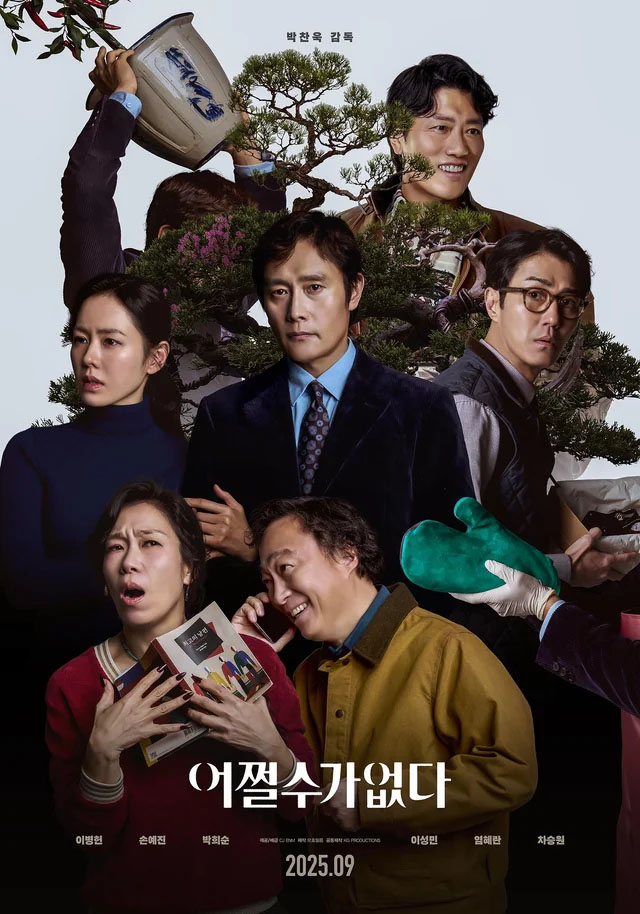
“No Other Choice” Theatrical Poster
Director: Park Chan-wook
Cast: Lee Byung-hun, Son Ye-jin, Park Hee-soon, Lee Sung-min, Yeom Hye-ran, Cha Seung-won, Yoo Yeon-seok, Kim Hae-sook, Kim Hyung-mook, Oh Dal-su
Running Time: 138 min
By Paul Bramhall
In the opening scene of director Park Chan-wook’s No Other Choice we meet a dedicated company man played by Lee Byung-hun (The Match, Ashfall) who seemingly has it all – a nice house, a loving wife, 2 kids, and a pair of golden retrievers – in fact the scene even finishes with his character declaring the same. Of course, things don’t stay that way for long, and with the paper manufacturing company he works at being taken over by an American conglomerate, an internal re-structure finds his 25 years of service coming to an involuntary end. To rub salt into the wound, we find out that the eels the family are barbecuing together in the opening scene, a gift from the company, were in fact an undisclosed part of the redundancy package. Suddenly unemployed and adrift, Byung-hun gives himself 3 months to find a new job and get back on his feet, but after a year passes with no success, he realises more drastic measures may be needed.
Much like Chan-wook chose to adapt a literary source for his 2016 production The Handmaiden, which was based on Sarah Waters’ 2002 novel The Fingersmith, so here he also returns to the literary well for No Other Choice, this time adapting Donal E. Westlake’s 1997 novel The Axe. Also much like The Handmaiden, Chan-wook’s take on the material isn’t the first time for the written word to be adapted for the screen, with The Axe first receiving the big screen treatment in France for the 2005 production of the same name, directed by Costa-Gavras (for whom No Other Choice is dedicated to).
For fans of Korean cinema No Other Choice represents a reunion of several Chan-wook collaborators over the years. The script was co-written by his protégé Lee Kyoung-mi, the director of Crush and Blush and The Truth Beneath (both of which Chan-wook contributed to the scripts), and it’s a joy to see him collaborate with Lee Byung-hun again, with the pair having not worked together since the Cut segment in the 2004 horror anthology Three (and on a feature length production you have to go back to 2000’s JSA: Joint Security Area). We even get Oh Dal-soo, who turned up in practically ever feature Chan-wook directed during the 2000’s, here appearing as a detective in what’s essentially a cameo role.
In many ways No Other Choice also feels like we’re getting a taste of the Chan-wook from the same era. While any discussion on his Vengeance Trilogy (2002 – 2005) tends to focus on the violence found in them (the electrocution scene in Sympathy for Mr. Vengeance or the corridor hammer fight in Oldboy), it’s easy to forget that they’re also shot through with some of the blackest of black laugh out loud humor. For his latest Chan-wook brings the black comedy element of the story to the forefront, and in doing so embraces the absurdities that go along with it, creating another distinctive piece of work that easily stands alongside the other titles in his filmography (is there another Korean director out there, minus Bong Joon-ho, who doesn’t have a single bad movie to their name?).
Realising how stiff the competition is, when Byung-hun’s wife (play by Son Ye-jin – The Negotiation, The Pirates) jokes about one of them biting the dust by a freak lightening strike, the seed is planted – find out who the competition is for the roles he’s applying for, and murder them. What follows is a cinematic masterclass in the art of escalation, starting with his first target, a similarly out-of-work paper engineer played by Lee Sung-min (Handsome Guys, The Beast). Residing in a mountainside property with his aspiring actress wife (a scene stealing Yeom Hye-ran – Wall to Wall, Special Delivery), the sight of Byung-hun clambering around the mountain in a suit and tie (which he gets decked out in every morning to give the illusion he’s going to job interviews) is as ridiculous as it sounds, culminating in a masterful mise-en-scène that sets the tone for what’s to come.
There’s a line of thinking within certain circles that, starting from 2009’s Thirst, Chan-wook’s work has increasingly become more style over substance, placing visual flair over storytelling. Personally I couldn’t disagree more. As a director he’s always had a distinctive visual style and aesthetic (this is the guy who gave us Choi Min-sik’s head on a dog in 2005’s Sympathy for Lady Vengeance!), however the visuals have always been in service of the story, never distracting from it. The cinematography and visuals in No Other Choice continue to show Chan-wook as a master of what he does, with every camera zoom or pan having an intention behind it, one that tells the story as much as anything in the script. It’s a pleasure to watch, and one that feels like it’s central to the very core of what cinema is all about – telling a story through sound and motion, the latter sometimes unfairly attributed only to those in front of the camera.
More than just being a black comedy of an unemployed former “Pulp Man of the Year” attempting to murder his way back into the workforce, Chan-wook diverts the story into a number of unexpected tangents. There’s an almost Stanley Kubrick-esque approach to the cracks that can appear in a marriage, with the mention of Byung-hun’s former alcoholism feeling like a subtle nod of the head to a certain Jack Torrance, and a ballroom dance sequence delivering distant echoes of Eyes Wide Shut. In the role of his wife Son Ye-jin makes a welcome return to the big screen following a 7-year absence, portraying a character with just enough ambiguity that you’re never quite sure what she’s thinking. Despite No Other Choice clearly being Byung-hun’s show, Ye-jin serves as the anchor that keeps the family together while they’re “at war”, and the choices she makes are the ones you’ll still be thinking about long after the credits roll.
It’s enough to make you wonder if, several decades from now, this era of filmmaking will be looked at with the same lens as the Hollywood New Wave of the 70’s. Back then cinematic themes were dominated by disillusionment and societal breakdown, and 50 years later we’re seeing the same patterns emerge, with rampant mistrust and concerns over the cost of living being fuelled by AI and social media. No Other Choice would likely be looked at as a classic example of the era, with Byung-hun’s only path to be granted a fair opportunity one that involves him trampling all over (or in this case – murdering) the competition. The critique on corporate culture and social stratification is one that’s common in Korean cinema, and for the same reason comparisons with Bong Joon-ho’s 2019 masterpiece Parasite are bound to be drawn, but Chan-wook’s creation has its own identity, feeling more like a fever dream than a suburban nightmare.
It would be a crime not to mention the stacked cast that Chan-wook has assembled, with Cha Seung-won (Uprising, Believer) and Park Hee-soon (Revenger, Monstrum) both getting to work with Chan-wook for the first time as a director, and here appearing as potential rivals to Byung-hun’s job prospects. Chan-wook regular Kim Hae-sook (RV: Resurrected Victims, Assassination) also clocks in a cameo appearance, appearing in the scene that provides No Other Choice with the particular poster artwork featuring Byung-hun brandishing a large plant pot.
In my review for Chan-wook’s last movie, Decision to Leave, I’d stated that “if Chan-wook ever did decide to do a full-blown comedy, it’d be a welcome one.” Is No Other Choice that full-blown comedy? There’s a hesitancy to say yes, as even though it delivers more laughs than any of his previous directorial outings, like only a director of his talents can, the closing scenes instead suggest something darker, leaving a kind of gnawing dread in the stomach as the credits roll. Can anything that leaves you feeling that way really be described as a full-blown comedy? Probably not, but then to expect anything less from Park Chan-wook would be a disappointment. Delivering an uncomfortable truth behind the veneer of laughter, No Other Choice is another masterwork from one of the best directors working today.
Paul Bramhall’s Rating: 9/10






Best movie of the year.
I expected to enjoy this film. I did not. I think “The Handmaiden” a masterpiece. I found this rather boring & slow. I watched the murders in disbelief – after all we’re in the AI era – and yet the murders happen as if forensics was a mythological beast. And even though this is an adult drama, as opposed to the Young Adult genre Hunger Games Series, the Hunger Games deals with the price of murder. As a decent, loving family man, I find it hard to believe the multiple murders don’t act as a creeping corrosive and tainting in every aspect of his life. Of course the cast was very good.
Oscars interview PCW. https://youtu.be/BGXhWdMuDzM?si=LFQVyTTNBkYxm71a
PCW talks the film on The Daily Show. https://youtu.be/Jj0N63qglbI?si=F9r-LOXC4r4moD98
I like how Lee Byung-Hun has been making the rounds appearing in various US talk shows and doing a piece for Vanity Fair while promoting No Other Choice. Hopefully, the Vanity Fair video gets more people to watch his earlier films.
I’m looking forward to watching the movie, and I can’t help but draw parallels with Falling Down and God Bless America where even though the plots are different, they also deal with protagonists reaching their breaking point from outside forces.
When Lee Byung-Hun’s character is murdering people, aside from viewing them as obstacles, he must also think they deserve to die for being unqualified and not working as hard as he does. Is that correct?
This is definitely a film to keep off your phone with!
Hi Andrew, incorrect, but to say any more would ruin the experience of watching it for yourself! Look forward to hearing your thoughts once you have a chance to check it out.