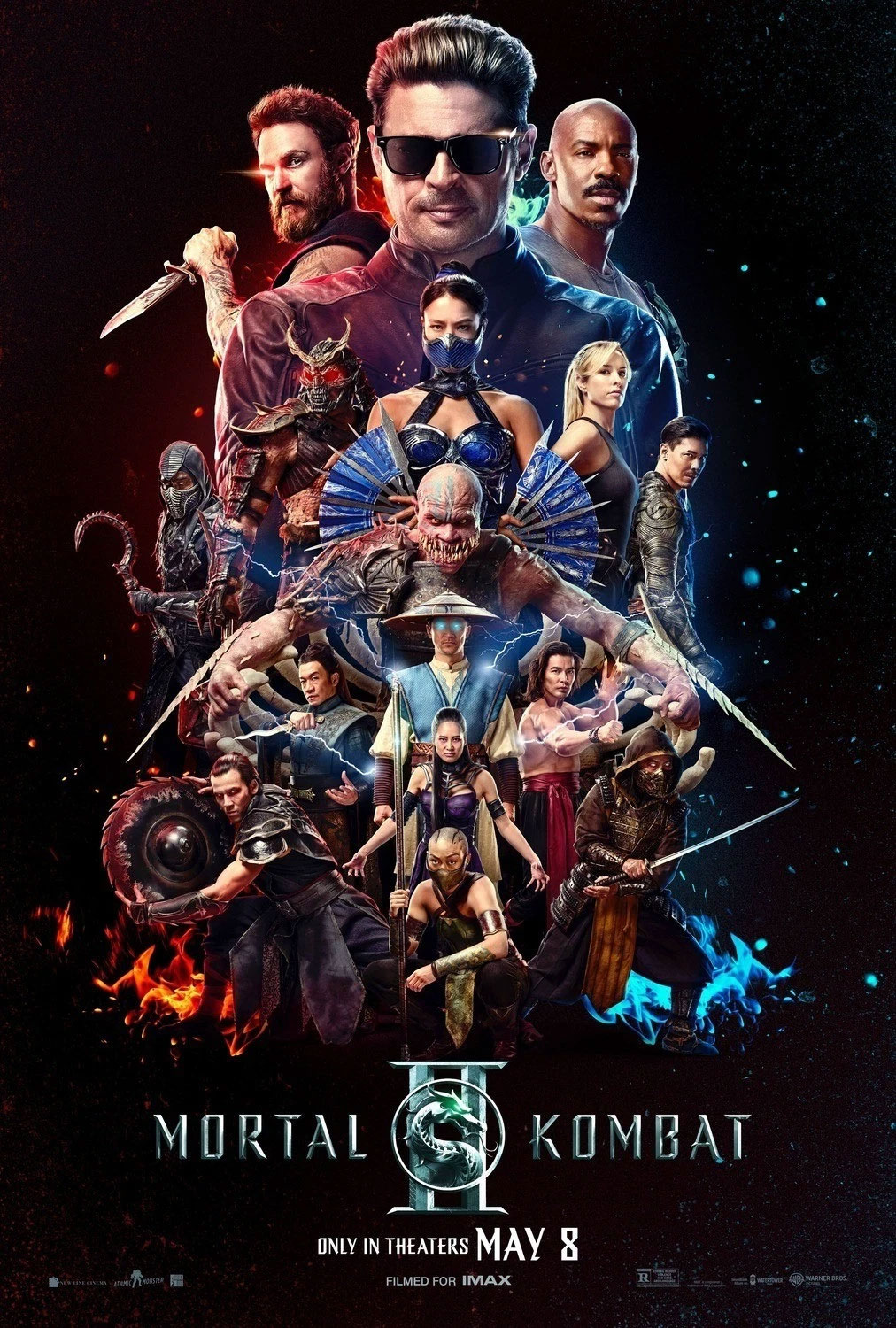
“Mortal Kombat II” Poster
You just know New Line was like, “we gotta get this out on VOD before The Furious hits theaters on Friday!”
Which is my cheeky way of saying the fights in Mortal Kombat II are not very good, a truth that is made all the more glaring by the knowledge that choreographer Kensuke Sonomura and director Kenji Tanigaki are likely about to reshape the genre this weekend with their latest martial arts epic.
Mortal Kombat II’s saving grace, then, might be that…Mortal Kombat has never been about just the fighting. It’s about the worldbuilding, the atmosphere, the iconic-looking characters, and the way the series is able to seamlessly combine genre flavors like military actioner and wuxia fantasy.
At the end of the day, this sequel had one mission: to be better than the 2021 Mortal Kombat movie. The producers needed it to be better, the fans needed it to be better—this franchise’s continued life on the silver screen depended upon it. In that regard, I want to call this Mortal Kombat II a mild success: it does indeed come closer to capturing the spirit of the games and provide a more entertaining experience than its predecessor. The faithful have been awarded and, despite relatively modest box office returns, a third installment is now on the way.
The major addition to this sequel is Karl Urban as fan favorite character Johnny Cage. Although there’s an argument to be made that he was miscast, Urban does what he can with the part, and if the goal was to inject some much-needed swagger and attitude to this franchise in order to balance out the more stoic warriors like Scorpion and Katana, then the Kiwi actor gets the job done, or at least as much as a non-martial artist can in a martial arts-heavy franchise like this. (All this discourse online about whether or not the art director on Obsession was paid enough for her work, when I guarantee you that Urban’s stuntman did not receive enough compensation—he has almost as much screentime as Urban!). The bigger problem might be that Cage’s character, a past-his-prime Hollywood actor in the vein of Jean-Claude Van Damme, feels so peripheral to this story, which leans heavily on the fantasy side of the Mortal Kombat mythology. For a plot concerned with mythical kingdoms, sorcerers, and demigods, it would seem counter-intuitive that the lynchpin for it all is a failed action star.
Also, once you have Kano and Johnny Cage playing opposite each other, you realize that two oneliner-dropping blokes might be one too many here, as Kano starts to make Cage seem positively mild-mannered. I think I’m on the outside of the general fandom because I’ve never found this incarnation of Kano to be amusing, but at least he doesn’t make any Asian jokes this time around. Another issue that Mortal Kombat II must contend with: it’s very difficult to maintain a feeling of genuine stakes to this story when the script introduces that idea that just about everybody can be brought back from the dead thanks to the necromancer Quan Chi, who straight-up looks like like he walked out of a vintage Full Moon Features flick. I realize this concept is rather inherent to the Mortal Kombat series, seeing as how the games frequently resurrected characters (or introduced their identical siblings) so that fans could always select their preferred fighter in each title, but it’s something I’d argue the films should avoid for the sake of more satisfying storytelling.
Notice I haven’t talked about the fights at all? I will say this: the Liu Kang vs. Kung Lao match-up (which was widely shared on social media as marketing for the movie) is very good for a mainstream Hollywood production, with Kung Lao’s hat acting as an incredibly exciting verb and wildcard to the fight. It no doubt helps that actors Ludi Lin and Max Huang (the latter a former member of Jackie Chan’s Stunt Team) are bonafide martial artists in real life, but even the setting for their match-up is more visually pleasing than most in the film. Too much of Mortal Kombat II lacks a sense of place and atmosphere, particularly compared to the physical sets constructed for Paul W.S. Anderson’s 1995 film, because its events are largely set against garish CG backdrops.
If this movie had at least two other fights as good as the Liu Kang vs. Kung Lao fight, I think fans would have talked about the film longer and you’d be seeing higher ratings on social film sites like Letterboxd. Instead, what we have is a passable effort, a watchable movie that accomplishes what it set out to do—and that’s to keep the Mortal Kombat name alive at the local multiplex. Like a sweaty-palmed kid slotting more quarters into an arcade cabinet, Mortal Kombat II ensures this series will live to fight another day, which means I’ll meet you back here for Mortal Kombat III in 2-3 years time. In Hollywood terms, that’s as close as we’re going to get to a Flawless Victory for this series.
Z Ravas’ Rating: 6.5/10



It’s good to see this being talked about here. The 6.5 is a fair rating, since the movie wasn’t horrible, but still had really annoying aspects.
There was almost no reason for Shang Tsung and Quan Chi to be in this film. They had very little effect on the plot and didn’t even participate in the tournament. For that matter, Shao Khan really should have been saved for last as seeing him fight multiple times in the tournament lessened his impact. (Especially when he uses the same uncreative fatality 3 times.)
For a tournament fighting movie, it didn’t seem to be following much rules with how Shao Khan became a free for all instead of following a structure. (The animated Battle of the Realms did this better)
As I’ve said before, Karl Urban has done well in other movie fight scenes, most recently in The Bluff, and that’s how he should have been utilized here. If he was incapable of doing kicks, then why cast him?
While I liked Kano in the previous film, he is overexposed here, and I do not like the direction the film makers are taking him or Baraka. I get that they’re trying to be creative and different from previous tellings, but it doesn’t work.
Everyone else does well with their characters and I want them portrayed in the best way possible. I would hope that the 3rd film has less stupid humor, more focus on the characters we want to see, no useless characters, and fight scenes that are just as good as the aforementioned Liu Kang vs Max Huang.
Quan Chi is Ginosaji’s lost brother.