




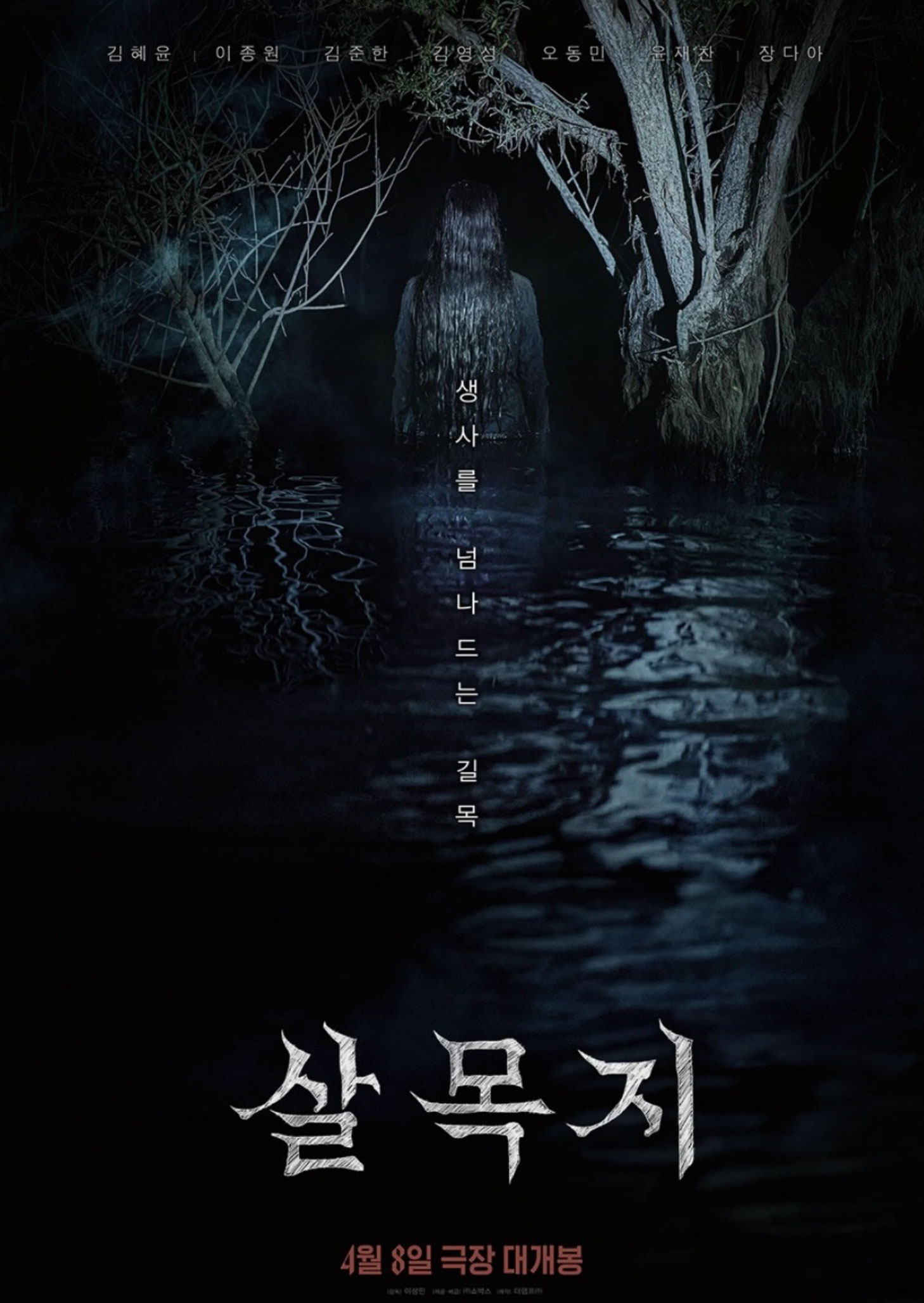
“Salmokji: Whispering Water” Poster
Director: Lee Sang-min
Cast: Kim Hye-yoon, Kim Young-sung, Oh Dong-min, Yoon Jae-chan, Jang Da-ah, Kim Jun-han
Running Time: 95 min.
By Paul Bramhall
In 2018 director Jeong Beom-sik had a stroke of genius for a found footage horror movie – film it in a real location that’s said to be haunted, effectively blurring the lines between cinema and reality. The result was Gonjiam: Haunted Asylum, a real abandoned psychiatric hospital, which would ultimately end up being demolished the same year. Skip forward to 2026, and for his feature length directorial debut Lee Sang-min has taken a leaf from the Beom-sik playbook, opting for a location that can’t be wiped off the map quite so easily. Salmokji: Whispering Water takes its name from, you guessed it, the Salmokji reservoir in South Chungcheong Province. Already known as a location haunted by ‘water ghosts’ (spirits of the dead restricted to bodies of water) and filmed on location, the setting provides the perfect backdrop for a dose of late-night horror.
Local audiences certainly agree, surpassing 1 million admissions (as of the time of writing), and spurring a surge of midnight pilgrimages to the reservoir by horror fanatics, the sudden surge in popularity seeing the small road that leads to the reservoir bumper to bumper with traffic. Of course it takes more than just utilising an actual real location to make a decent horror movie, and after working on a couple of horror omnibus productions – as an assistant director on 2022’s Strange, and directing a segment in 2026’s App The Horror – Sang-min proves to be a welcome addition to Korea’s horror scene.
Also responsible for the script, the story offers up a refreshing take on the whole ‘group willingly going to a haunted location’ trope. Following her powerhouse debut lead role in 2022’s The Girl on a Bulldozer, here Kim Hye-yoon returns as a producer working for a street view mapping company – think the same feature on the Google Maps app. The problem is one of their images on the latest update appears to have captured a ghost in the reservoir, and the locals, already tired of their village coming with a reputation of being haunted (a fact which also mirrors reality), have demanded it be immediately replaced or they’ll threaten legal action. Despite it being Sunday the manager insists they need to go and reshoot the route, and since the colleague who took the original shot a few days ago hasn’t been heard from, it’s Hye-yoon who volunteers to make the trip.
She’s joined by four colleagues who make up the classic horror movie archetypes. The camera operators are played by Kim Young-sung (The Roundup, Spritiwalker) and Oh Dong-min (Love in the Big City, Next Door), cast as brothers who are cynical towards any supernatural folklore. A pair of junior colleagues also tag along played by Yoon Jae-chan and Jang Da-ah, both actors who’ve featured in K-dramas, and here make their feature length debut. It’s revealed early on that Da-ah has an ulterior motive for joining, with a side hustle running a horror themed YouTube channel (much like Joo Hyun-young in the previous years Ghost Train), which gives the narrative an excuse to throw in equipment like a ghost sensing camera and audio devices.
Once there the group becomes six when they’re joined by Kim Jun-han (Mission Cross, Revolver), the senior colleague who hadn’t been heard of for a few days since he went there to shoot the original uploaded footage. Something doesn’t seem quite right with Jun-han’s demeanour, but the group are glad he’s been found safe, and with the GPS reception dropping in and out, his time there means he’s already figured out all the spots where a signal can be picked up. As expected, not everyone in the group will make it out of Salmokji alive, with the ghosts that lurk under the murky surface soon making themselves known once night starts to fall.
While the characters in Salmokji: Whispering Water are functional at best, Sang-min makes his intentions clear early on that his main goal is to present as many scenarios as possible that involve the audience jumping out of their skin. To that end he does a stellar job, with perhaps the most effective character in the narrative being the reservoir itself, explained as having been a cemetery before it was flooded (a similar background was used in 2018’s Seven Years of Night), one which wasn’t bothered to be relocated before construction started. The result is the aforementioned water ghosts, an element which gives the story a unique angle in that they have to lure their victims to willingly enter the water, being unable to come on land themselves.
Sang-min uses the nature of the groups employment to effectively mix in a found footage vibe, although in this case the footage isn’t really found since we’re watching it live with the group. When Dong-min is sent to shoot a dirt path by himself, comprising of him walking along with a mounted 360 camera in his backpack, we watch Hye-yoon as she controls the angle of the cameras at the base site, resulting in a scene that’s a masterclass in building gnawing dread. Indeed much of the horror in Salmokji: Whispering Water is derived from the sound design, with noises like the clacking of rocks together or (in one of the most effective scenes) the ‘plops’ of a stone skimming across the water used to instil a creeping sense of foreboding.
Sang-min’s script smartly uses the opening scene to establish the fact that the ghosts are able to mimic others, which results in scenarios later on where both the characters onscreen and ourselves as the audience are left to question whether everyone is who they appear to be. It keeps the question of how characters would willingly go into the water, even when they know it’ll result in almost certain death, an open one. The narrative is structured in such a way that it cleverly makes the reveal occur for both the characters and the audience at the same time – the realisation that it’s too late hitting home both onscreen and offscreen in real time.
At a punchy 95 minutes, if any criticism could be levelled at Salmokji: Whispering Water, it’s that I would have liked to have seen Hye-yoon’s character fleshed out more. There are hints in the dialogue that she may have been in a relationship with Jun-han, having previously separated from another colleague who she works with, however neither is explored any further than being fleetingly mentioned in passing dialogue. Particularly her ex, played by Lee Jong-won (Family Affair, Our Baseball), since he becomes key to the plot later on, a little more time (not something I usually say when it comes to Korean movies!) would have enabled audiences to be more invested in them. While there’s no issue in having the rest of the characters being thinly drawn, as the protagonist of the piece her character would have benefitted from being further developed, which would also have seen a late reveal land with more impact than it does.
For those looking for a dose of gore or blood being spilled, Salmokji: Whispering Water is definitely not that movie, instead relying more on delivering equal doses of creeping dread and jump scares, both of which is does effectively. I’m pretty sure it’s the first horror movie to use a street-view image as its core plot device (I’ll now prepare to be repeatedly proven wrong in the comments), and the concept is utilised well, applied in the story itself as well as in the way it’s filmed (I really enjoyed the use of the fish eye camera during the driving scenes). The true litmus test will come when you next find yourself next to a murky body of water, and if you find yourself hesitant to get too close, it’s safe to say Salmokji: Whispering Water did its job effectively. Personally, I kept a safe distance.
Paul Bramhall’s Rating: 7/10