




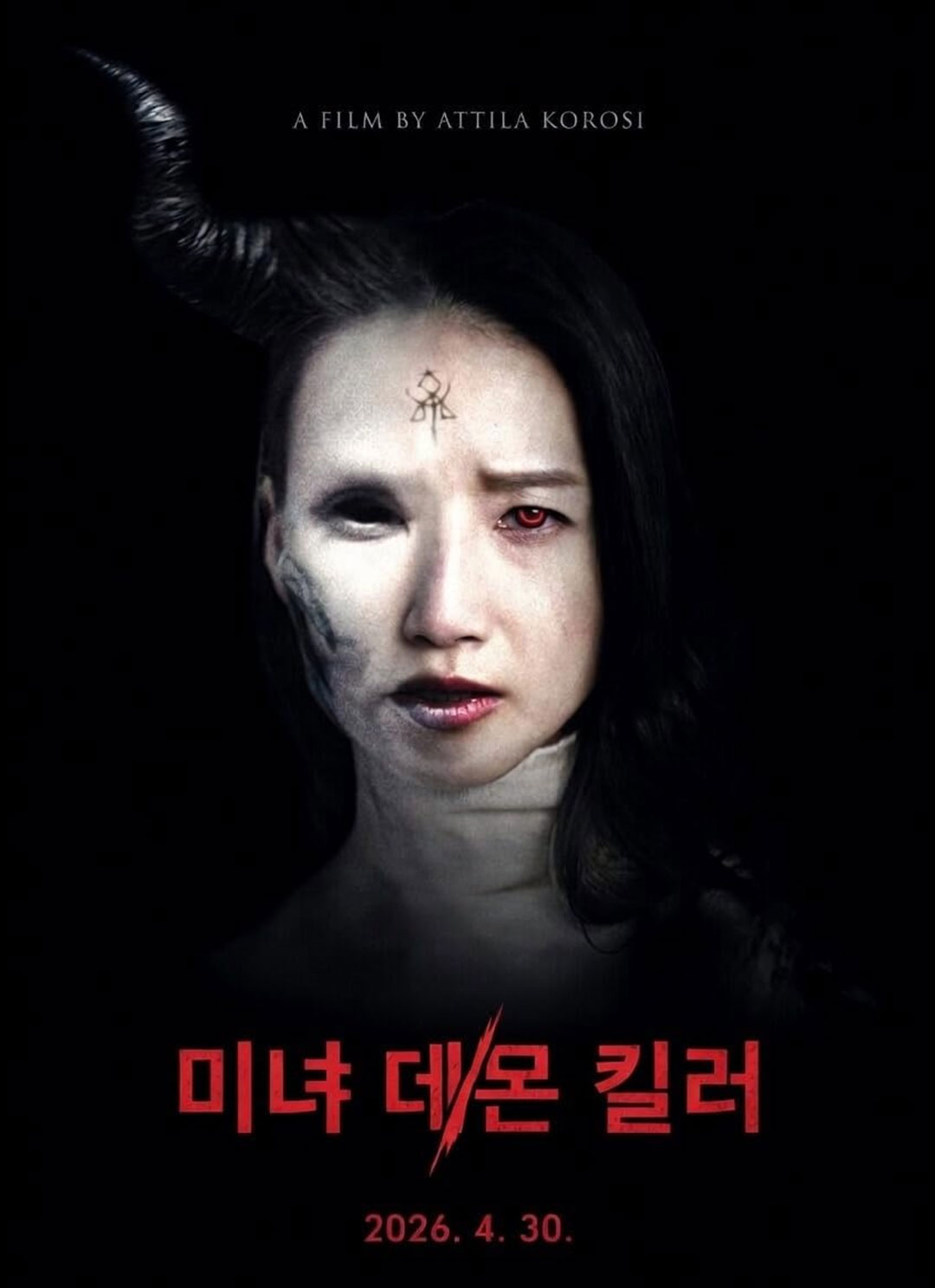
“Demon Dancer: Sua/Nara” Poster
Director: Attila Korosi
Cast: Jiyeon Han, Anita Korosi, Won Hee Lee, Isabella Rose, Wondae Son, Shinyoung Moon, Eunhee Jeong, Joseph Kim, Jayden Moon-Dell, Hyonkuk Pak
Running Time: 83 min.
By Paul Bramhall
In 2025 audiences were hit with the double whammy of the John Wick spin-off Ballerina, and the massively popular Netflix movie KPop Demon Hunters, so it was perhaps only a matter of time before someone thought to combine the 2 and create a ballet dancing demon hunter. That someone comes in the form of Yugoslavia born filmmaker Attila Korosi, who’s created the U.S. and South Korean co-production Demon Dancer: Sua/Nara as a self-proclaimed “love letter to anime.” Indeed the quote “No matter how many people you lose, you have no choice but to go on living.” is the first thing we see onscreen, credited as an ‘Anime Proverb’ (even though it’s actually taken from a character in the popular Demon Slayer anime series).
While Ballerina and KPop Demon Hunters had the backing of a major studio and streaming giant respectively, Demon Dancer: Sua/Nara doesn’t have the luxury of either, instead being an ambitious low budget indie production. The budget limitations are evident to see onscreen, and in a world which has gotten used to streaming gloss and seamless greenscreen work, for some audiences the gap may be a jarring one. However Korosi wisely kicks things off with a bang, as we witness a female victim who’s been tied and bound to a table, tortured by her captor who proceeds to chop off one of her fingers. Abruptly cutting to a black eyed, pale skinned demon screaming to be let free, it’s quickly established that the captive woman (Sua) has a demon (Nara) residing inside her, one who’s capable of taking over her body if given permission by its host.
The captive woman is played by Jiyeon Han, a professional ballerina who here makes her acting debut (as well as serving as executive producer), and after her finger magically reattaches itself we segue into a 10-minute action sequence, the majority of which plays out in first person. Rampaging around the building while taking out a steady stream of attackers, it’s an eye-catching sequence, which includes a part that unfolds on top of an automated parking system elevator done with no CGI – a worthy inclusion on any elevator fight list for its uniqueness alone. Watching it I was immediately reminded of the similar opening first person action sequence from Jung Byung-gil’s The Villainess, and having read up on the production once it wrapped the reason why became clear – the scene was crafted by the same action director in the form of Kwon Gui-duck (Carter, Escape).
Credit goes to Korosi for bringing an action director of Gui-duck’s quality onboard, who first heard about his talents when watching Joe Rogan interview Chad Stahelski, with the latter having high praise for the action in The Villainess. Despite Gui-duck initially being reluctant to meet, Korosi’s insistence paid off, even going so far as to meet when Gui-duck was still recovering from surgery in hospital! (There’s a rather amusing photo of their first meeting on IMDB here) As worthy as the action sequence may be, the decision to film in English is a questionable one. Many of the lines are functional in terms of propelling the plot forward, however as the lead Han delivers them in a way which is best described as stilted, not helped by the demon who suffers from the same issue, played by Korosi’s sister Anita Korosi.
The siblings frequently work together, with Demon Dancer: Sua/Nara being Attila Korosi’s third feature length production in the director’s chair, following 2015’s City Full of Angels and 2023’s Live and Die in East L.A.. His sister executively produced all of them, including an acting role in the latter. Able to appear in human form that only Han can see, at one point she asks “Would you prefer me to speak in Korean or English?”, which saw me breathe a sigh of relief as I assumed the language would switch to Korean, however Han retorts back that English is fine. My head is still sore from where I banged it against the table. The reason given is it reminds her of her late husband, whom she was forced to kill due to being possessed by a powerful demon, and is played in flashback by Attila Korosi himself (and I’m sure, from a behind the scenes perspective, was also due to neither of them being able to actually speak Korean).
However despite the occasional clunkiness of the acting and line delivery, the story that emerges becomes an engaging one. Towards the end of the action sequence Han finds herself beaten and close to defeat, choosing refuge in an elevator to get a brief respite from the sustained attacks. Korosi shares the lift with Han, the pair slumped on the floor, as the demon asks its host to remember why she’s there. It’s this question that forms the basis of the narrative, as we flashback to learn that her late husband was subject to a powerful curse, leading to Han making the ultimate sacrifice. Seeking revenge, she invites the same demon that possessed him into her own body, so she can learn from it who put the curse on him in the first place and track them down to dispense justice.
As the elevator goes up an Inception style plot device is used, with Korosi explaining that the time Han is spending in her mind is passing slower than in reality, hopefully giving her enough opportunity to re-discover her will before the elevator reaches its floor and the onslaught recommences. The strength of the story that slowly emerges, with the non-linear approach utilised effectively to keep the audience invested, helps to look past some of the more rough around the edge elements of Demon Dancer: Sua/Nara, and most importantly become invested in the outcome.
What’s initially jarring ultimately becomes part of the productions charm, with Korosi frequently balancing the meaningful with the goofy, often in ways I’m not always sure was intentional. On the one hand it feels like he intended the story to be a homage to artistry, with the creativity behind ballet and painting playing a prominent part of the plot, which is then offset by the villain of the piece being an ultra-nationalist shaman who wants to rid Korea of mixed race kids. The action contains some unexpected wirework flourishes, and Han’s ballet background is effectively incorporated into the fights giving them a welcome flow, however they’re also interspersed with some early 2000’s DTV style CGI effects that will either feel nostalgic or misplaced (for me it was the former). There’s some surprisingly effective practical gore in the mix (look out for a Hannibal moment!), but at the same time people’s souls are represented by a plain old egg.
Likely a case of diverting the budget where it would have the most impact and looking at more practical cost-effective ways to portray everything else, at times I was reminded of Pearry Teo’s Shadow Master in the way it blends fight choreography, the supernatural, and occasional doses of practical gore. It’s clear a lot of passion went into Demon Dancer: Sua/Nara, and it’s a testament to the talent both in front and behind the camera that the question of “am I going to sit through this?” that floated around during the initial scenes changed to a firm “I’m glad I stuck around” by the time the end credits rolled.
A rare co-production between South Korea and the U.S., even more so for a low budget independent feature, the Korean settings and cast offer up something a little different to what you’d usually expect from a slice of Korean cinema. As a director and scriptwriter Attila Korosi is clearly an ambitious filmmaker with a vision, combined with a willingness to convey it onscreen despite the budgetary limitations, and in the case of Demon Dancer: Sua/Nara it’s a vision that feels realised. If we ever get a sequel to the John Wick Ballerina, then here’s hoping Jiyeon Han receives a call to step up to villain duty, as that’s a showdown I’d truly like to see.
Paul Bramhall’s Rating: 6/10










Great and detailed review! Just a single note — we developed the script for Demon Dancer: Sua/Nara in late 2023, before the trailers for both Ballerina and KPop Demon Hunters were even released.
Can’t wait to check this film out. I like the level of ambition and enthusiasm that went into it.
Thank you! We are very excited to release the finished version!
Any idea when/how this will be released in the US?
Hi Alex — September release in the US. Limited theatrical + VOD. Keep an eye out for it 🙂