



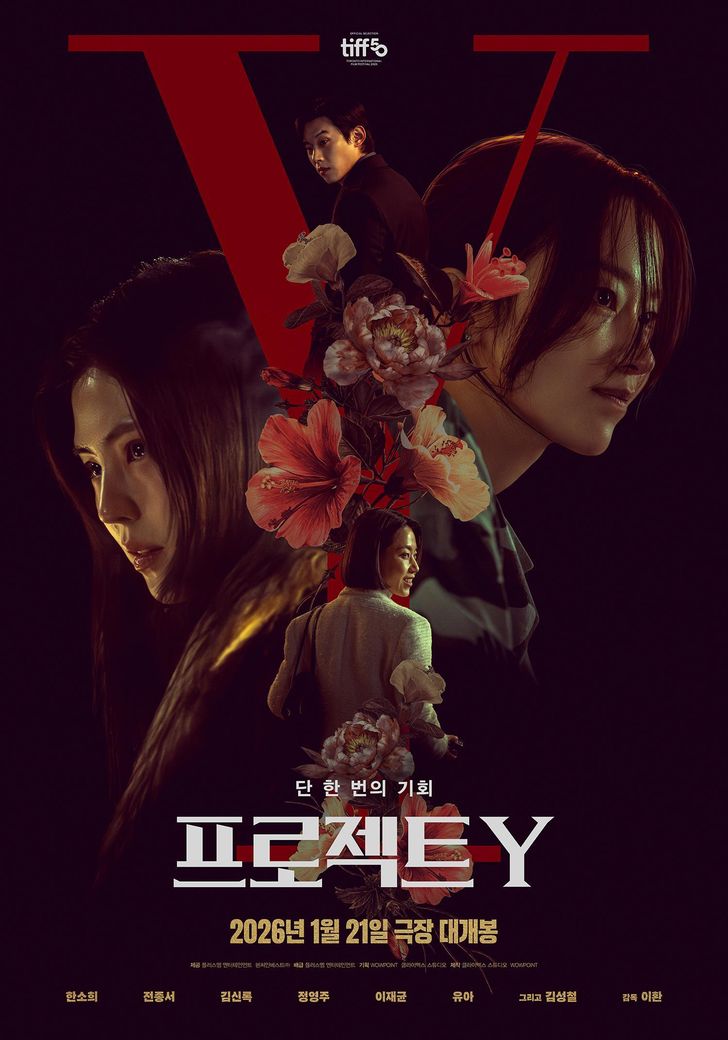
“Project Y” Poster
Director: Lee Hwan
Cast: Han So-Hee, Jun Jong-Seo, Kim Shin-Rok, Kim Sung-Cheol, Kim Sung-cheol
Running Time: 110 min.
By Paul Bramhall
It’s always interesting to watch a director who’s primarily worked in the independent scene have the opportunity to helm a mainstream production. The likes of Jo Sung-hee would go from the lo-fi post-apocalyptic road movie End of Animal to helming Werewolf Boy, Phantom Detective, and Space Sweepers. Yeon Sang-ho went from helming gritty animated dramas like The King of Pigs and The Window to become the busiest director working today, responsible for the likes of Train to Busan and Jung_E. Actor Lee Hwan would voice the lead character in Sang-ho’s The Window, who in 2018 would transition into directing and screenwriting himself with the realist youth drama Park Hwa-young, following it up with the similarly themed Young Adult Matters in 2021 (in which he’d also act in front of the camera).
Both productions are centred around disenfranchised youth living on the margins of society, with the lives of runaway teens portrayed as a cycle of brutal bullying, being taken advantage of, and hopeless futures. In short, if anyone was to state a claim that Korean indies tend to be relentlessly gloomy and nihilistic affairs, then Hwan’s pair of directorial outings are not the one’s you’d go to in order to change their mind. So to see him turn his attention to heist flick territory is one which is bound to pique curiosity, with 2026’s Project Y based on a script he’d completed before making Park Hwa-young. While funding for the production fell through back in 2017, now almost 10 years on his vision has made it to the screens, with a few tweaks to the original script. Notably in the original version the main characters where male and female, whereas now both leads are female.
Popular K-drama actress Han So-hee (here making her sophomore feature length appearance after 2024’s Heavy Snow) and Jeon Jong-seo (Mona Lisa and the Blood Moon, Ballerina) play friends who’ve grown up together in the underbelly of the affluent Gangnam. So-hee has been attempting to run a florist store to turn over a new leaf, however still finds herself working hostess gigs to make ends meet, while Jong-seo is employed as a driver, escorting the hostesses and their clientele to wherever they wish to continue their fun outside of the karaoke salon where they work. However when a bet on a basketball game fixing scheme backfires, their savings are wiped out, and they find themselves back at square one. Overhearing about a stash of 700 million won in cash from one of their associates, the pair hatch a plot to steal it and make a clean break to start a new life.
One of the first things that struck me while watching Project Y was how it almost resembles a 2026 remake of Ryoo Seung-wan’s sophomore feature from 2002, No Blood No Tears. That movie also featured a pair of women operating on the fringes of society who hatch a plan to steal a healthy amount of cash from a gangster, right down to one of them being a driver! However while that production fully embraced its crime thriller trappings, infused with Seung-wan’s love of Hong Kong cinema inspired action, Lee Hwan’s latest is a different beast altogether (although ironically, he did state in an interview that he “was very inspired by the golden age of Hong Kong cinema in the 90s” when talking about the look and feel of Project Y!).
Best described as a neo-noir, much of the narrative plays out at night, unfolding in whisky drenched karaoke rooms and darkly lit apartments. The biggest issue with Hwan’s mainstream debut though, is that he still seems tuned into the kind of grounded in reality, daily struggle narrative structure of his indie features. While the slice of life style of filmmaking applied to Park Hwa-young and Young Adult Matters works because the investment is more on the characters than the typical three-act story structure, when you’re dealing with a crime thriller involving a stash of stolen money, the approach runs into issues. Despite being pursued by a ruthlessly violent gangster played by Kim Sung-cheol (The Old Woman with the Knife, The Battle of Jangsari), a sense of escalation is missing for much of the runtime, with a distinct lack of tension despite the increasingly dangerous predicament our leads find themselves in.
It’s a problem which could be overlooked if Hwan still paid the same level of attention to the characterisation as he did in his indies, however So-hee and Jong-seo never really feel like fully formed characters (a perfect example being I spent half the run time believing they were in a relationship with each other, when it’s later revealed that one is the adopted sister of the other). It’s a problem which is exasperated by the fact it’s difficult to shake the feeling the characters they’re playing are supposed to be much younger than they are (both actresses are in their early 30’s), with the maturity they bring to their performances not quite matching the way the characters are written. The result is an odd disconnect for much of the runtime, with the casting of the bankable So-hee and Jong-seo ironically working against the more age appropriate, albeit lesser known, casting choices of his earlier features.
The casting does get it right with Jung Young-joo (Miss Fortune, Hot Blooded), who’s striking appearance consists of a fully shaved head and a black leather trench coat, playing an almost emotionless enforcer for Sung-cheol. Usually in Korean cinema the vicious righthand man to the final boss is played by, well, a man (think Thanayong Wongtrakul in The Man from Nowhere), so to see the role be given to a female is a welcome change. Young-joo has showed off her tougher side before as the lead in 2023’s DTV women in prison fight flick Prison War, but it’s here where she’s given a character that truly leaves a lasting impression, with her fleeting appearances usually a sign that violence isn’t going to be far away. I’d go so far as to say I would have preferred for Young-joo to be the main villain, as her unique character is far more intimidating than Sung-cheol’s stereotypical gangster schtick.
In fact whenever Project Y leans into its gangster genre trappings it’s familiar but welcome territory. It’s ambition only stretches as far as creating slight variances on well-worn tropes, but it’s still effective enough to create some memorable scenes. In particular the buried alive in a shallow grave genre staple is here given a twist by having the shallow grave be filled with liquid tar, causing whoever’s thrown into it to gradually sink beneath the unforgiving black mass, the more they struggle the faster they find themselves being pulled under. Hwan doesn’t let the opportunity pass to have a couple of opposing characters fall into it at the same time, making for arguably the tensest scene in the runtime.
Unfortunately though outside of these fleeting moments the narrative falls flat. A misguided ending makes the bizarre decision to place a basketball game front and centre, even though for the majority of the runtime the game itself has never played an important part of the plot. The sudden aesthetic switch from smoky karaoke salons and nightclub back alleys, to one where we’re watching a basketball game that feels like it’s had no build up or consequence, is a jarring one. The sequence also indicates that the relationship Jong-seo has with one of the players (played by newcomer Seo Wu-joon) is expected to have more weight to it than what’s ended up onscreen, with it being entirely forgivable to wonder who the guy is that Jong-seo is giving a pep talk to before the game.
On paper Project Y may sound like a heady mix of No Blood, No Tears meets Beastie Boys, however an unfocused story, lack of narrative thrust, and some debatable casting choices ultimately serve to make Lee Hwan’s first foray into mainstream filmmaking a mostly forgettable one.
Paul Bramhall’s Raitng: 5/10