

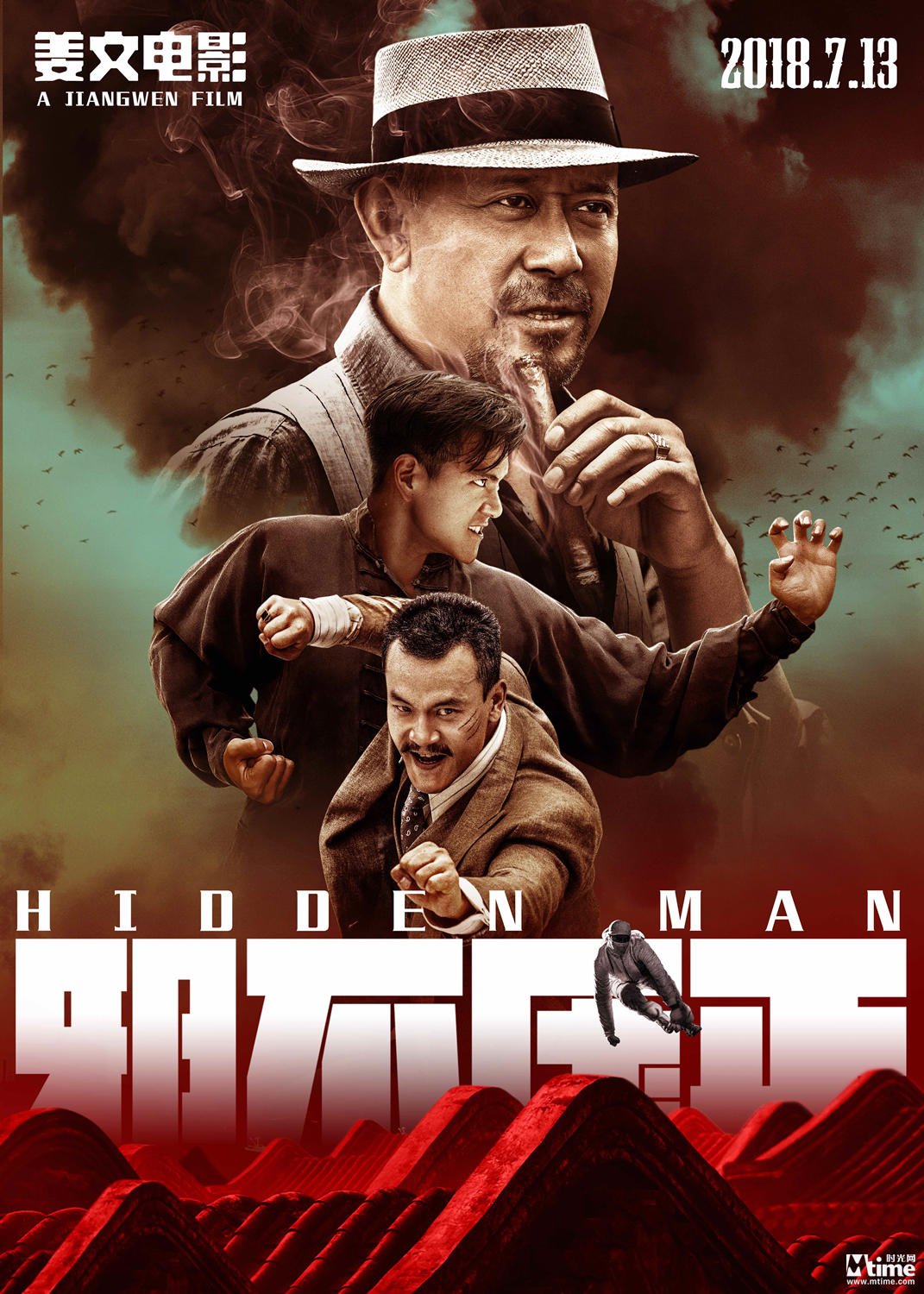
“Hidden Man” Theatrical Poster
Director: Jiang Wen
Cast: Eddie Peng, Liao Fan, Jiang Wen, Zhou Yun, Xu Qing, Kenya Sawada, Li Meng, Yuan Shanshan, Ding Jiali, Shi Hang, Paul Morris, Junichi Kajioka, Chen Xi
Running Time: 137 min.
By Paul Bramhall
While for many Jiang Wen may be most recognizable as that guy who threatened to act Donnie Yen off the screen whenever they appeared together in 2011’s The Lost Bladesman, he’s also one of the most multi-faceted talents to emerge from the world of Chinese cinema. An established director, writer, actor, and editor, Wen’s most accomplished achievements are arguably his bombastic Republican China set epics Let the Bullets Fly, and Gone with the Bullets, from 2010 and 2014 respectively. Sharply crafted and executed with a deft wit, Wen showed just how entertaining Chinese cinema can be if you’re smart about it, and in 2018 he returned to make it a loose trilogy with Hidden Man.
While Let the Bullets Fly set itself in Sichuan, and Gone with the Bullets in Shanghai, Hidden Man sets itself in Beijing, giving each entry its own unique visual aesthetic. Like Let the Bullets Fly, Wen has opted to adapt a novel as Hidden Man’s source material, using author Zhang Beihai’s 2001 opus Xiayin as a source of inspiration. It’s taken a while to hit the screens though, when a cameo by Kevin Spacey in a small but important role was decided to be re-shot, after he was accused of sexual misconduct by various actors. His role was eventually replaced by Steven Schwankert.
Whereas Wen was very much front and center of the previous two, here he takes a step back to play a crucial supporting character, but gives us the closest thing to a lead in the form of Eddie Peng. I confess I’m not Eddie Peng’s biggest fan. Granted, I haven’t seen every one of his movies, but those that I have (Rise of the Legend, Operation Mekong, and Call of Heroes) failed to convince me he was leading man material. There’s an element of trying too hard in his performances, which somehow emanates off the screen, kind of like someone who wasn’t quite ready for the big screen yet is desperately trying to convince us he is.
However here those same traits have been used to the narratives advantage, with Peng playing the grown version of a child whose adopted family is murdered, when the father refuses to hand over his land for growing opium. Rescued by an American doctor and Chinese businessman (Wen), he’s sent to San Francisco in the U.S. to study medicine, however also moonlights as a special agent working for a shadowy organisation. When he’s ordered to return to Beijing to complete a mission, the chance to exact revenge on those that killed his adopted family, is too much of an opportunity to turn down. So begins a distinctly different fish-out-of-water tale, as Peng returns to Beijing to find that one of the murderers has become the police chief, played by Liao Fan (Black Coal, Thin Ice), and the other a Japanese general, played by Sawada Kenya (yep, the same Sawada Kenya from Thunderbolt and Extreme Crisis).
Like both Let the Bullets Fly and Gone with the Bullets though, what appears straight forward on paper, onscreen plays out as a series of escalating double crosses, hidden agendas, double entendres, and veiled threats. Wen has a flair for comedy, and Hidden Man wears its comedic ambitions on its sleeve more than any of his previous work. Peng’s father is played by the Beijing born Andy Friend, allowing for once an actor who can deliver an effective performance in both English and Mandarin, and the pair go at it in a number of energetic verbal exchanges, seamlessly switching between the two languages. Everything about it shouldn’t work considering how annoying such switches usually are (Michael Wong, we’re looking at you), but here it not only feels natural, but also hits the desired comedic notes.
This approach will likely mean those who were hoping Hidden Man would follow in the tradition of Wen’s previous entries could be disappointed. The epic feel and similar themes (a bunch of characters all trying to double cross each other) are still there, but Hidden Man feels much pulpier in its tone, sometimes almost feeling like a live-action cartoon. Characters partake in verbal banter, firing off double meanings and hidden threats at each other in a barrage of rapid fire exchanges that are a joy to watch, and every character feels well fleshed out (well, except for Sawada Kenya, whose Japanese general is evil and Japanese for all the reasons we know he needs to be).
Liao Fan is clearly having a hoot. He first came on my radar in 2014’s Black Coal, Thin Ice (although, unknowingly, I’d seen him before in Assembly and CZ12), and has yet to disappoint in any role I’ve seen him in since. From playing a Wing Chun master in 2015’s The Final Master, to a low-level gangster in Ash is the Purest White, this is an actor who, much like Song Kang-ho in the ought’s, seems unable to put a foot wrong. Here his villainous police chief with a connection to Peng’s past allows him to ham it up as much as the narrative will allow, and his turn is an entertaining one. He gets to flex some of the same kung fu muscles he showed in The Final Master, while also having to deal with (what feel like) such important matters as his mistress having her posterior stamped as property of the Japanese general.
Indeed the 2 women of Hidden Man light up the screen whenever they’re on it, adding a certain zest and depth to proceedings. Frequent Wen collaborator (and understandably so – they’re married) Zhou Yun plays the town seamstress, who has a hidden agenda of her own, while Xu Qing (League of Gods) practically drips sexuality off the screen in her flirtations with Peng, despite being 13 years his senior. Yun has a strong presence onscreen, and as the object of Peng’s affections, their time onscreen together sometimes allows for Peng’s weaknesses as an actor to shine through. His handling over the dramatic moments is decidedly one-note, and whenever he’s called to emote it fails to resonate.
What he does do however, is handle the action scenes well. Like Wen’s previous entries, Hidden Man isn’t an action movie by any stretch, and those clocking in hoping for a fight fest will need to reach the 80 minute mark to receive a small dose of gratification (involving a delightfully painful usage of chopsticks). However Wen pays attention to the action when the narrative calls for it, leveraging the talents of Donnie Yen action team members Tanigaki Kenji (Big Brother) and Yan Hua (Special ID). There are times when Hidden Man even indulges in some playful Bruceploitation, with Peng mimicking the Little Dragon’s footwork, and a Bruce Lee joke so preposterous it had the intended effect of making me laugh out loud.
Much like Let the Bullets Fly and Gone with the Bullets, Hidden Man’s setting serves an ulterior motive. Taking place in 1937 on the brink of the Second Sino-Japanese War (the Marco Polo Bridge Incident is referenced, for those who enjoy their history), the fact that the events are taking place before the founding of the People’s Republic in 1949, allows for some additional leeway with the notorious Chinese censors. There’s not too many movies these days which allow for lines like “brain dead China”, however Hidden Man’s script gets away with certain liberties thanks to its time period, usually to comedic effect.
If Wen’s latest hits all of the marks it’s aiming for is debatable. Certain characters story-arcs seem to aim for poignancy, however the breezy pace of the narrative means it comes across as unearned. However as a confident piece of quick witted entertainment, it doesn’t put a foot wrong. Throwing in everything from selfies to bullet dodging to sly swipes at film reviewers (I swear I’ve seen every movie I’ve reviewed!), this is the kind of filmmaking that makes you appreciate cinema. Like Wen’s previous efforts, some may see Hidden Man as absurd, some may see it as a reflection of his arrogance, and some may see it as all of those things, and still have a great time, I just happen to be one of those.
Paul Bramhall’s Rating: 8/10



I forgot that Gone With The Bullets was already out. (Was it released wide?)
I like the sound of the snappy back and forth banter. It’s not something I see everyday I Asian cinema. (I think the subs can’t keep track of it.) Hope to watch the whole trilogy one day.