

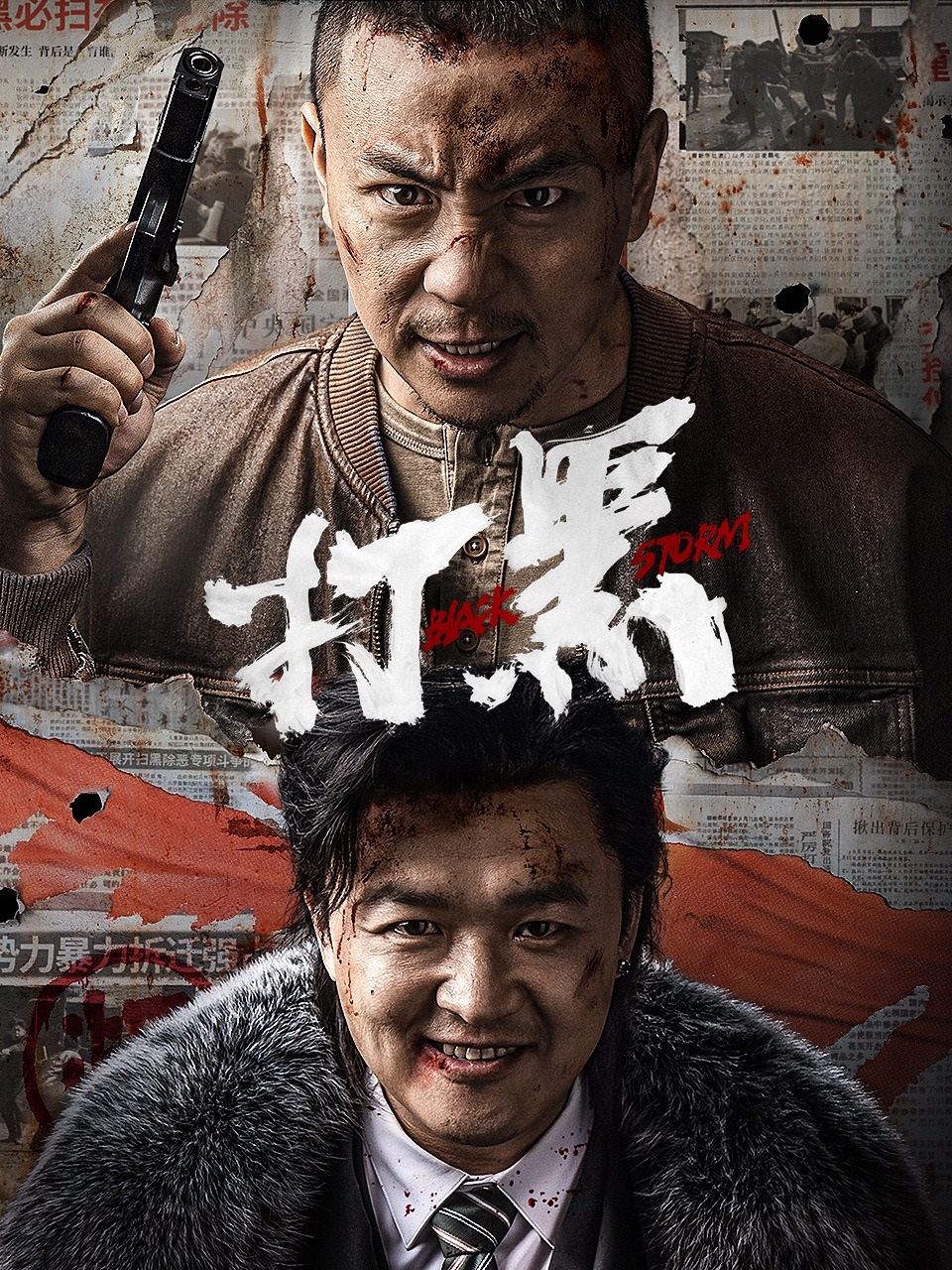
“Black Storm” Poster
When China’s now ubiquitous web-movie scene first appeared in the mid-2010’s, it would be a hard sell to believe that such productions would eventually lead to a resurgence of the contemporary setting martial arts movie. Back then they mostly consisted of cheap looking wuxia movies and even cheaper monster flicks, however it was arguably 2021’s Fight Against Evil that made fans of HK style action sit up and take notice. The resurgence is popularly attributed to Qin Pengfei, a former wushu practitioner who entered the film industry in 2005 as a stuntman. In 2019 he made the transition to director, and while Fight Against Evil was only his third movie, it proved to be a winning combination. Said combination was the casting of former child actor Xie Miao as a determined cop, and villains involved in the kind of criminal activity that was doing the rounds on the news at the time of release – in this case, an illegal online gambling syndicate.
In 2024 Pengfei would enlist another former child actor known for their kung-fu talents in the form of Ashton Chen, casting him as the lead in the period kung-fu movie The Drunken Prodigy. Things move fast in the web-movie world though, so in the same year it seems Pengfei realised that his sweet spot is in more contemporary surroundings. If the theory is true, then you could say that if Xie Miao got his time to shine in Fight Against Evil (which has since spawned 2 sequels), Chen got his equivalent outing with Black Storm. Same template – he plays a morally upstanding cop determined to catch the bad guys, and the villain of the piece is a greedy property developer, one who’s pocketed government funds intended for residents who need to be rehoused due to their home’s demolition.
I admit one of my curiosities about contemporary Chinese action movies is always the little nuances they apply to ensure they don’t run afoul of the sensors. This is nothing new, as even the likes of the mid-2000’s Donnie Yen movies Sha Po Lang and Flash Point both set themselves in 1997 Hong Kong, specifically to make it clear the story unfolds when the police were still under British rule rather than Chinese. In recent web movies we’ve had settings that involve made up Southeast Asian countries like Manulla (Blind War) and Wusuli (Hunt the Wicked), and if they are set in China, filmmakers need to get even more creative.
For Black Storm onscreen text tells us the story is set in 2017, a year recent enough to feel completely random, sending me on a mission to find out what happened after 2017 that meant the story could only be set then? Turns out in 2018 China passed the Supervision Law that expanded the reach of its anti-corruption investigations, the result of which saw many property developers convicted for embezzlement, effectively (at least in web movie terms) putting an end to any such scenarios ever happening again. So there you go, useless information that I’m sure no other review for Black Storm has mentioned!
Much like in The Sin Trade which would come 2 years later, here Chen plays a cop who gets called back to his hometown due to one of the locals going missing. In this case it’s a resident who was one of the last holdouts to refuse relocation from his family home, which includes his mother’s grave. With the house ransacked and the mothers grave desecrated, the villagers turn to Chen for assistance in getting to the bottom of what happened. Of course, pending permission from the local police authorities to get involved, Chen duly obliges and finds all roads point to a local big shot karaoke establishment owner played by Bao Beier (The Four trilogy).
While many fans of HK’s golden era of action have celebrated the way Pengfei’s productions hark back to the territories glory days, the more I watch of them the more I feel they’re not just an updated version of the mid-1980’s to mid-1990’s HK action aesthetic, but rather they have their own distinct identity. Far from the bright lights of Hong Kong, Pengfei’s productions are often set in grimy towns that still cling on to the traditions of old, often clashing with the more capitalist leanings of modern China. They’re locations we’re used to seeing in the likes of Jia Zhangke’s A Touch of Sin and Bi Gan’s Long Day’s Journey Into Night, but rarely in the context of a straightforward action movie.
The rough around the edges surroundings make for a welcome change, and Pengfei consistently proves he knows how to take advantage of them. Here he continues to work with Jian Shi and Yi Wang, even if the credits make it a little confusing as to what their exact roles are – in the opening credits Shi is credited as the action director, however in the closing credits it’s Wang credited in the same role, with Shi billed as the fight choreographer. Credit continuity semantics aside, the trio also worked together with Chen on The Drunken Prodigy, with Wang additionally handling the fight action on Pengfei’s Curbing Violence from the same year. Within a very short timeframe Pengfei has grained a reputation for staging brutal fight scenes within confined spaces (the inflight bathroom fight from Wings of Dread is a highlight), and much of the action on display here is a testament to the reputation being a deserved one.
A mid-runtime fight between Chen and two assailants in a hospital elevator is up there with any of the best elevator fight scenes, with the male and female attackers feeling like a subtle nod to Baseball Boy and Hammer Girl from The Raid 2. However the MVP of almost any web movie he turns up in belongs to Liu Fengchao, who thankfully has gotten to headline his own production since Black Storm’s release with 2026’s The Butcher’s Blade, and here is no different. Playing the bodyguard of Bao Beier, his mostly mute performance sees him munching on a bao bun in practically every scene he’s in (including when the fists start to fly!), with a gnarly meat hook being his weapon of choice. After a brief tussle early on, the pair eventually find themselves facing off in a knock down, drag out fight that starts off in an illicit clubs dressing room and ends on the rooftop, taking in everywhere in-between.
There’s a clear influence of Kensuke Sonomura’s choreography style (who thankfully got his own opportunity to work on a Chinese production recently with The Furious) in the fight action, but it’s never derivative, and ultimately the action on display is distinctive enough to have its own identity. An early fight takes place in a massage parlour, in which the fact the bad guy is covered in massage oil is smartly incorporated in a way I haven’t seen before (at least not in a massage parlour setting!). More importantly though, and something that personally I felt was missing from a production like The Furious (I’ll get ready to duck the rotten tomatoes), is that there’s a sense of becoming more exhausted and hurt as the fights progress, incorporating a level of desperation and scrappiness into them the longer they go on for.
The eventual showdown between Chen and Beier certainly gets an award for the most unique location for a final fight – a pollock farm! It’s even preceded by an impressively staged car crash. How is it that big budget productions manage to stage completely unconvincing CGI car crashes, but a web movie like this one could afford to send a real vehicle flying through the air!? It’s a satisfying showdown that sees slow motion sparingly used to capture some of the more wince inducing impacts, with the scenery chewing Beier giving as good as he gets against Chen’s determined efforts to arrest him, even when such efforts involve flying kicks to the face.
With Black Storm Pengfei has struck a healthy balance between crime procedural and kung-fu beatdown, and half the fun is spotting some of his influences – at one point we get a scene that keeps cutting to Beier villainously dancing alone in his office, an obvious nod to Ray Lui’s similar scene in Flash Point, and in another we get a unique riff on the horses head in a bed from The Godfather (you’ll know it when you see it!). But more than anything, we’re here to see Ashton Chen punch and kick his way to justice, and to that end, Black Storm delivers the goods.
Paul Bramhall’s Rating: 8/10





If it wasn’t for the furious, I would have never watched a straight to streaming movie on IQIYI but now as of late I’ve watched everything lolol. The fight sequence at the massage parlor leading to the hallway was incredible.
The best part of an action or a good one is there’s always that one sequence that makes up the highlight reel. I love action cinema baby!
I’m waiting for all the by title-only “Furious” clones ‘n sequels to pop up.
Furiously Fast n Furious
The Good the Bad and the Furious
Furious Friday
Furious Resurrection
Armour of God 5 – Furious Condor
Furious Against Evil
Furious Storm
The Furious Trade
Very Furious, No Surrender
list kind of writes itself
Remember gents, Korea did it first! 🙂
Actually, Americans did it first! To the word. lol (but at least the Rhees are Korean!)
https://www.imdb.com/title/tt39393717/?ref_=nm_flmg_job_1_accord_2_cdt_t_1
Furious Attack
Original title: Nu xi
2026
1h 17m
Furious Attack (2026)
A former special forces soldier infiltrates northern Myanmar to rescue his missing daughter, fighting against scam gangs and organ traffickers in a final showdown with the crime boss.
Remove Myanmar for somewhere in Asia and former special forces for mute handyman and it kinda reminds me of another movie also released in 2026.
Jokes aside, this movie was so generic I’ve seen it and then totally forgot about it.
Acutally Furious Friday might be a winner – all you kungfu experts out there has there ever been an action movie where the 2 main leads have a body swap situation? Like Lindsay Lohan and Jamie Lee Curtis in Freaky Friday but with kungfu. Closest thing I can think of is that little sequence in Twin Dragon finale when all of a sudden classical music Jackie takes on the fighting ability of Triad Jackie
This is an underrated gem. Super gritty, to the point where folks crying about “Chinese censorship” should watch this – this is not one of those glamorized takes on futuristic, safe China. This is old-school, corruption in high places, down and dirty, full of grimy locales and grimier people. It’s hard to believe that this was approved by SARFT, even despite the 2017 setting (by the way, superb review as always, Paul Bramhall).
In the middle of all this is Ashton Chen, who plays the righteous hero with an independent streak so well, and who kicks copious ass in a ton of well-choreographed fights. Chen and Liu Fengchao need to be headlining big budget kung fu films pronto. One of my favorite webmovies.
Every one who has seen black Storm has always regarded this a classic of its genre, definitely and deservedly so. It definitely pushes what can be shown onscreen but until the Ashton Chen character can be more than just righteous, I will still argue that censorship still alive and well.
And you probably know this already but I’ve got time to kill at work, the censorship in China is constantly changing. Also the SARFT disbanded then replaced by the China Film Administration aka the publicity department of the CCP. Whatever this implies, the Chinese governement were happy with the takeaway of this movie otherwise like you say, it wouldn’t even get past the script stage which apparently was a big problem with the previous administration where movies were approved, shot and edited and then left on the shelf for years because of ….reasons
Also in China , what applied yesterday doesn’t apply today. Remember when people used to laugh at China cos they banned time travel in movies. People still quote this even though Avengers Endgame is the biggest American movie in Chinese history (fact check me on this) and that whole movie for at least 2/3rds is a time travel movie. And that was 7 years ago.
Marvel movies were “banned” for a few years , No Way Home never made it to the screens over there but Brand New Day is about to do Zootopia 2 numbers over in China. Actually loads of movies got theatrical releases this year that I did not expect. Obsession and Backrooms…..in China with a nationwide theatrical release, this never would have happened in 2021/2022
Great points. I sense that the way censorship works over there is that the regulations are purposefully vague, which prompts artists, AI models, etc to self-censor to avoid a possible ban. Time travel is now very much on the menu again in China, but for a while, it wasn’t. In general, I would prefer as little censorship as possible, globally, but in reality, it’s always existed. Every country controls the messaging in its media to fit a certain narrative – it certainly isn’t a China-specific issue. In the US, we have our DEI initiatives, our pro-military messaging done via coordination with the DOD/DOW, etc. And constraints don’t have to be a hindrance to great art – the Hayes Code didn’t stop Hollywood from turning out generational classics during the Golden Age. Patriotic heroes who fight for their country will always resonate with the domestic audience, whether it’s Rocky vs Drago, Rambo vs the Soviets, or Ip Man vs the Japanese/Brits/Americans. I suppose the thing to remember too is that these movies weren’t made for us, they were made for a domestic audience, much of it working class, who find characters like Ashton Chen’s to be noble, righteous, and both relatable and aspirational.
The Hays Code? That was the censorship in Hollywood during the Hollywood contract studio system days where you had these B movies like crime thrillers of noirs smuggling in ideas because there was less scrutiny. I think I’m paraphrasong Scorsese here. I’m not sure its a one to one likeness but yeah these Chinese streaming movies are able to go right up to the line of what the censors will allow.
And yeah definitely the primary market for these movies are for Mainland Chinese but its still fun to discuss them through a different lens.
I’m totally wrong on one thing I said though. Spiderman is defintely not going to do Zootpia 2 numbers. Apparently that made the equivalent of over $600 million. That is insane numbers especially now that local audiences are lot more picky about American movies and have more options in general.
“And constraints don’t have to be a hindrance to great art”
This reminds me of a comment Jesse V. Johnson made when I had the opportunity to interview him in 2019 as part of the promotion for ‘Triple Threat’. I’d asked about how much of a challenge it was to direct a movie co-financed by China and the associated restrictions that come with it, and he surmised that it’s “always that set of boundaries that causes the artist to do his best work, because it forces you to work as hard as possible.”
Speaking of co-finnancing from China, I felt the urge to rewatch The Edge of Seventeen starring Hawkeye’s Kate Bishop. If you enjoyed those 80s John Hughes high school set drama comedies, The Edge of Seventeen is as good as those.
Anyway after pressing play i see the Huayi Brothers logo brand thing. Of all the movies to co-finance, was there an investor over in China that grew up watching these movies as well and wanted to be a part of the movie. I just thought it was strange and funny to find out this was a China-US cofinanced film.
If there were concessions to be made to China with this movie it wasn’t obvious to me. This isnt a Transformers 4 deal where Stanley Tucci is sipping a YiLi milk carton for no reason at all.
“Far from the bright lights of Hong Kong, Pengfei’s productions are often set in grimy towns that still cling on to the traditions of old, often clashing with the more capitalist leanings of modern China. They’re locations we’re used to seeing in the likes of Jia Zhangke’s A Touch of Sin and Bi Gan’s Long Day’s Journey Into Night, but rarely in the context of a straightforward action movie.”
This is why people come to this site. Where else can we get reviews for a direct to streaming low budget actioner that also mention Jia Zhangke and my favourite movie of his. Its true though, its an aesthetic which really works on screen. With just a few shots, the movie can say so much more than endless exposition.
A hero is only as good as the villain and if these movies are the new versions of 80s HK actioners, does that mean Bao Beier is today’s Dick Wei/ Billy Chow? The same year Black Storm was released, he was also an absolute scumbag in Curbing Violence. More story and drama than usual from Qin Pengfei, theres still enough fighting from Jiang Luxia for it to qualify as a down and dirty gritty actioner.
It’s funny you should mention ‘Curbing Violence’. 🙂
Let’s also not forget why BLACK STORM kicks all kinds of ass: A terrific villain.
Bao Beier simply doesn’t get enough credit. As someone who watched both BLACK STORM and CURBING VIOLENCE (a movie featuring plenty of violence, none of it curbed) where Bao also takes on Bad Guy duties, the dude is simply too good, combining both reptilian sleaze and quiet menace, all while rocking a combo look of a successful businessman merged with an exceptionally nerdy accountant! (This is a little more apparent in CURBING VIOLENCE). Like Christophe Waltz though, it’ll probably, if not already, lead to a career of terminal typecasting.
Yes! He excels at playing exceptionally despicable and oleaginous villains, which just makes his inevitable comeuppance all the more satisfying.