



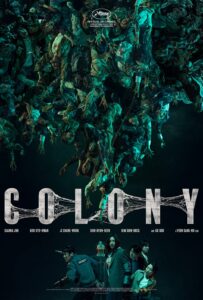
“Colony” Poster
While in recent years it’s 2019’s Parasite that most commonly gets referred to as Korean cinema’s international breakout hit, over the course of the 21st century there have of course been other examples along the way. In the early 2000’s it was 1999’s Shiri that made waves overseas and for many, including myself, acted as the first introduction to what Korean cinema had to offer. In 2003 I still remember colleagues who had no interest in Asian cinema discussing a crazy movie in which some guy eats a live octopus, in what would turn out to be Oldboy. Then of course in 2016 there was Train to Busan, a production for which the simple concept of setting a zombie outbreak on a train (in Korea!) proved to be a recipe for success.
Train to Busan was the first live action movie from director and screenwriter Yeon Sang-ho, a follow-up to his animated feature Seoul Station from the year prior, and in the 10 years since its release he’s become Korea’s busiest filmmaker. Based on directing gigs alone he’s helmed 5 movies (including a sequel to Train to Busan in the form of 2020’s Peninsula) in addition to both seasons of Hellbound and Parasyte: The Grey. Regular readers may be aware that I haven’t exactly been the biggest fan of much of his output, but I certainly can’t fault his work ethic, and when it was announced that in 2026 he’d be returning to the zombie genre for a 4th outing, I confess it was a return I looked forward to.
The result is Colony, and Sang-ho has remained tight lipped over whether it has any connection to his previous trilogy of zombie outings. The general consensus is that it’s a standalone tale, however as the credits rolled I’d say there’s certainly room for speculation to if the production is intended to be the origin story of the outbreak. In the opening we meet a pair of divorced professors, played by Jun Ji-hyun (The Berlin File, Daisy) and Go Soo (The Fortress, Haunters), who are attending a seminar on the future of collective intelligence. Hosted by the research companies CEO, played by Kim Jong-tae (Black Money, The Bad Utterances), he’s soon distracted by the presence of former disgruntled employee Koo Kyo-hwan (Escape, Kill Boksoon).
Said disgruntlement stems from Kyo-hwan’s belief that Jong-tae stole his research on collective intelligence, and in his ire has created a serum capable of turning those injected with it into human flesh eating, hive mind equipped zombies. The “2nd cognitive revolution” as he puts it. Injecting himself with the only vaccine so as to make himself indispensable (and also impervious to the zombies), it’s not long before Kyo-hwan forcibly injects Jong-tae with the serum, turning his former boss into a mucus vomiting, body contorting member of the undead. Cue your classic zombie movie setup, as Ji-hyun and Soo quickly find themselves grouped together with various other characters that make up the who’s who of classic stereotypes.
There’s the building security guard (Ji Chang-wook – Revolver) who ends up looking after his wheelchair bound tech-wiz older sister (Kim Shin-rok – Uprising), the cop who’s only goal is to secure the vaccine (Lee Joong-ok – Brave Citizen), a salary man, a pair of bullies and their victim, an elder – you know the deal. All of course are there to eventually become zombie fodder in one form or another, however at the end of the day isn’t that what audience’s clock into zombie movies for in the first place? Sang-ho is a stalwart of the genre at this point, and while fundamentally Colony doesn’t do much to reinvent the genre (or even tropes like ‘disgruntled employee out to get revenge’ for that matter), it does just enough to make it feel fresh again.
The key differentiator, and arguably also the productions selling point, is the zombies themselves. Their ability to transfer information as the colony that the title alludes to, much like a nest of ants as the script points out, is well utilised to give the undead an intelligent edge that we don’t usually see in the zombie genre (although I’ll admit to being far from an expert, so am happy to be proved wrong!). Initially racing around on all fours, they gradually evolve to stand (and run) on their own two feet, and attempts to distract them with life-size cardboard cutouts don’t last for long once they learn to tell the difference between cardboard and the real deal. That means that whatever is used to fool the zombies in one scenario, is unlikely to work if it’s tried again, causing our ragtag group of survivors to have to constantly improvise.
There’s a genuine sense that Yang-ho is having fun with his latest, and would appear to be paying homage to the movies that have inspired his own career at regular intervals. Some are more subtle, like the way the lower floors of the building being a shopping mall echo George A. Romero’s classic Dawn of the Dead, while the way the zombies stop in their tracks mouth agape whenever they’re sharing information feels distinctly Invasion of the Body Snatchers-esque. Others feel more direct, like how the slimy mucus ends up encrusting the walls in a way that resembles a similar setup in James Cameron’s Aliens, and watching Chang-wook strap a camping chair to his back to carry Shin-rok can’t help but recall the recent Predator: Badlands.
The star of the show here though is undeniably Jun Ji-hyun, here in her first headlining role in a feature length production since 2021’s disastrous series spin-off Kingdom: Ashin of the North, which effectively killed off the planned third season it was so poorly received. Apart from starring alongside Gang Dong-won for the Disney+ series Tempest in 2025 she’s done nothing since, so to have her headline a theatrical release (the last of which you have to go as far back as 2015’s Assassination) in 2026 is a risky proposition. Playing her divorced professor character as somewhat prickly and headstrong (you may even say sassy), she makes for an effective de facto leader of the ragtag group, and her portrayal is one that’s easy to get behind. I’ve always felt like Ji-hyun comes across as somewhat dour when taking on serious roles, stripped of the quirkiness of her more energetic characters, but here she finally seems to have found the balance.
There are elements that have a tendency to stretch believability, none more so than the scientist who the government have enrolled to assist in solving the outbreak turning out to be Go Soo’s current wife, played by Yeon Sang-ho regular Shin Hyun-been (The Ugly, Revelations). Despite the connection coming across as contrived, thankfully the relationship that develops between Ji-hyun and Hyun-been is a relatable one, and makes for a refreshing dynamic onscreen. It’s a testament to Sang-ho’s maturity as a screenwriter that Ji-hyun’s character is a world a way from the tired trope of ‘salary man who realises he should spend more time with his family’ that Gong Yoo was ladened with in Train to Busan.
While the zombie action may not be as relentless as Train to Busan, that’s not necessarily a negative. Here Sang-ho mostly uses actual extras (comprising of dancers and contortionists) as the zombies over the CGI excess of Train to Busan, which is an admirable choice, and one that takes full advantage of their physical dexterity. The image of various zombies attempting to imitate the way Chang-wook carries Shin-rok on his back is a striking one, their bodies stuck together with mucusy gloop, proving that less can indeed sometimes be more.
As for it it’s really a prequel to the original trilogy, perhaps the biggest argument is in the casting of Koo Kyo-kwan, who in Peninsula played Captain Seo, and here plays a character named Seo Yeong-cheol. The same character? It’s a theory worth considering for sure! Throw in a violent monkey attack, the equivalent of a zombie death spiral, and Jun Ji-hyun putting the pedal to the metal on a zombie destruction derby, Sang-ho’s decision to dial back the social commentary and dial up the fun factor ultimately makes Colony an infectious watch.
Paul Bramhall’s Rating: 8/10










Love Paul’s review. Gianna Jun leading a zombie movie just feels right. Way more believable than the usual “random dude saves the day” setup.
I believe in that film.
And I also wanna see Hope.