

Tazza: The Song of Beelzebub
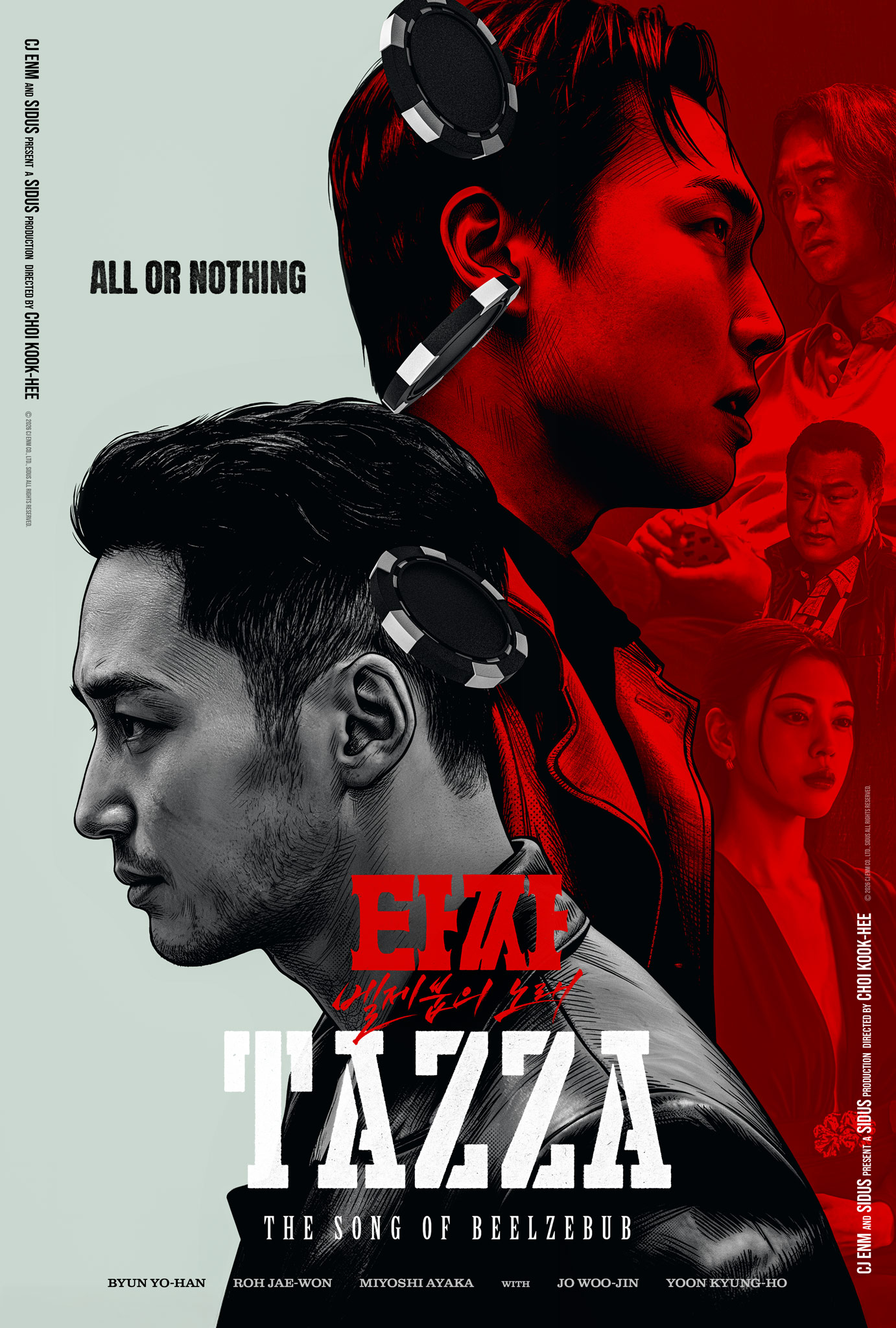
It’s been 20 years since the release of director Choi Dong-hoon’s Tazza: The High Rollers in 2006, one of the defining productions of the 2000’s K-Wave that, unlike today, was mainly driven by the countries cinematic output. A TV series adaptation followed in 2008, while the 2010’s delivered 2 sequels (2014’s Tazza: The Hidden Card and 2019’s Tazza: One Eyed Jack), and who can forget 2024’s (definitely not officially related) Female Tazzas trilogy!? In 2026 a fourth instalment hit the screens in the form of Tazza: The Song of Beelzebub, and while I’d hoped the cameo by the original’s director Choi Dong-hoon at the end of One Eyed Jack was a hint he’d be returning to the franchise, alas it wasn’t to be. In his place is Choi Gook-hee, who helmed the likes of the 2018 Asian Financial Crisis thriller Default, and 2022 musical Life is Beautiful, his latest offering up the opportunity to continue exploring his versatility as a director.
Not many Korean movie sequels in the 21st century make it to a 4th instalment (the only company I can think the latest instalment has is The Roundup: Punishment, which arrived just 7 years after the original), and the heady mix of gambling, violence, and sex which defined the series so far is one which has become increasingly sanitised in recent years. Thankfully such worries are put to rest in the opening scenes, which finds Byun Yo-han (Believer 2, No Tears for the Dead) sitting in a pool of dried-up blood on a ship somewhere off the coast of Vietnam, his face already battered to a bloody mess. His captors ultimately give him a chance – if a flipped coin somehow manages to land on its edge, he can walk free. Being a guy “who’s always been lucky”, that’s exactly what happens, but not before they forcibly extract his kidney, leaving him for dead on the side of the road.
Muck like the previous instalment Tazza: One Eyed Jack, the latest entry also acts as a standalone tale, taking place outside of the connected universe that the original and The Hidden Card took place in. After the opening scene the plot takes us back to Yo-han’s life in Korea, where we follow the relationship with his online casino business partner, played by Roh Jae-won (Ms. Apocalypse, Ditto). The pair grew up together, with Jae-won eventually moving in with Yo-han and his older sister after his religiously fanatical mother perishes in an apartment fire. Their penchant and skill for gambling soon sees them become a pair of front-page magazine featuring entrepreneurs, however bubbling underneath the surface Jae-won has always been envious of Yo-han’s superior intellect. To top it off, he also falls for Yo-han’s older sister, who understandably rejects his advances, further adding to a growing feeling of resentment.
It’s when they’re negotiating a deal to open a new casino that Jae-won concocts a story which involves Yo-han having to travel to Vietnam to secure additional funding, unaware he’s actually being sent to meet a grizzly end by a gang Jae-won has hired. Of course, the fact Yo-han survives turns The Song of Beelzebub (as I’ll refer to it from here on in) into that classic Korean genre staple – the revenge flick.
While the first 2 Tazza outings focused on the Korean card game of hwatu, both the third outing and the latest instalment opt to focus on poker, however the one element that no Tazza movie would be complete without is the role of the legendary gambling master. Always introduced in the context of having to take the down on his luck main character under their wing, in previous instalments the role has been played by the likes of Baek Yoon-sik and Ryoo Seung-beom, with screen presence and gravitas being an essential part of their character. Thankfully The Song of Beelzebub continues the tradition, with Yo-han crossing paths with a drunken master of disguise played by Jo Woo-jin (Mantis, Harbin), who’s been living off the radar in Vietnam after he got caught up with a ruthless Japanese yakuza several years earlier.
The yakuza in question is played by Tsuyoshi Ihara (Yakuza Princess, 13 Assassins), who re-enters the picture in a tangential plot that sees him track down Woo-jin, and demand he represent him in a high-stakes poker match. Critically Ihara’s joined by a trusted aide, played by Ayaka Miyoshi (for which The Song of Beelzebub marks the 2nd time to be directed by a Korean, having played the lead in the 2023 Japan-Korea co-production Knuckle Girl, helmed by Yoon Hong-seung), who comes with a revenge back story of her own. The introduction of Ihara and Miyoshi sometimes strikes a tricky balancing act, occasionally distracting from the main plot of Yo-han seeking his revenge on Jae-won, and feeling like it could have been its own movie. Luckily Gook-hee reins in the plot threads before they become too disparate, although it comes at the cost of Woo-jin exiting the narrative.
Indeed when compared to his predecessors like Baek Yoon-sik and Ryoo Seung-beom, it feels like Woo-jin’s exit is somewhat undignified, almost as if he had to abruptly leave the production so had to be quickly written out. It’s a little odd, however his exit makes for a logical if slightly awkward transition for Yo-han to take his place during a match with Ihara, their characters crossing paths paving the way for Yo-han to return to Korea. Somewhat ironically in an earlier scene Yo-han finds himself in bed with a Korean American in which he begs her to speak Korean rather than English, and I confess I found myself thinking the same when Yo-han is called upon to launch into a poker strategy heavy English spiel. I have nothing but respect for anyone who can speak another language, but in a movie it at least has to be intelligible, and the English spoken parts here are definitely more Kwak Do-won in Steel Rain than Kim Hye-soo in Default.
Stilted English line delivery aside, Yo-han acquits himself well as the lead, proving to be a worthy successor to Cho Seung-woo and Park Jeong-min (apologies, but I refuse to acknowledge T.O.P.’s performance), capably throwing down in action scenes, keeping cool when called upon to gamble, and offering up views of his posterior when things get steamy. Much like the previous years The Hidden Face, The Song of Beelzebub eschews the approach of looking to appeal to a broader audience base as possible, instead offering up an unapologetically adult affair. Likewise Jae-won makes for a suitably complex villain, striking the balance between coming across as terrifying in some scenes, and hopelessly pathetic in others, leaving the audience never quite knowing how far he’ll be willing to go.
Of course like any gambling movie, having some knowledge around the rules of poker will be an advantage to enjoying the all-important gambling scenes, but it’s by no means a prerequisite. What can be considered a prerequisite is a fondness for improvisational jazz, since a large part of the soundtrack is comprised from what sounds like a free jam jazz session, and occasionally feels somewhat jarring based on the scenes the score plays over.
There’s no doubt the more time that’s passed since the original Tazza: The High Rollers came out in 2006, the longer its shadow has become, continuing to cement its status as a genre classic as the years go by. Director Choi Gook-hee makes the wise move to have the story he tells be a standalone one, allowing the characters and narrative to thematically echo what made the original work so well, while also freshening it up for a modern audience. It’s to the productions credit that said freshening hasn’t come at the cost of smoothing off the grittier edges, with Tazza: The Song of Beelzebub offering up a healthy dose of violence, gambling, and sauciness without ever feeling derivative of the source material. Maybe for the next instalment we can get a Tazza x The Roundup crossover, now that’s a movie I’d be willing to bet on.
Paul Bramhall’s Rating: 7/10




So you have a problm with female Tazzas? 😭 Let me guess, just because they’re women?
Only problem I have with them is that it stopped at being a trilogy. 🙂
nice save.