



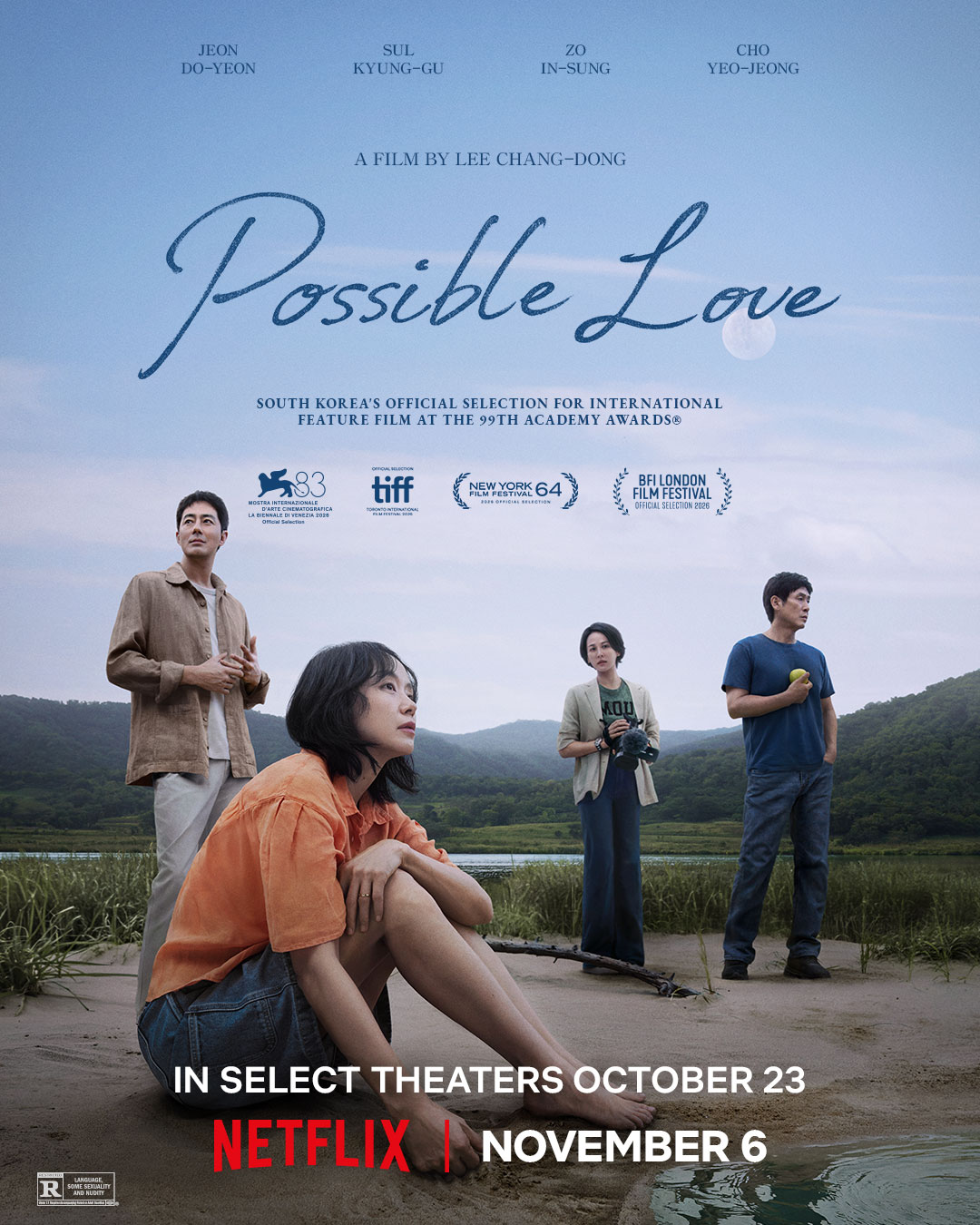
“Possible Love” Poster
The last 12 months could well be argued to be the best year for Korean cinema since 2003. It may seem like an improbable statement considering the film industry is still largely in a slump, driven by a lack of cinema attendance which has stubbornly refused to bounce back since the COVID-19 pandemic days, however at the same time the quality is hard to ignore. Park Chan-wook returned with No Other Choice, Na Hong-jin broke his 10-year drought with Hope, and local box office records were smashed by Jang Hang-jun’s The King’s Warden. Adding to the impressive turnout is Possible Love by director Lee Chang-dong, who last helmed Burning in 2018, a production which has frequently topped lists of greatest Korean films in the years since its release.
While Burning was an adaptation of a short story by Japanese author Haruki Murakami, Possible Love started life as part of a broader global project, which intended for different directors to helm their own feature length takes of episodes from Krzysztof Kieślowski’s TV mini-series Dekalog. Originally linked to Dekalog: Ten, once Netflix joined the production its association to the project diminished, with Chang-dong’s latest landing on screen as its own standalone movie (notably the project continued, with director Asghar Farhadi’s 2026 production Parallel Tales being the first to be released, an adaptation of Dekalog: Six). For those wincing at the thought of Lee Chang-dong making a Netflix movie, thankfully they gave him the same “artistic autonomy” that was granted to Bong Joon-ho when he made Okja, meaning the final product is one that was created without having to compromise to the dreaded viewer attention algorithm.
While the first draft of the script for Possible Love was written by Chang-dong more than 10 years ago, it was his decision to direct the short film Heartbeat in 2022 that proved to be the biggest contribution to it coming to fruition. Written by Oh Jung-mi, who studied under Chang-dong at the Korea National University of Arts, it would mark the beginning of a professional relationship between the pair, with Jung-mi going on to co-write the scripts for Burning and Possible Love. Significantly, it was Heartbeat that reunited Chang-dong with the stars of his 2000’s era masterpieces. Jeon Do-yeon, who starred in 2007’s Secret Sunshine (and who, if you saw interviews with her from the time, you’d be convinced would never work with him again!), was cast as a factory worker, while Sol Kyung-gu, who headlined 2000’s Peppermint Candy and 2002’s Oasis, played a traumatized laid off worker.
The short film acted as a warmup for the themes that Possible Love would explore in more detail, acting as the genesis of the feature length production, that clocks in with a run time just short of 165 minutes. Do-yeon and Kyung-gu are cast in identical roles to the short film, who we meet travelling with their young son to the funeral of another laid-off worker who took his own life. There’s already a simmering tension in the air when Kyung-gu tells his wife and son to go in first, with his eventual appearance leading to an argument between the pair when Kyung-gu breaks his promise to only drink at home. Further fanning the flames is an independent filmmaker who films the confrontation, played by Cho Yeo-jeong (My Daughter is a Zombie, Hidden Face), who’s there capturing footage for a documentary she plans to make on laid off labourers.
The stylishly dressed Yeo-jeong is married to a wealthy businessman played by Zo In-sung (Hope, Humint), although she insists on not using any of his money for her creative endeavours. Sensing the dynamic between Do-yeon and Kyung-gu could make for an engaging onscreen presence, Yeo-jeong approaches Do-yeon to propose a catch up over coffee, and is soon on a charm offensive to form a friendship with the beleaguered couple. While Do-yeon is particularly receptive, and seems to find solace in being in front of Yeo-jeong’s camera, both men come across as less enthusiastic about the venture. Kyung-gu spends much of the first half barely speaking, and In-sung seems reluctant to be dragged into the blue-collar world of factory workers and union strikes.
One of the Chang-dong’s strengths as a director has always been that you never quite know where the narratives of his stories are going to end up, and that’s certainly the case here. Initially Possible Love comes across like a more sombre and grounded take on the kind of subject matter Bong Joon-ho’s Parasite and Park Chan-wook’s No Other Choice have covered, with the class differences between the couples and Kyung-gu’s laid off worker echoing their themes. However Chang-dong has always shot his stories primarily with a human focus, and here it’s this element that increasingly comes to the fore, with all 4 of the main characters feeling fully rounded and real.
There are scenes where the tension feels like it’s being cranked up to almost unbearable levels, none more so than when the quartet end up drinking inside Do-yeon and Kyung-gu’s home. The reveal that Do-yeon and Yeo-jeong are similar ages makes the latter drunkenly channel a high school delinquent, jokingly calling her a bitch, the mention of which sees Kyung-gu tighten up in a way which feels like things are going to boil over into violence. However not for the last time the scene cuts off, leaving an uncomfortable feeling in the stomach, before realising that any tension simply fizzled out. The threat, or danger is probably more apt, of physical connection is one that’s prevalent throughout Chang-dong’s latest, conveyed as perhaps the one equalizer across the class divide that separates the two couples – whether that connection be violence or sexual.
Just as compelling as the invisible divides that exist between the two couples though is the way Chang-dong portrays the dynamic between the couples themselves. Despite Kyung-gu being a ghost of a man, Do-yeon remains doggedly loyal to him, putting up with his outbursts and fondly recalling to Yeo-jeong how they met in their younger days. There are the flickering embers of a relationship still there through their interactions, and in some ways it could be looked at as Yeo-jeong and In-sung coming into their lives acting as the conduit to bring them closer together. Yeo-jeong and In-song on the other hand feel intentionally opaque, with Yeo-jong conveying a somewhat naïve innocence to her friendship with her subjects, one which is questioned by In-song who seems surer of his place in the world. In one particularly powerful scene he tells Yeo-jeong “You’re not like them, but you’ve convinced yourself that you’re the same.”
How much disparities in status and wealth play a factor in human relationships has long been explored by Korean cinema, however by exploring the theme through the framing of a documentary within a film, here it’s forced to be considered by the characters who are the subjects just as much as the audience. By the time Do-yeon and Kyung-gu agree to join Yeo-jeong and In-sung for a weekend getaway at In-sung’s secluded beach house, the mix of alcohol, karaoke, and even some taekwondo converge in unexpected ways (and just to make it clear, there’s nobody secretly living in the basement) that would be a crime to spoil.
Ultimately, much like Secret Sunshine almost 20 years earlier, Possible Love belongs to Jeon Do-yeon as the factory worker whose curiosity towards the world she’s pulled into is left for the audience to interpret – is it jealousy, admiration, resentment, or empowerment? Opening with the quote “Thou shalt not covet”, Lee Chang-dong’s latest is an undeniably uncomfortable watch in the most intentional way, but rewards in its implication that, if we can overcome the desire for what our neighbour’s possess, then love is, indeed, possible.
Paul Bramhall’s Rating: 9/10