




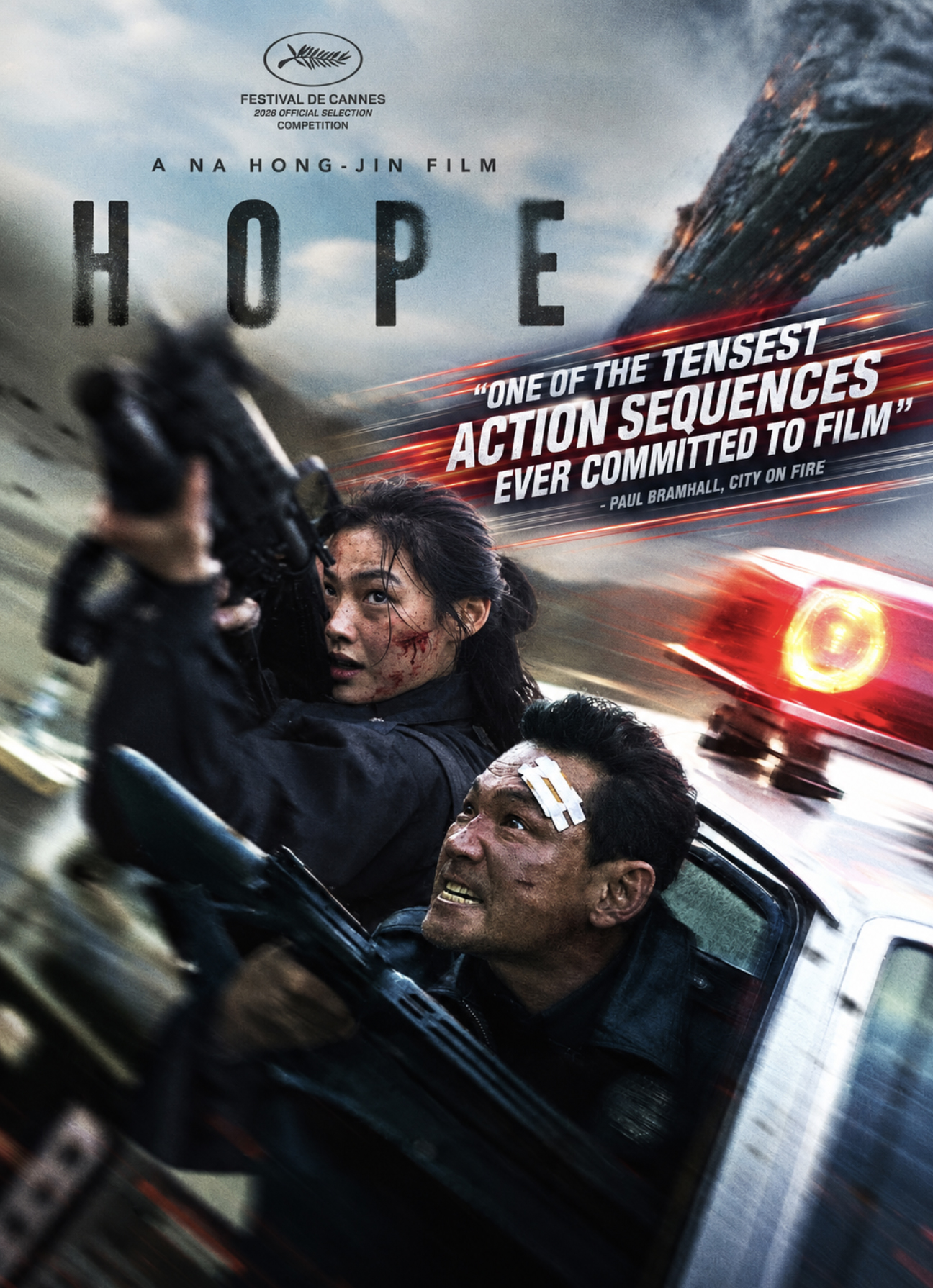
“Hope” Poster
Ten years is a long time to wait for anything, but as a fan of director Na Hong-jin, that patience has finally paid off in 2026 with the release of Hope. Notwithstanding his 2023 short film Faith (made to promote the Samsung Galaxy S23 Ultra) and foray into producing with the 2021 Korea-Thailand co-production The Medium, the last time Hong-jin sat in the director’s chair for a feature length production was the 2016 horror masterpiece The Wailing. Hope sees him reunite with the star of The Wailing in the form of Hwang Jung-min (I, The Executioner, 12.12: The Day), here playing the police chief of Hope Harbor, a small coastal village not far from the 38th parallel.
It’s never implicitly stated, however Hope appears to be set at some point in the late 70’s or early 80’s, with billboards visible encouraging the public to report spies, and a surplus of heavy artillery likely leftover from the Korean War still readily accessible. In fact the way characters frequently turn up armed to the teeth with everything from assault rifles to rocket launchers becomes a running joke, as Jung-min’s somewhat naïve police chief constantly questions where the weapons have come from, seemingly clueless to what’s been under his nose the whole time. In case it wasn’t clear already, Hong-jin’s latest sees the director at his most playful, opting to forego the dark tone that defined his classics like The Chaser and The Yellow Sea in favour of a rollicking action flick.
This becomes apparent from the opening moments, where Jung-min arrives at the scene of a dead cow sprawled across a country road, its presence called in by his second cousin, played by Zo In-sung (Humint, Smugglers). Mauled by a much larger creature, In-sung and his hunting buddies weave a tale of a tiger that travels down from Siberia every year, through North Korea and into the South, however once Jung-min drives into the town itself, it becomes apparent it’s something much bigger than any tiger. Whatever it is has left a trail of destruction in its wake, and the result is one of the tensest action sequences committed to film, one that extends for well over an hour. Hong-jin proves the mastery of his craft through the fact that, for the longest time, we don’t even know what Jung-min is up against, instead we’re left to follow him weaving in and out of the devastation trying to catch up with the mysterious perpetrator.
Very much befitting of the phrase ‘hit the ground running’, the village set sequence aptly shows why Hope is the most expensive Korean production ever made, with literally a whole town laid to waste, and bodies (and body parts for that matter!) strewn everywhere. By the time the mysterious creature reveals itself, best described as a kind of ridiculously fast, completely uncoordinated distant relative of the titans from Japan’s live action Attack on Titan adaptations, it’s difficult not to smile at the bombast of it all. That’s even before a scene stealing Jung Ho-yeon (here making her feature length debut after appearing in Squid Game) makes her entrance, tearing down the street in a police car while pumping bullets from a semi-automatic out the window in pursuit of the creature, the whole time turning the air blue.
In fact the whole first half feels like Hong-jin is riffing on the kind of gritty 70’s Hollywood cops and robbers movies that defined the era, just swap out the robbers with a gangly limbed alien. Jung-min and Ho-yeon’s line delivery consists almost exclusively of expletives, delivered with such poker-faced sincerity that the narrative eschews any need to give a wink at the audience. By the time Hong-jin regular Hwang Seok-jeong (The Phone, Memoir of a Murderer) makes an appearance as a public health official, hilariously brandishing a chainsaw in order to perform an autopsy on one of the creatures, Hope’s sense of humor is apparent.
However Hong-jin’s latest is also a movie of 2 halves, with the latter half of the hefty 160-minute runtime focused on In-sung and his hunter buddies, who Jung-min sent off into the mountains to look for traces of the monster there. It’s during the back end of Hope that the adrenaline rush of the village set sequence wears off, and the broader story comes into focus. How much audiences will enjoy the remainder will largely depend on how much they buy into the extraterrestrial aspect of proceedings. Hong-jin has brought in some international firepower for his latest, with offscreen husband and wife Michael Fassbender (Prometheus, Haywire) and Alicia Vikander (Tomb Raider, Jason Bourne) onboard as a pair of not entirely convincing CGI aliens (although in 2026, I feel like I’ve come to accept that CGI will never reach the levels of the early 1990’s again).
Beyond the not quite there CGI though, the biggest question I found myself asking was why do each of the aliens look like they’ve been designed by someone different? The titan like alien of the village scene looks nothing like Michael Fassbender’s alien, who looks nothing like Alicia Vakander’s alien (that should come with a warning if you squint, you may think you’re watching Avatar), and that’s without mentioning their offspring. It’s a strange design choice to have them look so different to each other, and one that I found more distracting than the occasional iffy CGI (which for long-time fans of Korean cinema, may occasionally bring to mind 2011’s Sector 7).
The move to the forest also offers up a second environment for the action beats to play out in, with the chase sequences from the village transposed onto horseback in the mountains. The issue though is that watching a four-legged alien chase people on horseback through a forest just doesn’t offer up the same excitement as the urban setting of the village, and the result is that a feeling of repetitiveness eventually creeps in. It’s particularly telling that, during a highway chase that sees the alien in pursuit of a horseback riding In-sung and cop car, the most exciting moments aren’t those when the alien almost catches up with them, but rather a stunt that sees In-sung attempting to jump onto the car roof from the horse he’s riding (courtesy of veteran action director and frequent Hong-jin collaborator Yoo Sang-seob).
Despite Hope only being the fourth movie Hong-jin has helmed in 18 years, one thing that’s become apparent is that he’s always known how to play with audience expectations, and this is on full display during the closing scenes. Moving the focus away from the human characters altogether, we finally spend some time with Fassbender and Vikander as they come to realise the extent of their situation. It’s a daring bait and switch which is there to essentially act as a setup for a sequel. Or could it just be that Hong-jin is sarcastically riffing on the Hollywood blockbuster trope to leave proceedings open for another round, and like much of the humor infused runtime, the idea of a sequel that would focus more on the alien’s side of the story is also there to be laughed at? Only time will tell, but my only ask would be that it doesn’t take another 10 years for the answer to arrive.
Despite its flaws, Hong-jin’s latest is rarely anything other than entertaining, even if the message of how violence stems from ignorance and a fear of the unknown gets a little muddled along the way. It contains possibly the most laugh out loud diarrhoea anecdote in cinematic history, Hwang Jung-min and Jung Ho-yeon deliver the cop character pairing the world didn’t know it needed, and for the first time in far too long, we have a Korean movie that demands to be seen on as bigger screen as possible. These might not be the reasons a fan of Na Hong-jin’s previous work would be expecting as to why Hope is a worthy addition to the auteur’s filmography, but they’re also the same ones that make him an auteur in the first place. I hope you’ll agree.
Paul Bramhall’s Rating: 7.5/10








Not as good as The Chaser or The Yellow Sea, but just as good as The Wailing. Of course, it’s nothing like any of those movies.
I agree with your score, but I’d rate it slightly higher, somewhere between a 7.75 and a solid 8. Very rarely do I clench my fists during action sequences out of excitement. That being said, Na Hong-jin knows how to make an intense action scene.
Your review itself is spot on and pretty much reflects what I think. I do think the movie could have been trimmed down a bit (I find it hard to do anything for more than two hours lol)
Knowing that one of Na Hong-jin’s favorite movies of all time is MACROSS (so is mine) is such a tease, because I really think he’d be a great contender to direct a live action adaptation, especially after seeing some of the elements in this movie (space ships, giant aliens, exciting action, etc).
Did you stay throughout the credits?
As far as the aliens looking different… man, who knows. It was crazy how they were able to shape shift, almost in a “Transformer” like way, which I thought was bizarrely cool (there was even some H.R. Giger-sploitation).
The CGI was dated, but for me, didn’t take away from the quality (I’d rather have a good movie with crappy effects, than a crappy movie with realistic effects).
“Did you stay throughout the credits?”
Didn’t the Marvel movies practically make this a mandatory requirement in modern cinema? 😛 But yes, I did, and in the screening I was in the audience cheered!
Definitely picked up on the H.R.Giger influence as well in the one scene, nice to see it in a non-Ridley Scott movie (or movies about horny aliens desperate to reproduce lol).
I hated this movie with a vengeance. I thought Supergirl was the worst movie of the year. Every line of dialogue has the f**ck word. Most disappointing is I loved The Wailing.
LOL!
What did you think of Yellow Sea and Chaser?
#MeToo
It’s about time there is a strong Asian female lead in a male dominated industry.
One of the best films of the year for me.Hwang Jung-min on the big screen I need more please. Love him since A BitterSweet Life
As a fan of Nah Hong-jin, I came away deeply disappointed by Hope. I can understand why some viewers enjoy it, particularly because the film is often described as being split into two distinct halves. Many seem to respond positively to the action-heavy first half, but for me it felt surprisingly empty.
The opening relies heavily on large-scale action sequences, yet the storytelling is sparse and underdeveloped. Rather than supporting the narrative, these set pieces dominate the film, and their repetitive nature quickly becomes exhausting. There is a sense that the production is trying to overwhelm the audience with spectacle instead of engaging them with strong characters or meaningful dramatic development.
As the film moves into its second half, these problems become even more apparent. The extended sequences in the woods grow increasingly monotonous, and the film begins to drag. The repetition that was already present in the first half becomes difficult to ignore, making the overall experience feel far longer than it is.
The visual effects are another major issue. The CGI, particularly in the movement of certain elements, looks surprisingly poor and often feels unintentionally reminiscent of a low-budget B-movie. Instead of enhancing immersion, it frequently becomes distracting and takes the viewer out of the experience.
Ultimately, my biggest criticism is that the film lacks a strong narrative foundation. It feels like one massive action set piece stretched across an entire feature, but without compelling storytelling to support it. While the ambition and scale are undeniable, the inconsistent execution, weak narrative structure, repetitive action, and underwhelming visual effects make Hope a disappointing and surprisingly weak entry from a filmmaker whose previous work set much higher expectations.
Thanks for sharing your views Sai, can certainly see that side of the coin as well. It sounds like you need a palate cleanser, so allow me to recommend Hi-Five, I have complete confidence it would be right up your alley.
🤣 Thanks for the recommendation! Mason suggested we do Hope and Hi-Five as a double bill one weekend!