


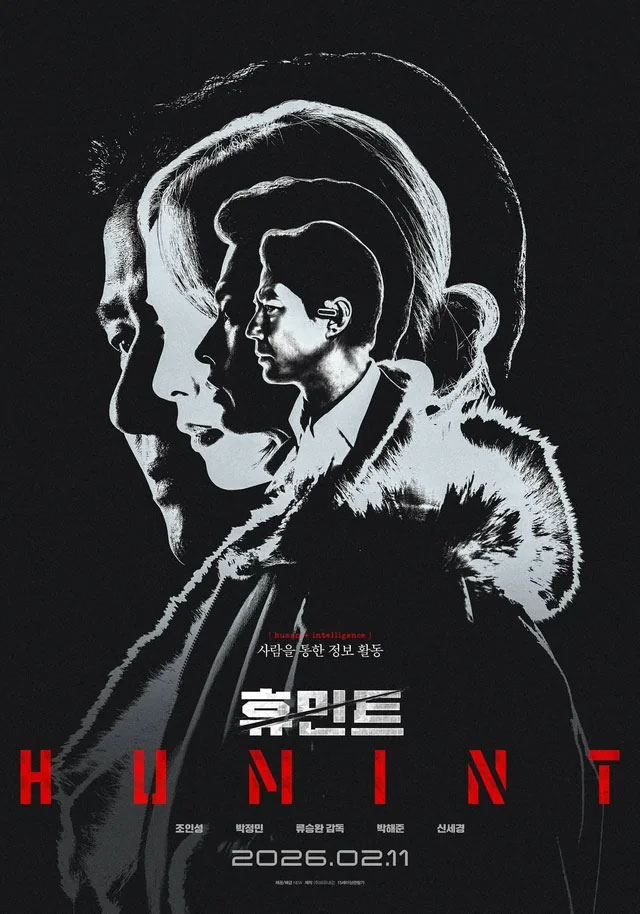
“Humint” Theatrical Poster
Director: Ryoo Seung-wan
Cast: Zo In-Sung, Park Jeong-Min, Park Hae-Joon, Shin Se-Kyung, Lee Shin-Ki, Jung Eugene, Park Myung-Shin, Kim Eui-Sung, Jang Hyun-Sung
Running Time: 119 min.
By Paul Bramhall
It’s been 13 years since director Ryoo Seung-wan helmed The Berlin File, a murky espionage action thriller that revolved around a quartet of characters – a South Korean agent and a trio of North Koreans, two of them operatives, one of whom is married to a potential traitor collaborating with the South. The Berlin setting offered the production a different look and feel to the usual Korean ports and cityscapes, being one of the few cities that still has a North Korean Embassy as a legacy from the Cold War. Seung-wan makes a welcome return for his latest to the secretive world of North Koreans stationed overseas, with Vladivostok (which also has a North Korean embassy) in Russia taking the place of Berlin, however the character dynamic remains the same – once more we have a South Korean agent and a trio of North Koreans, only this time one of them has an ex who we know for a fact is colluding with the South.
The Humint that the title refers to is a portmanteau of the word’s human intelligence, a reference to the network of North Korean informants the South’s National Intelligence Service has established while trying to crack a drug ring, one they suspect the North are working together on with the Russians. An agent played by Zo In-sung (The Great Battle, A Dirty Carnival) is dispatched to Vladivostok while still reeling from the death of his last informant, a trafficked woman being forced to work as a prostitute in the fictional country of Mahador. Tasked with establishing contact with a singer working in a North Korean restaurant, played by Shin Se-kyung (Tazza: The Hidden Card, Hindsight), the agency hope she’ll provide an insider view to the deals that take place during the extra-curricular activities staff provide for their male clientele after hours.
As it happens Pyongyang suspect the same, so send one of their own agents, played by Park Jeong-min (The Ugly, Harbin) to look into the local North Korean consul general, played with a villainous relish by Park Hae-joon (Yadang: The Snitch, Broker). One of Hae-joon’s main jobs is to round up the many defectors who end up in Vladivostok and repatriate them back to the North, however lately several of them have disappeared into thin air, with the one commonality being all of them are women. Hae-joon is instantly weary of Jeong-min, and he has plenty of reasons to be, the biggest one being he’s been assisting to broker attractive female defectors into the hands of the Russians, who drug and sell them into brothels. Jeong-min encounters a curve ball though when Hae-joon takes him for dinner in the same restaurant Se-kyung works at, and it’s revealed the pair used to be in a relationship before she left without notice.
While on paper it may appear that Seung-wan is revisiting The Berlin File territory, it soon becomes clear the similarities are only on a surface level, with his true intention being to create a homage to John Woo’s 1989 masterpiece The Killer. This first becomes evident in the same scene, when after sharing a longing glance, Se-kyung is whisked off to perform on stage, singing a sorrowful song of loss while Jeong-min looks on from his table, directly referencing when Chow Yun Fat watches Sally Yeh perform onstage after accidentally blinding her. It’s also where Humint’s problems start. When Chow Yun Fat is watching Sally Yeh he’s filled with the regret of making her lose her sight, something the audience can feel, however watching Jeong-min with a slightly furrowed brow while Se-kyung solemnly sings doesn’t work. We know nothing of their past, so the gravitas the scene is filmed with feels unearned from a narrative standpoint.
Indeed the character dynamic between In-sung, Jeong-min, and Se-kyung is a direct lift and shift from The Killer, as she finds herself the centre of attention of both men – In-sung’s previous trauma sees him harbour a strong protective instinct to ensure she doesn’t get hurt, while Jeong-min seeks closure of why she disappeared back when they were a couple in the North. If you know your John Woo movies, then you’ll also know it’s a safe bet that at some point In-sung and Jeong-min will cross paths in the middle of a gun fight and point their pistols at each other, before realising that they both share a similar goal.
Unfortunately for Jeong-min and Se-kyung though things don’t improve when they do manage to share some screentime together, as whether it be down to the script or a mismatch of acting styles, the unavoidable fact is they lack any kind of romantic chemistry together. As a result the exposition heavy first hour at some point begins to feel like a slog, with the initial spark intended to propel the narrative forward failing to ignite, a misfire that ultimately means the characters never really connect in the way that was intended. What we’re left with is a homage that looks the part, but definitely doesn’t feel it, with the emotional connection that’s always been such an underrated aspect of Woo’s best work nowhere to be found.
Thankfully you can always rely on Ryoo Seung-wan to deliver some top shelf action, and in that regard Humint does hit the mark, with action duty going to frequent collaborator Yoo Sang-seob (who’s worked with Seung-wan dating back to his debut Die Bad in 2000) and Lee Wonhaeng (The Roundup, Hunt). This is the third time for In-sung to work with Seung-wan following 2021’s Escape from Mogadishu and 2023’s Smugglers, and he’s once more given a standout fight scene with an impressive opening one versus many melee. Every director known for action tends to have a trademark that gives away their style even before knowing they’re involved, and for Seung-wan he’s the master of shooting impacts in such a way that you really feel it. Here there are several wince worthy moments, with bodies colliding with bannisters mid-fall down a stairwell, or pens aggressively being clicked while thrust halfway up someone’s nose.
The final half hour is essentially one long action sequence, with In-sung and Jeong-min teaming up to raid the mansion where Se-kyung is being held captive by the Russian gang boss, played by stuntman Robert Maaser (Ballerina, Mission: Impossible – Rogue Nation). The sequence offers up an entertaining mix of gunplay and frantic fight choreography, with the fact that the girls being auctioned off are imprisoned in their own bullet proof glass cubicles (complete with gradings like A, A+ etc.) taken full advantage of, making for one of the most original bullet riddled finales in recent years. Except – it turns out to only be part of the finale, with Hae-joon and his lackeys still outside in the parking lot waiting to shoot anyone who steps out.
The ingenuity of the mansion rescue sequence sadly doesn’t transfer to the exterior shootout that closes proceedings, with the style switching to the tired tactical gunplay approach. In my humble opinion the tactical gunplay golden era spans the 10 years from 2008’s Taken to 2017’s John Wick: Chapter 2, and after that it’s begun to feel largely uninspired. I don’t think anyone will argue it was a breath of fresh air for a while, but in 2026 it’s still the John Woo classics that I find myself going back to if I want a dose of bullet riddled, adrenaline pumping action over the point, shoot, repeat approach. I figured Seung-wan felt the same way after the mission to rescue Se-kyung from the Russians, however maybe he wanted to have the best of both worlds, so once they step outside to find themselves under a hail of bullets from Hae-joon, it becomes much more tactical. It may make sense, but it’s not as pulse pounding as what just preceded it.
Ultimately Seung-wan’s latest feels like it repeatedly expects you to be much more invested in the characters than it’s possible to be, with a script that frequently takes you out of the movie. Would a detached, efficient North Korean agent like Jeong-min really have a happy smiling selfie of him with his ex as his smartphone wallpaper on a dangerous mission like the one he’s on? Apparently. How many scenes can you have where a character whispers secret instructions to another in front of other characters who are just a couple of metres away, and believe they’re not supposed to have heard anything? Certainly one too many in this case. A classic example of action alone not being enough to cover a lack of characterisation and compelling story, Humint is a frustrating missed opportunity.
Paul Bramhall’s Rating: 5/10







That sucks that Humint misses the mark. Considering that originally The Killer was going to feature a love triangle with the 3 leads, I wonder if this movie was attempting the same thing.
I understand that “John Wick-styled” action may be played out for a lot of people, but I would argue that it probably would have worked better if the audience cared about the characters.
I’ve learned over the years that even if a movie has top notch action choreography, it won’t mean anything if you don’t like the characters even a little bit. Sometimes there’s an exception, but I get it. (And why weren’t they attempting “The Man From Nowhere-styled” action?
Maybe I’ll enjoy this for the action scenes if I find myself wanting to skip to those parts when I watch Humint.
John Wick style action was already played out even before the end credits of John Wick 2 rolled. The first movie works cos there is motivation for the carnage and you are willing to forgive the repetitive action beats and the underwhelming finale. By part 2 his motivation is he needs to pay back a gold coin with some accrued compound interest, fighting Batwoman and a musician who doesn’t have a surname.
And yeah 2026 is time for a John Woo revival and reappraisal. The gunplay, slomo, bromance, cantopop, OTT drama all comes together in a perfect package, at least for the Holy 4 that is playing at the Prince Charles.
The worst effect of the Wick style gunplay is that Woo felt he needed to cater to that market with Silent Night. He should have went all in and give us remake Robocop killing the bad guys CYF style while Christmas classics play in the background but in a non ironic way that only Woo can deliver
To be honest, I don’t think “Silent Night” (2023) deserves its negative reputation. I personally liked it: Woo does go outside his typical style, but he’s able to transfer his best traits — heightened emotion, great action, and a sort of moral code between two different people (observed between father Godlock and cop Vassel) — and makes something worthwhile from having little to no dialogue. The revenge plot is typical, but Woo builds from that to create an effective movie.
I’m a Silent Night defender too. I babbled all about it on its review page. There’s a lot I would have changed in the film, but I still liked it.
Humint might be one of those movies that I’d change a lot of too if I could.