
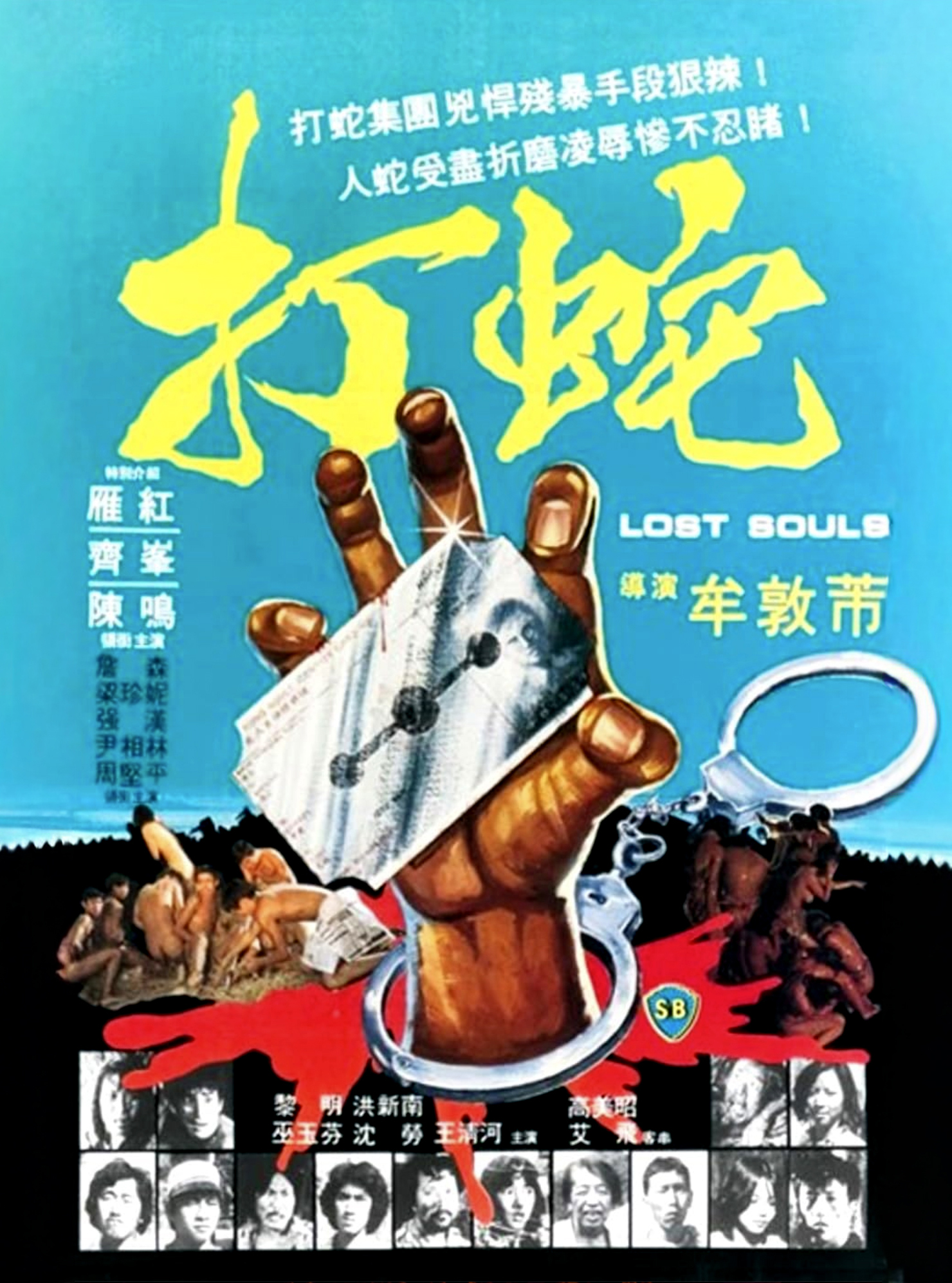
“Lost Souls” Poster
There are some directors whose names will always be associated with one specific movie, and in the case of T.F. Mou, it’s his 1988 production Men Behind the Sun. A controversial re-telling of the activities undertaken by Japan’s Unit 731, the department responsible for conducting experiments on the Chinese in the dying days of World War II, both the filmmaking techniques employed and what ended up onscreen make it a decidedly notorious piece of cinema. After making it Mou went off the map for the next 7 years, re-emerging in 1995 to co-direct Trilogy of Lust with its star Julie Lee, and returning to similar subject matter as Men Behind the Sun with his swan song Black Sun: The Nanking Massacre, released the same year.
Mou had an illustrious career before Men Behind the Sun though, one that stretched back to his directorial debut in 1969 with the Taiwanese children’s drama I Didn’t Dare to Tell You. However it was always the darker, grittier side of life where he found himself most at home at in his cinematic work, one that started to come to the fore once he was contracted to the Shaw Brothers studio. From helming a segment in the 1977 omnibus movie The Teenager’s Nightmare to 1978’s crime thriller Bank Busters, for a moment there he flittingly became a part of the Hong Kong New Wave, popularised by the likes of Alex Cheung’s Cops and Robbers and Man on the Brink. It was Mou’s last production at Shaw Brothers that left the biggest impression though, when in 1980 he’d helm Lost Souls.
In the opening scene narration it’s explained that “In October 24, 1980 Hong Kong announced that illegal immigrants would be expounded as soon as they’re caught…In Hong Kong, do we really understand how tough it is for them to have experienced the journey from the border to Tsim Sha Tsui! Let’s take a look at the plight of the majority and unfortunate ones.” Viewing Lost Souls 45 years since its release, the landscape in which the story unfolds offers up a snapshot of a bygone era, one in which Hong Kong and the Mainland were considered 2 different countries. During this time, when the repercussions of the Cultural Revolution were still being felt, many Mainlanders attempted to enter Hong Kong illegally, believing it to be a prosperous territory with opportunities aplenty.
The plot focuses on 3 of them, played by a debuting Eric Chan (Curse of Evil, Little Dragon Maiden), Aan Hung, and Chai Fung, who believe that once they get to the bountiful Diamond Hill they’ll be able to start a new life. Precursing the same approach he’d take in Men Behind the Sun, for Hung and Fung Lost Souls is their one and only credit, and once the end credits roll, it’s easy to theorise as to why. Mou paints the Hong Kong and China border as one that’s even deadlier than the DMZ separating North and South Korea, full of deviant traffickers who’s only goal is to capture the illegal border crossers, whether that be by razor sharp leghold traps hidden in the fields, or feigned kindness to help them. Once caught their captors set out to extort them, usually by getting them to give up the telephone number of any relatives they have in Hong Kong, and by selling on the ladies to sleazy brothel owners.
In my review for Men Behind the Sun I referred to it as “a movie that stands as a powerful document of what happened in Unit 731”, a line intended to reflect Mou’s ability as a filmmaker to balance the vileness of what’s portrayed on screen, with the humanity of the characters who populate it. I’d hoped to find those same traits in Lost Souls, however whether it be where he was at in his filmmaking journey at the time, or the limitations of the Shaw Brothers style of filmmaking, the balance in question is all but non-existent. Instead, what’s left is by far the nastiest slice of exploitation in the entire Shaw Brothers catalogue, with its 90 minutes so unwaveringly committed to portraying acts of cruelty, humiliation, sexual assault and violence, that you’ll probably need a shower after watching.
No sooner have the trio crossed the border, than they end up in the hands of a trafficker played by Shaw Brothers regular Chan Shan (The Magic Blade, Shaolin Hand Lock). Played as a limping, pimp suited deviant with a taste for young boys, we first meet Shan painfully pouring hot candle wax over an incapacitated naked woman, before getting bored and throwing her to his lackeys, who proceed to gang rape her. The most jarring element of Lost Souls is the perspective of which such scenes are shot from, as wherein a production like Men Behind the Sun it’s clearly about the victims, here everything is framed from the male gaze of the traffickers. Instead of focusing on the trauma of the event, the camera lingers on her naked body, and when they throw her away like a ragdoll (quite literally), we even get a slow motion shot from below, her naked body floating across the screen to ensure we get an eyeful of everything.
It feels problematic, and while I like a sleazy dose of exploitation as much as the next guy, here the almost constant bombardment of sexual assaults never feels anything less than uncomfortable. In fairness that could well be the point, as if Mou wanted to hold up a mirror to Hong Kong and show its dark underbelly in all its unfiltered ugliness, however the unrelenting nature of it ultimately comes across as overly grim and tasteless. To prevent any of the illegals from escaping they’re rounded up and kept in a dilapidated barn covered in excrement, with their clothes forcibly ripped off to prevent them from escaping, which means that for much of the runtime most of the cast are only covered with sheets of newspaper. There’s a young boy amongst them who couldn’t be more than 10, so I only hope he grew up to be a well-adjusted adult (either that, or his experience on the movie would have likely become a Dr. Lamb style origin story).
By far the most shocking scene in Lost Souls though is when Shan subjects Eric Chan to an anal rape. Initially presented by his lackeys in gift wrap complete with a ribbon (I wish I was exaggerating), Shan removes the wrapping to find an unconscious and naked Chan already tied to a chair and in position. It’s a gruelling scene, and is notably the only one that doesn’t indulge the viewer from the perspective of the rapist, instead choosing to fully focus on the pain of the victim. The scene also acts as the instigator for the captives to finally turn against their attackers, as they look to use their numbers to overwhelm them and make a break to reach Kowloon. It almost comes as a relief to see the action finally move out of the decrepit walls of the barn, and offers up some minor retribution to see the captors get their comeuppance, however there’s been too much misery up to this point for any of it to truly feel cathartic.
However Mou sticks to his guns of the opening narration that promises “a look at the plight of the majority and unfortunate ones”, ensuring nobody in Lost Souls is able to find the better life they were hoping for. One of the cruellest twists isn’t the physical or mental torture that the illegal immigrants are subjected to by the traffickers, but rather a scene where one of them reaches their sought after Diamond Hill (which is a real place in Hong Kong, so consider this a non-spoiler!), only to find out that it’s a slum no better than where they’d come from in China.
A savage, bleak look at the depths of human depravity, the same way Mou painted a picture of the Japanese treating the Chinese as pieces of worthless meat in Men Behind the Sun, 8 years earlier he’d show that people from their own race can treat each other just as worthlessly. Lost Souls lacks the nuance of his later work though, instead framing the horrors through an exploitative lens, challenging the viewer to be titillated rather than turned off, and in this case the combination of gratuitous nudity and brutal nihilism doesn’t quite gel.
Paul Bramhall’s Rating: 5/10