



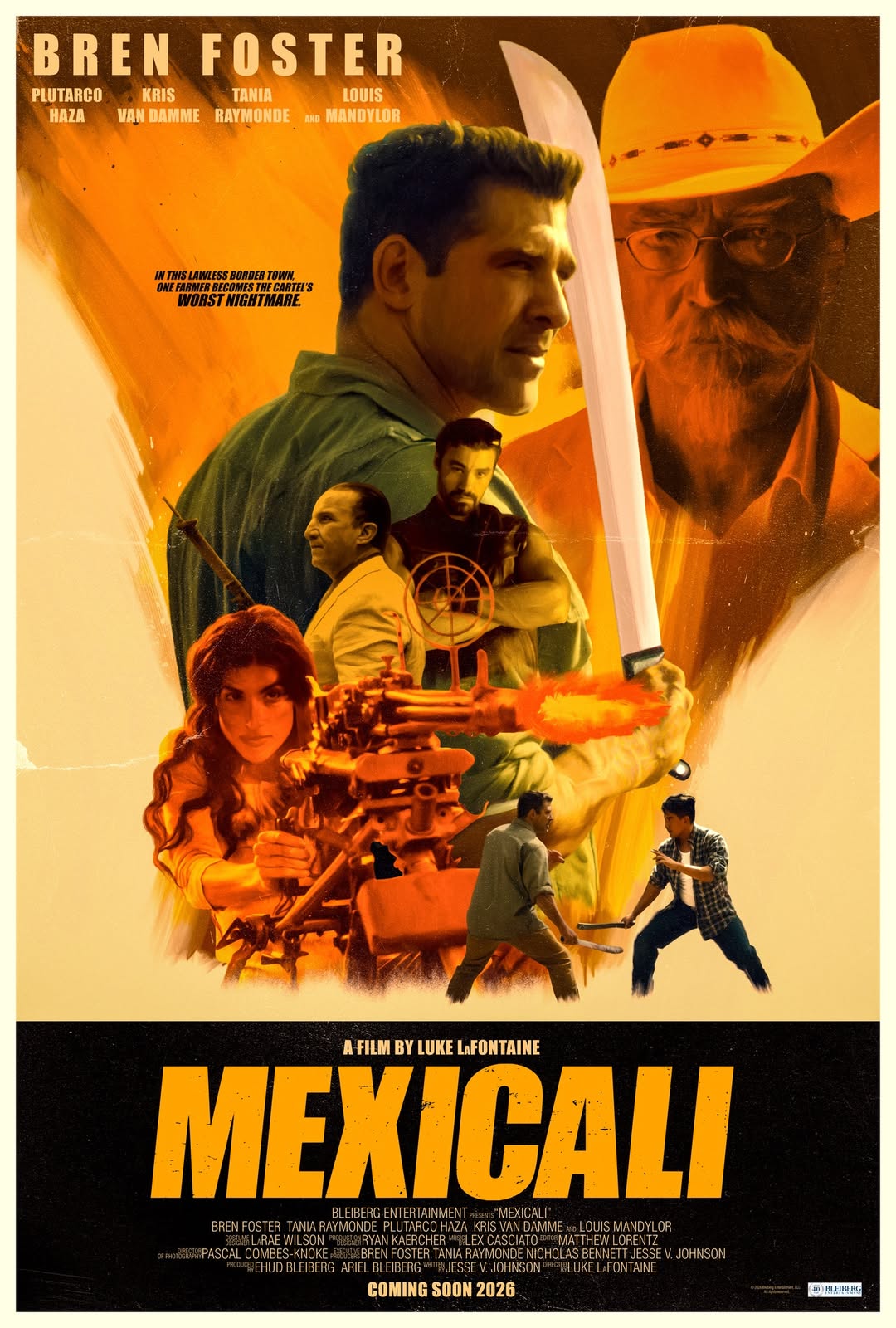
“Mexicali” Theatrical Poster
Director: Luke LaFontaine
Cast: Bren Foster, Tania Raymonde, Plutarco Haza, Kris Van Damme, Louis Mandylor
Running Time: 99 min.
By Z Ravas
Mexicali is a movie that knows precisely what its audience wants and decides to give it to them without delay. It’s been two short years since Bren Foster broke out on the international action scene with Life After Fighting, and the filmmakers behind Mexicali understand that fans are likely curious if that movie was a one-off or if Foster will continue to cement his status as a rising star in the martial arts world; therefore, Mexicali opens with Foster in the ring for not one, not two, not three, but four fights in a row. Befitting a movie with a former stuntman in the director’s chair, the fight choreography here is top notch, and Foster very quickly proves that Life After Fighting was no fluke, as the man seems incapable of not going Beast Mode whenever a scene calls for him to throw a punch or kick.
Needless to say, the wait for Bren Foster’s follow-up to Life After Fighting was worth it. Mexicali arrives from Luke LaFontaine, the aforementioned former stuntman and second unit director with past credits on many Direct to Video action efforts like Jesse V. Johnson’s Savage Dog and The Mercenary. It’s likely no coincidence, then, that Jesse V. Johnson wrote the script for Mexicali (and included a small part for his frequent star, Louis Mandylor). The experienced LaFontaine makes a natural transition to the director’s chair: Mexicali is a polished, well-paced effort that puts Bren Foster’s physical prowess front and center.
Despite the movie opening with Foster’s character Joe engaging in an illegal fighting ring South of the Border, this movie is decidedly not a tournament flick; it turns out Foster’s ex-mercenary is only bare knuckle boxing in order to raise cash to pay the workers on his fiancee’s farm after a bad crop. The real plot kicks into gear when Foster heads into town on some errands and accidentally runs afoul of a local drug lord’s sadistic son. This puts Foster and his fiancee (actress Tania Raymonde) firmly in the sights of said drug lord—fortunately, Joe’s former soldiering days have left him with the training and skill set necessary to wage war on any and everybody that the cartel can throw at him.
That ‘any and everybody’ includes Kris Van Damme, the son of action icon Jean-Claude Van Damme, and viewers who mostly associate Kris with his past appearances as a skinny kid in his father’s movies like Universal Soldier: Regeneration, you may be surprised to see just how much the actor has bulked up these days. (To be fair, if you saw 2017’s Kill ‘Em All, you likely noticed that Kris has been putting in the work to be able to throw kicks befitting his familial name). And if there’s one major strike against Mexicali, it’s that the movie doesn’t showcase a major fight scene between Bren Foster and Kris Van Damme. There’s a tease of a fight scene about halfway through the movie that’s interrupted, leaving you with the feeling that their conflict is ‘to be continued,’ but the climax of the movie ends up not going there.
Actually, there were a couple choices in the storytelling department that left me puzzled: like when the movie seems to be building up to an action climax where Foster’s character has to take back his fiancee’s farm from a small army of cartel enforcers, and suddenly he instead decides to briefly go back to fighting in the ring. Is Joe trying to raise money to purchase weapons? Does he think he can offer to buy the farm back from the cartel? It’s not entirely clear in the moment, and while the choreography during this segment is just as excellent as what’s come before, the seemingly arbitrary nature of the fights left me feeling disconnected from what was happening onscreen, as though this portion of the story was only here to justify Louis Mandylor’s cameo. Jesse V. Johnson’s screenplay otherwise does a commendable job of bucking action movie cliches: for instance, Tania Raymonde’s character is far from the damsel-in-distress you might be expecting, and Plutarco Haza portrays a villain who at first seems like your typical smooth-talking cartel baddie before developing more complicated shades. While I’m being critical, though, I will say that I was slightly let down by the fact that the final setpiece is so reliant on gunplay; Mexicali feels like it was one more great fight scene away from being truly exceptional.
I take that back: as it stands, Mexicali still feels plenty exceptional. That’s what happens when your leading man is Bren Foster, an actor who seems to have come out of nowhere (‘nowhere’ being daytime soap operas and bit parts in DTV Steven Seagal flicks) to instantly become one of today’s most compelling action stars. You sense the man has the Aussie charm and martial arts skills to power a dozen movies like Mexicali and, you know what, I’d happily watch all of them. Life After Fighting proved Foster is a talented director in his own right, but if he’s going to hand over the reins to other filmmakers, he’s executed a smart play by working with Luke LaFontaine, who here continues the trend of stuntmen making for great action directors. In the end, my storytelling quibbles end up being just that, quibbles, as Mexicali qualifies itself as a top shelf offering in the Direct to Video action market.
Z Ravas’ Rating: 7.5/10









I really enjoyed the action scenes and Foster had good chemistry with Raymonde. The Peckinpah vibes were certainly felt throughout the movie.
It was hard to ignore some of the other quibbles as well, such as when Foster could have prevented the murder of a civilian earlier in the film but did nothing. I suppose they were trying to show that he didn’t get involved so not to draw attention to himself, but the movie completely ignored how doing nothing also has consequences.
Plutarco Haza’s character was underwritten in the sense that it seems like he’s the main villain, but then he’s not, and the movie ignores his complicity in everything that led to the plot. I also felt like there was a lot of padding where scenes should have breezed by more quickly than they did. (Although I did appreciate the scene where Foster trains Raymonde)
But this was certainly a winner for Bren Foster and Luke LaFontaine, and they stuck it to Hollywood.
Sounds like typical DTV crap.
You can’t polish a turd🤣
What site do you write at, man? I’m always looking for new film sites and ideas. And I know you don’t fuck around, so wherever you’re writing, the standards must be high. I’m probably missing out on new favorites and classics and I’d like to catch up. Hook me up and let me know. It would be a big help.
Oh look its mr lame-oh again