



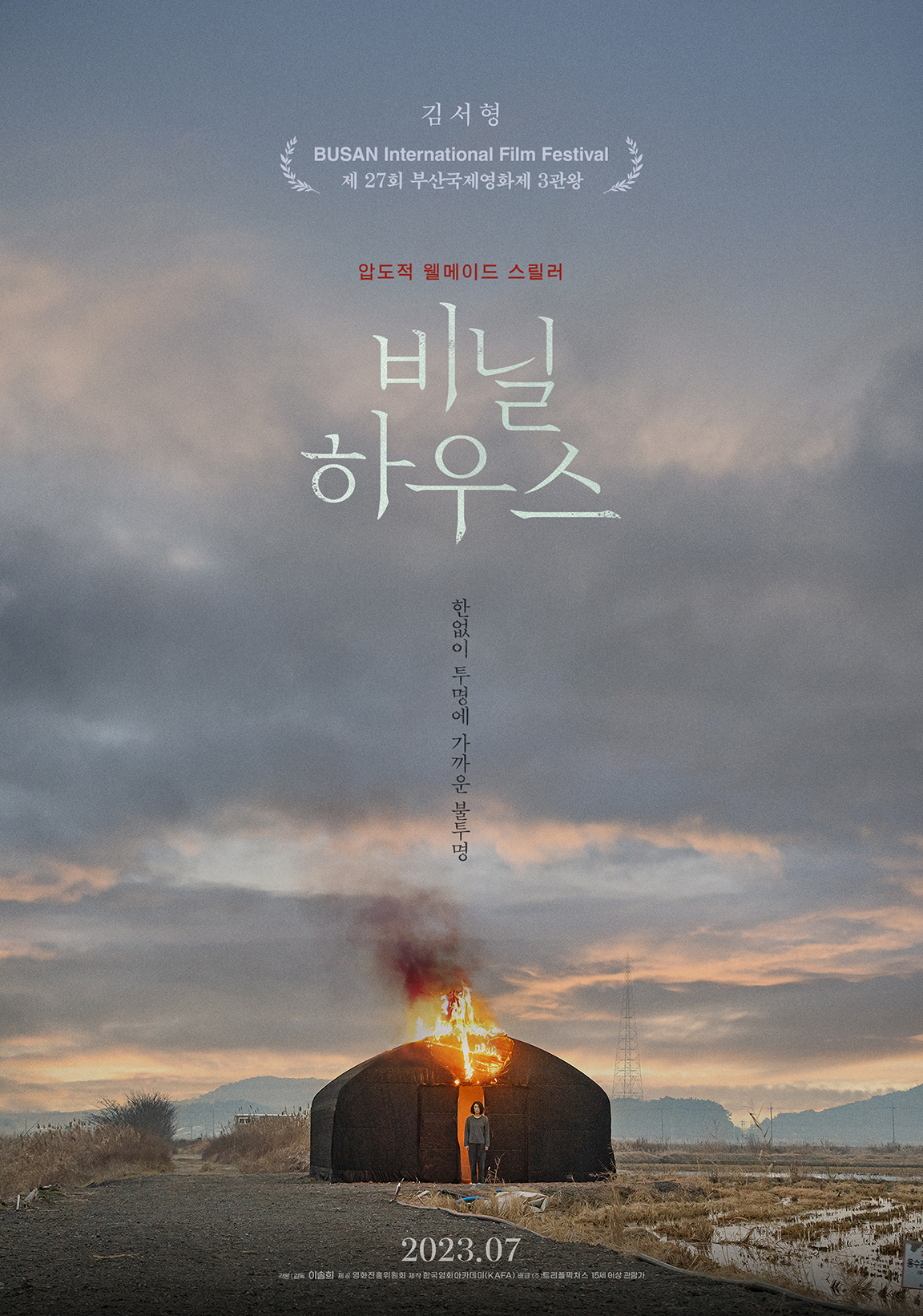
“Greenhouse” Poster
Whether it’s a stereotype or not, there can be a tendency to lump Korean indie features from debut directors together as being rather depressive affairs. Usually gritty character driven dramas centred around those on the bottom rungs of society and their daily struggles, the genre is an understandable go-to, able to be executed on a small to mid-budget while still being able to pack a powerful emotional punch.
Director Lee Sol-hui’s feature length debut Greenhouse shows all the classic signs of falling into similar genre territory. Opening with the image of a woman sat on the edge of her bed shot from behind, the first thing we’re witness to is her violently slapping herself repeatedly, immediately setting a somewhat harrowing tone. The woman is played by Kim Seo-hyung (The Villainess, The Berlin File), a character living on the fringes of society – both figuratively and literally, being that her homebase is an isolated greenhouse in the middle of a field.
We learn that Seo-hyung is a divorcee whose teenage son is incarcerated in a juvenile detention centre. Soon to be released, once he’s out she hopes they’ll be able to live together, rather than him going back to live with his uncle as he’d done before. With the clock ticking to find a place and ensure she has enough for the deposit, Seo-hyung has been saving up by working as a carer for an elderly couple. The wife, played by Shin Yun-sook (The Liar, A Blood Pledge), has advanced dementia and is convinced Seo-hyung has plans to kill her, subjecting her to spitting, hair pulling, and general misery whenever they interact. The husband, played by Yang Jae-sung (Devils Stay, Public Enemy), has lost his sight and has early onset Alzheimer’s, a diagnosis that sees him decide he should move both himself and his wife into a care home while he’s still of a sound mind. Of course, that also means Seo-hyung will lose her one source of income.
Things aren’t much better in the rest of her life, with her own mother, played by Won Mi-won (The Ugly, Officer Black Belt) suffering from cognitive issues while living a lonely life in a care facility, and her decision to join a community support group for other self-harmers puts her in the sights of a fellow attendee. Played by Ahn So-yo (Dust and Ashes, In Her Place), while initially friendly it soon becomes clear she’s also mentally fragile, attaching herself to Seo-hyung to the point of being a stalker and showing signs that hint at her being a compulsive liar. With a cast of characters who are all either suffering from debilitating health conditions or mild mental illness, the tone of Greenhouse is a familiar heavy one, however Sol-hui has a few tricks up her sleeve. Also responsible for both the script and the editing, when a character unexpectedly bites the dust in Seo-hyung’s presence, the narrative takes on a decidedly different tone.
While the greenhouse setting that the title lends itself to brings to mind the likes of Lee Chang-dong’s Burning and Kim Ki-duk’s Pieta, the far more comparative work would be Kim Seung-hun’s A Hard Day, in which Lee Sun-kyun attempts to hide the body of someone he accidentally kills. Whereas in that movie the cast of characters who the body risks being discovered by consist of law enforcement, here the script reveals an almost cruel streak of black of humor (meant in the most complimentary way!) as it becomes clear as to why Greenhouse is populated with such a cast of characters. A dead body combined with characters who are blind, have dementia, or who it’s impossible to trust anything that comes out of their mouth sets up an unlikely comedy of errors, as Seo-hyung plots and schemes to keep herself in steady employment.
What’s particularly admirable for a debut is that Sol-hui doesn’t let on at any point that we’re watching a black comedy, playing the ever escalating ‘everything that can go wrong will go wrong’ scenarios completely poker faced, which at times can feel a little disorientating. Greenhouse follows her short films The End of That Summer, Look-alike, and Anthill (which was her graduation work at the Korean Academy of Film Arts), and as a first full-length feature, she shows a strong grasp on how to build tension and a feeling of discomfort that lingers just under the surface. The tangible sense of desperation from the situation Seo-hyung finds herself in is offset by the increasingly absurd scenarios the plot unfolds across, sometimes throwing together a sense of unease and laugher in the same scene.
Set to a refreshing 100-minute runtime, the genre blending of social drama, crime thriller, and black comedy keeps Greenhouse engaging throughout, in part through never knowing which one you’re watching at any given time. A similar sense of the unknown is instilled though the information that Sol-hui keeps from the audience. The script never goes into how Seo-hyung came to be divorced and living in a greenhouse, nor do we get to find out why her son is incarcerated, leaving a sense of mystery around the characters past that works in the narratives favour. An audience doesn’t need to know every last detail about a character to understand them.
Sol-hui’s work as her own editor is also notable, both for being unusual for a director and scriptwriter to edit their own work, as well as her approach. Several scenes have a habit of cutting before revealing their conclusion (including the last scene), forcing the viewer to come to their own, while also serving to crank up the tension through what’s not seen. It’s a gamble that pays off, with a large contributing factor being the strength of the performances. Seo-hyung anchors even the more implausible moments with a level of authenticity, ensuring we’re never pulled out of what’s happening onscreen, however the MVP of the cast belongs to Yang Jae-sung as one half of the elderly couple. Imbuing his character with a likeably warm demeanour, combined with an awareness of what’s to come with his Alzheimer’s diagnosis, his performance feels the most relatable, only wanting the best for those around him.
With that being said there are some issues with Sol-hui’s debut. There’s a sub-plot that involves Seo-hyung’s relationship with her former doctor, played by Nam Yeon-woo (Champion, Jazzy Misfits), who she’s been sleeping with that feels undercooked. There’s an implication that Yeon-woo has a tendency to take advantage of his patients, however it never really goes anywhere, and as a result ends up feeling superfluous to the main plot. Similarly once Seo-hyung’s son is released, an important scene with his friends plays out somewhat stilted, lacking the realism of the scenes that surround it.
How forgiving audiences will be to the change in tone will likely also vary, with the undeniable fact being that many of the predicaments that unfold rely on coincidences and suspension of disbelief, the same of which could be said for many genre outings. Much like Park Chan-wook’s recent No Other Choice, the difference will be down to those who continue to watch Greenhouse as a slice of life drama about the downtrodden, and those that are able to tune into its admittedly blacker than black comedy leanings.
For the latter, the rewards are great, with Greenhouse marking the arrival of a bright new creative talent in the form of Lee Sol-hui. Displaying the kind of genre blending talent that put 21st century Korean cinema on the map back in the early 2000’s, what starts off feeling like a psychological drama about the fragile connections that hold families together, gradually turns into something very different, and it’s all the better for it. Up there with the likes of End of Animal and The Fifth Thoracic Vertebrae as indie debuts that prove a big budget isn’t a necessity to producing an entertainingly original piece of work, I for one will be eagerly awaiting to see what Sol-hui does next.
Paul Bramhall’s Rating: 7.5/10