


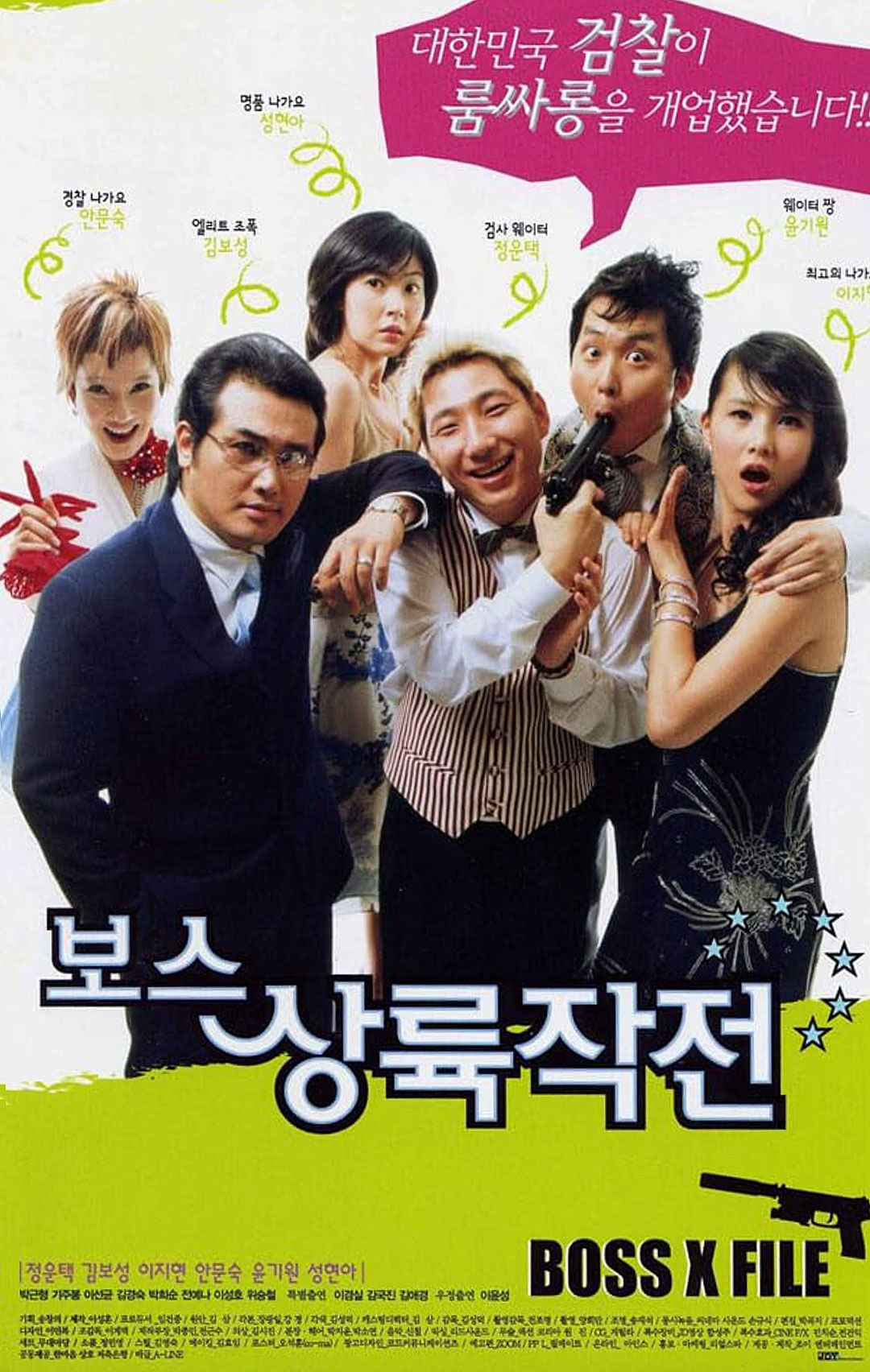
“Boss X File” Poster
Director: Kim Sung-duk
Cast: Jeong Woon-Taek, Kim Bo-Sung, Lee Ji-Hyun, Ahn Moon-Sook, Sung Hyun-Ah, Ki Joo-Bong, Jo Sang-Geon, Lee Yoon-Sung, Park Geun-Hyung, Kim Kuk-Jin
Running Time: 108 min.
By Paul Bramhall
I confess that Boss X File would have been one of the many comedies that Korea churned out during the early to mid-2000’s that would never have landed on my radar, had it not been for an interview that I did with Won Jin in 2015. The same Won Jin who appeared in Hong Kong classics like Operation Scorpio and Women on the Run, I was particularly curious about his work in the Korean film industry post the success he found in Hong Kong through his amazing kicking ability. During the discussion he revealed that he’d spent most of the early to mid-2000’s working as a fight choreographer behind the camera, bringing up the work he’d done on the likes of familiar titles like 2001’s My Wife Is a Gangster and 2003’s Sword In the Moon. A title I wasn’t familiar with though was 2002’s Boss X File, so when the opportunity arose recently to check it out, it was a no brainer.
I’ve always found Korean movies from that small window of 2000 to 2002 to have their own unique feel. It was 1999’s Shiri that put Korean cinema on the map internationally, but arguably it wasn’t until 2003 that the floodgates opened, thanks to the release of movies like Oldboy, Memories of Murder, A Tale of Two Sisters, Save the Green Planet, and Spring, Summer, Fall, Winter…and Spring. I struggle to think of any film industry that’s able to rival Korea’s output in 2003 for Bonafide masterpieces. It also marked a turning point where the film industry began to take itself more seriously, and the kind of light-hearted comedic outings that were popular during the early 2000’s like A Bizarre Love Triangle and Fun Movie became less prominent.
Boss X File falls squarely into that small window, a production that still feels like it has one foot firmly entrenched in the Hong Kong influenced style of the 1990’s (which it wasn’t alone in, with 2002 also being the same year director Jang Sun-woo brough Ridley Tsui onboard to choreograph the action in Resurrection of the Little Match Girl). The directorial debut of Kim Sung-duk, he’d follow Boss X File with his sophomore feature Silver Knife in 2003, direct the TV movie Family Love in 2005, and then disappear from the film industry all together. Perhaps a victim of the rapidly changing times the film industry was going through, there’s no doubt that Sung-duk’s style is more a continuation of the 1990’s style of Korean filmmaking than that of a fresh new voice, so perhaps he found himself out of touch before his career had even started. This is all purely speculation on my part though.
It’s a shame, as in many ways Boss X File feels like a precursor to the successful 2019 action-comedy Extreme Job, which saw a drug squad set up their own chicken shop in order to take down a gang they’ve been tracking. Sung-duk’s debut has the same principle, however instead of a chicken shop, it sees a prosecutor and a team of cops set up a room salon hostess bar in order to catch a mob boss exerting his influence to get a corrupt politician into congress. While the latter certainly isn’t particularly new ground in Korean cinema, the concept of law enforcement going undercover to run a hostess bar is one that’s rife for comedic shenanigans, and in that regard it certainly doesn’t disappoint.
Essentially an ensemble piece, the cast paints an interesting snapshot of established names from the 1990’s, with several small roles populated by names who’d become headlining stars towards the latter end of the 2000’s and beyond. The closest to a lead role goes to a prosecutor played by Jung Woon-taek (Friend, My Boss, My Hero), who swaps out his suit and clean cut image to become a bleach blonde haired barman, with the mob boss in question played by Kim Bo-sung (Two Cops 2, White Badge). The plan to lure Bo-sung to the new hostess bar, appropriately named ‘Boss’, is reliant on them bringing onboard his favorite hostess, played by Lee Ji-hyun (To Sir, With Love, La Belle). However complications ensue when Woon-taek and Ji-hyun begin to develop feelings for each other, putting a spanner in the works that risks the whole operation.
Amongst the cast is a young Park Hee-soon (No Other Choice, Revenger) playing the righthand man to Bo-sung’s gangster, as well as the late Lee Sun-kyun (Parasite, The Land of Happiness) as one of the non-undercover waiters who works at the bar. For both actors Boss X File represents their sophomore appearance on the big screen, giving a glimpse into their talents that would come to fruition in the 2010’s. First and foremost though Boss X File belongs to the ladies, with most of the comedy derived from the various escapes that take place in the bar. There’s the steely eyed superintendent who steps into the role of the madame played by Kim Gyeong-suk (That Last Winter), a colleague played by Ahn Moon-sook (Age of Youth) who comes from a strict religious upbringing, and the charming Sung Hyun-ah (Cello) who quite literally floats across the room.
Director Sung-duk imbues the narrative with an episodic feel, lurching from comedic nonsense, to fight scenes, to the occasional dialogue scene whenever the plot needs to be nudged along. Those coming to a Korean production expecting a certain level of polish will definitely find themselves in the wrong place, however there’s an undeniable energy to the proceedings that keeps things fun. Whenever the action does hit it’s a welcome highlight, with Won Jin’s choreography owing a debt to the kind of DTV taekwondo actioners that populated the 90’s. Somewhere in the 2000’s Korea found its own distinctive 21st century flavour when it came to action, mastering the art of messy group brawls populated by steel pipes and hammers, however here the action beats still carry over the 90’s aesthetic. Namely, a stylised Hong Kong influence combined with plenty of kicking.
Kim Bo-sung gets to do most of the heavy lifting on the action front, which is unsurprising considering by 2002 he’s become a DTV action regular in the likes of the 2nd and 3rd Rules of a Gangster sequels, and Won Jin’s choreography serves him well. Like many Korean action sequences involving fists and feet, the beatdowns are of a one versus many variety as opposed to one on one, but there’s a rhythm to the action that sees Bo-sung in constant motion, conveying a sense of impact through every punch and kick. He even gets his own Fist of Fury moment (you’ll know it when you see it!).
Seemingly aware of the level of action talent he’d brought onboard, Sung-duk ensures they get enough opportunities to flex their muscles, usually finding ways to incorporate an element of comedy into the beatdowns (the perfect example being when Bo-sung and his crew rip through a small army of assailants, only to get to their target and realise it’s the wrong person, almost as if to say “we just needed one more action scene, and this is the best excuse we could come up with.”). While I’d never say to go into Boss X File as an action movie, what’s there is of a high quality, and balanced with the zaniness of the comedy, the 105 minute runtime has a livewire energy to it that’s maintained to the end credits.
Despite the zany nature of Boss X File, it was in fact inspired by a real life political scandal (the kind that Korea is no stranger to), with the way the hostess bar is intended to launder money for political purposes being a poke at the way the National Tax Office had allegedly helped to collect illegal campaign funds in 1997. Ironically (or perhaps not?), when wiretapped conversations from the same scandal were released to the media in 2005, 3 years after the release of Boss X File, the illegally made tapes became known as ‘The X-file scandal’ – quite possibly taking its name from the movie (but, for the 2nd time in one review, I’ll state that’s just speculation on my part!). Whatever the case, for a welcome dose of early 2000’s Korean comedy with a healthy sprinkling of action beats, Boss X File is an easy recommendation.
Paul Bramhall’s Rating: 7/10