

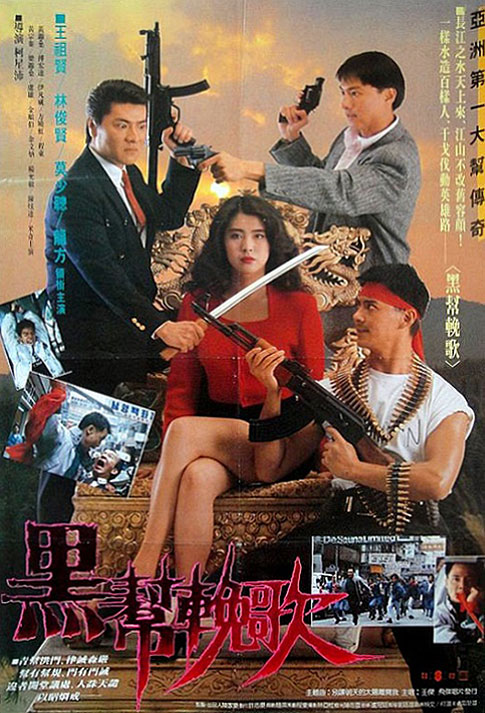
“An Eye for an Eye” Poster
Director: O Sing-Pui
Cast: Joey Wong Cho-Yin, Max Mok Siu-Chung, Wilson Lam Jun-Yin, Lung Fong, John Ching Tung, Ricky Yi Fan-Wai, Leung Gam-San, Melvin Wong Gam-San
Running Time: 90/93 min.
By Paul Bramhall
For fans of Hong Kong cinemas golden age 1990’s An Eye for an Eye makes for an enticing prospect on paper – Joey Wong (The Beheaded 1000, God of Gamblers) steps into the role of a triad boss when her father is imprisoned, leaving her to take on fractured loyalties within her own organisation, as well as increasing scrutiny from the law. Considering the year it was made, those unfamiliar can be forgiven for expecting to find an overlooked entry in the Girls with Guns genre, but alas, as enticing as the thought of Joey Wong letting loose with some heavy artillery may be, the reality is far different.
By 1990 Wong’s onscreen persona as the most beautiful ghost in Asian cinema was well established following her turn in 1987’s A Chinese Ghost Story, however it wasn’t until 1989’s Reincarnation of the Golden Lotus that she got her first real starring role in a Hong Kong production. A surprisingly downbeat affair that, perhaps in an attempt to prove she could do more than look ethereal or be limited to supporting roles, sees her raped, beaten and degraded over the course of 90 minutes. I mention this because An Eye for an Eye is essentially her sophomore outing as a lead, and director O Sing-Pui (Easy Money, My Flying Wife) opts for exactly the same approach (which he wasn’t alone in, since Thomas Yip also subjected her to the same treatment in 1991’s An Eternal Combat).
While Wong believes her father had gone straight and was running a legitimate shipping company, once she starts reviewing the books she’s surprised to find a number of mahjong parlours, casinos, and saunas on the payroll. Not that she really should be, considering it was her own police captain boyfriend, played by Wilson Lam (Magic Cop, Ghost for Sale), that arrested him right in front of her on suspicion of being involved in illegal activity. Her father’s righthand man Lung Fong (Casino Raiders, The Big Score) explains the businesses keep her father’s former triad “uncles” in gainful employment, but the headstrong Wong refuses to have any of it, insisting they should find legitimate businesses to be involved in. As expected, things don’t turn out to be quite that simple, and soon the challenges that Wong has to face begin to stack up until they result in dire consequences for all.
Every reviewer has their biases, and for myself I tend to be particularly forgiving to Hong Kong cinema from the 80’s and early 90’s, purely because it was this era of the territories output that got me into Asian cinema in the first place, so the look and feel always evokes a certain sense of nostalgia. However I have to confess that the unruly narrative structure of An Eye for an Eye tested that nostalgia to its limit, with an overly cluttered plot and numerous implausible character decisions making stretches of the runtime a rather grating experience to sit through. The biggest contributor to the productions issues (apart from Lam’s flaccid screen presence as Wong’s boyfriend) is Max Mok (Night Lift Hero, Fire Dragon), who seems determined to win the Most Unlikeable Character of 1990 award.
Also playing a cop, together with the co-worker he’s dating (played by Angela Fong – Inspector Pink Dragon, On Parole) the 2 couples usually hang out together as a foursome, acting all happy in the kind of scenes you just know are going to be used as “flashbacks to a happier time” inserts later on. The issue is Mok seems to hold a deep resentment for his so-called girlfriend, spending most of his time verbally abusing her, or throwing the soup she dutifully makes for him every day across the room. Even Lam points out to that he treats her “like a dog.” Why could this be? Of course, it’s because secretly he’s always loved Wong, so much so that he keeps a picture of her in his wallet, which is just as creepy as it sounds.
A disproportionate amount of time is spent on Mok and his somewhat abusive, supposedly tortured love life, to the point that we even get a montage about it set to him singing a Dave Wong Kit power ballad alone in a karaoke room. Is any of this really cohesive to a compelling plot? No. The fact is, and maybe this was the whole point, almost every decision a character makes in An Eye for an Eye results in some negative impact for Wong. Her boyfriend stops talking to her since he gets internally transferred to another department due to dating a triad boss. The foursome’s friendship gets destroyed since Mok is basically a complete douche. Oh, and Lung Fong turns out to not be so loyal after all (not a surprise, considering he was practically the go-to bad guy for late 80’s/early 90’s triad potboilers), so ends up raping her and then forcing her to be his live-in partner who he beats and (continues to) rape every night.
Those hoping to see any level of female empowerment (even if it’s not of the Girls with Guns variety) from a plot that involves a triad bosses daughter taking over the business will have to look elsewhere (I’d recommend start with The Godfather’s Daughter Mafia Blues), which feels like a missed opportunity. Wong is arguably the main character, however she spends the majority of the runtime as a victim, a lot of it related to sexual violence. In addition to raping her Fong also records it, using it as blackmail to keep her in check (despite showing the footage to the triad “uncles”, who all seem to get a kick out of it), and when she does get a break from his advances, it’s to be forced to watch him have sex with a prostitute. Sing-Pui goes so far as to have the plot not even allow her to sleep in peace, when after one of the uncles takes her side, she wakes up in the middle of the night to find his blood covered corpse next to her in the bed!
What’s left is a tale of triad infighting, as Fong becomes increasingly ambitious, which combined with a ruthless streak to get rid of whoever is in his way, quickly sees the body count start to rise. While An Eye for an Eye is more triad potboiler than action movie, it’s interesting to note that the movie was cut in various places for its Hong Kong release due to the excessive violence (and also for a scene in which the police attend an Anti-Triad Society Course, which goes into detail on triad hand gestures, a no-go even back in 1990). The 2021 Hong Kong Blu-ray from Mei Ah maintains these cuts, however thankfully the 2024 Blu-ray from Vinegar Syndrome is fully uncut.
The violence comes to the fore in the finale (ironically of which Wong has nothing to do with), as two triad factions clash in a restaurant that eventually spills out onto the street, lasting for several minutes and containing a joyously ridiculous amount of machete hacking and slashing. Regular action choreographer collaborators Benz Kong and Poon Kin-Kwan (Black Cat, Nobody’s Hero) get to fully let loose in this sequence, leaning towards a desperate and scrappy feel with fake blood used liberally. One particularly memorable visual comes when a lackey is slashed with a machete next to a blown fire hydrant, with a slow-motion shot showing the blood mixed in with the water spraying from the hydrant. Whenever slow motion is used in similar HK action cinema of the era you can normally feel the John Woo influence, however here it felt refreshingly original, capturing a kind of macabre beauty amongst the bloody chaos.
It’s a strong finish, however if it does enough to make everything that comes prior worth sitting through will depend. Would I feel differently about An Eye for an Eye if I’d known that Joey Wong is basically there to have her life made miserable and be a helpless victim? I’m confident I’d feel exactly the same, since its issues go far beyond the treatment of her character, with an unfocused narrative, misplaced misogyny, and poorly developed characters being just as problematic. Still, in the closing scene Max Mok throws his hat in the ring for one more award, with a nomination for Coolest Looking Character in a Vegetative State category. For those debating about checking it out, hopefully that could be the deciding factor.
Paul Bramhall’s Rating: 5/10




Sadly, Joey Wong getting horribly abused in this film and the others must have been a selling point back in the day, and the raincoat crowd must have loved watching that. It must really have been shitty for Wong to be put in a position of either making a living as an actor or not.