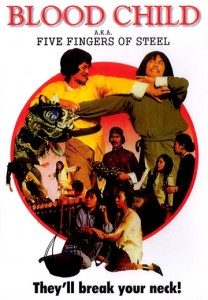
“Blood Child” DVD Cover
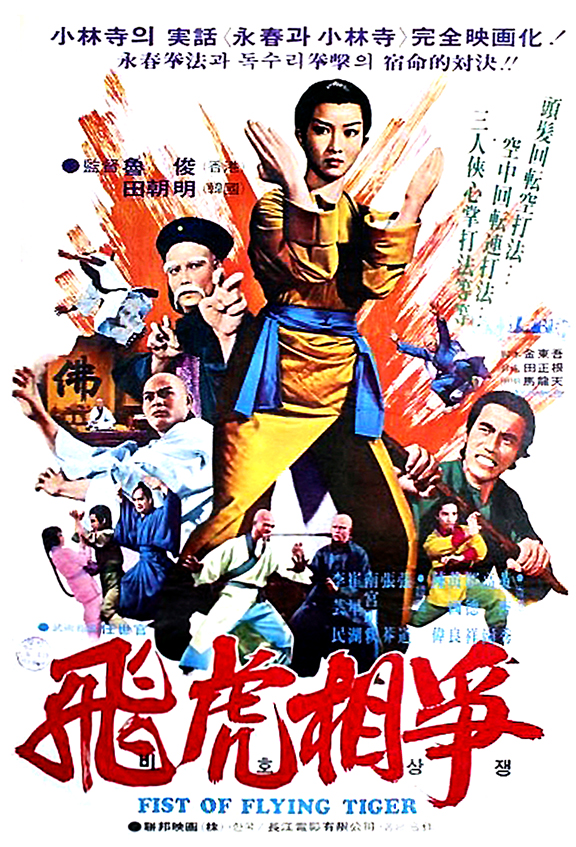
AKA: 5 Fingers of Steel
Director: Vincent Leung
Cast: Hwang Jang Lee, Yen Shi Kwan, Kwan Yung Moon, Lee Yi Yi, Yuen Mao, Chu Tiet Wo, Chan Lau
Running Time: 87 min.
By Paul Bramhall
While Blood Child without doubt belongs in the category of being an old-school kung fu movie, there’s also a few elements to it that undeniably set it apart from being just another cookie cutter fight fest. A pre-credit sequence opens with the scene of a mother, played by Lee Yi-Yi, sat on the doorstep of a dwelling as she cradles her new born baby. It’s immediately apparent that somethings wrong, and when a passer-by enquires as to if she’s ok, her lack of response and glazed expression prompt him to check on the wellbeing of the child, only to discover that it’s been stabbed to death.
After the credits finish, proceedings open a year earlier, as we learn how events transpire to lead to such a traumatic opening. The dark tone set by such a gruesome early reveal makes Blood Child engaging from the beginning, a rare feat in the old-school kung fu genre, as we’re invested in how Lee Yi-Yi came to be incoherently sat there, cradling a murdered baby in her arms. The movie was directed by Vincent Leung, his first and last time in the director’s chair. Leung worked mainly as an editor, with over 160 productions to his name from the mid-60’s, all the way through to the millennium. However while he’d also direct the 1994 Jet Li documentary, Shaolin Kung Fu, he never returned to directing feature length productions outside of Blood Child.
It’s a shame, as he gathered an enviable group of kung fu talent to appear onscreen together. Yuen Miu and Yen Shi Kwan play brothers, with Miu set to marry Yi-Yi. Yuen Miu is probably the least known of the ‘Seven Little Fortunes’, the same Peking Opera School troupe that the likes of Jackie Chan, Sammo Hung, and Yuen Biao were a part of. He worked mainly as a choreographer and stuntman, so Blood Child provides a rare opportunity of witnessing him performing his own choreography in a lead role. Shi Kwan is one of the most familiar faces of kung fu cinema, featuring in everything from The Master Strikes to Iron Monkey, and his name is usually a guarantee of kung fu goodness. Interestingly this wouldn’t be the last time that Miu and Shi Kwan would work together, as they’d also collaborate over 10 years later on Yuen Biao’s Kick Boxer.
Their father, played by Chu Tiet Wo, has recently opened a courier business, and takes on a job to escort a shipment of gold. If there was ever a sign of foreboding disaster in the old-school kung fu genre, it’s usually when the good guys agree to escorting a priceless item, on a route which is guaranteed to involve an ambush in a forest. This is of course, exactly what happens, it would be a crime if it didn’t. After Golden Harvest producer Ng See Yuen’s frequent visits to Korea in the 70’s, by the time the 80’s came around it was pretty much a guarantee that, if a kung fu movie needed some high calibre kicking action, it was likely to be delivered from the boot of a Korean. Blood Child provides us with one of Korea’s finest, with the bad guy role going to Kwan Yung-moon.
Yung-moon was particularly busy in 1982, with his role in Blood Child being one of six productions that he’d feature in, including the likes of such classics as Ninja in the Dragons Den and Dragon Lord. Yung-moon isn’t the only Korean import in ‘Blood Child’ though. After laying waste to the couriers, a fight against Miu ends up in Yung-moon kicking him off the top of a cliff. This being a kung fu movie of course, being kicked off the top of a cliff doesn’t guarantee certain death. Events transpire that see Miu being discovered and nursed back to health by a kung fu master, living a solitary existence in the forest. The master is played by Hwang Jang Lee, perhaps the most famous of all the boot masters who populated the golden age of kung fu cinema. Like Yung-moon, Hwang was exceptionally busy in the early 80’s. Between 1980 – 1982 alone he featured in 21 productions, ranging from Bruceploitation flicks, Shaw Brothers productions, local Korean movies, and even making his directorial debut.
While Yung-moon and Hwang don’t actually make their appearances until the 30 minute mark, the calibre of kung fu talent involved ensures that even those clocking in purely for their presence won’t be left wanting. While Hwang is also credited as an action choreographer, he actually only has a single fight scene (more on that later), so it’s a safe assumption to say that most of the fight action was handled by Miu. There’s an instantly recognizable feel to the choreography, which tends to be the case with any action that’s provided courtesy of a Yuen clan member, in that the moment the first fight breaks out, the speed and intricacy of the movements are a joy to watch. In a pre-wedding celebration, Miu, Shi Kwan, and Tiet Wo end up facing off against a group of lackeys led by Lau Hok Nin and Lin Ke Ming. The fight constantly segues between one-on-one exchanges to one-on-multiple opponent showdowns, and the fluidity combined with the amount of chorography taking place onscreen at the same time is a reminder of just how special this era was.
When Yung-moon does appear, his presence isn’t wasted, with plenty of his ferocious kicks being dished out to whoever is unfortunate enough to be in the way of them. What I particularly liked about the fight scenes that Yung-moon features in, is that the moment his adversary manages to get one kick or punch in against him, he manages to look genuinely enraged. Sure nobody is here for these guys acting talent, but small touches like a change in facial expression during a fight scene, only go to prove just how much of a high level performers like Yung-moon were operating at. He also makes a suitably hateful villain of the piece, and mid-way through viciously rapes Lee Yi-Yi in a prison cell, resulting in her becoming pregnant with his child.
During these scenes Blood Child takes on a suitably darker tone, as learning that Yi-Yi is carrying his child, she’s kept prisoner in Yung-moon’s property, during which she’s constantly beaten by the housekeeper and attempts suicide. When she finally gives birth, events take a turn that almost send the movie into horror territory, as Yung-moon forcibly takes the baby from her, and realises she’s given birth to a deformed monstrosity. Sent into a murderous rage, we learn how Yi-Yi came to be sat outside the house at the beginning of the movie. However her misery is far from over, as Yung-moon and his weasel like assistant, effectively played by Chan Lau, arrange for her to be framed for the murder of her own child.
These scenes play out in stark contrast to those with Hwang Jang Lee, who we learn also has a vendetta against Yung-moon for some misdemeanour he did in the past. Hwang is amusingly introduced into the plot via a scene which suddenly cuts away to him running full speed towards the camera, before he launches into a flying kick against a fully grown tree, one which sends it toppling to the ground. In fact all of Hwang’s scenes have him either kicking trees, or thrusting his fingers through hanging coconuts (this scene is likely what provided the movie with its English title, Five Fingers of Steel, although technically it should be ten). It’s worth noting that the coconut setup is constructed exactly the same as John Liu’s bottle kicking training in Secret Rivals, so I couldn’t help but feel what a waste of Hwang’s kicking talents it is to have all these hanging coconuts, but for him to only poke them with his fingers. Thankfully though he does eventually unleash his kicks, so for those that wants to see some Hwang vs coconut action, you’re in the right place.
Eventually events culminate that see Miu and Shi Kwan team up to take on Yung-moon, who’s constructed an elevated wooden platform in the middle of a field, seemingly for no other reason than to have Lee Yi-Yi tied to a pole in the middle of it. As expected, the pair take a complete licking on the receiving end of Yung-moon’s kicks, until that is, Hwang Jang Lee makes a late in the day entrance into the fray. Blood Child can be considered unique in the way that, especially during this era, Hwang had a habit of suddenly showing up in final scenes as the bad guy, so to see a movie in which he suddenly shows up as the good guy is a rarity. This briefly results in a three way team up with Miu, Shi Kwan, and Hwang taking on Yung-moon, but it quickly becomes a Yung-moon vs Hwang showdown.
What’s surprising, is that the face-off between a pair of revered Korean boot-masters somehow doesn’t feel as epic as it should. For a start, once they’re left to face off against each other, the scene repeatedly cuts away to Miu and Shi Kwan attempting to untie Yi-Yi from the platform, while being hindered by Chan Lau attempting to stop them. The sound effects of the fight frustratingly play on in the background, but you can’t see it! However even during the fight itself, Hwang mostly utilises the Eagle Claw technique, choosing to scratch Yung-moon to death rather than kick him. Don’t get me wrong, the fight has plenty of kicks, but they’re often framed as stand-alone cut-away scenes, rather than part of the flowing choreography in one of their exchanges. Considering what both Hwang and Yung-moon are capable of, it would have been great to see them really go to town on each other with their boot work, but for some reason it just doesn’t happen that way.
That said, Blood Child really belongs to Miu, Shi Kwan, and Yung-moon, and despite the minor let down of the final fight, there’s enough action crammed into the rest of the runtime to satisfy those looking for some shapes based goodness. To see the least well known member of the ‘Seven Little Fortunes’ onscreen in a lead role is more than enough to recommend a viewing, and for everyone else, you have Hwang Jang Lee kicking coconuts.
Paul Bramhall’s Rating: 7/10













1 Comment