
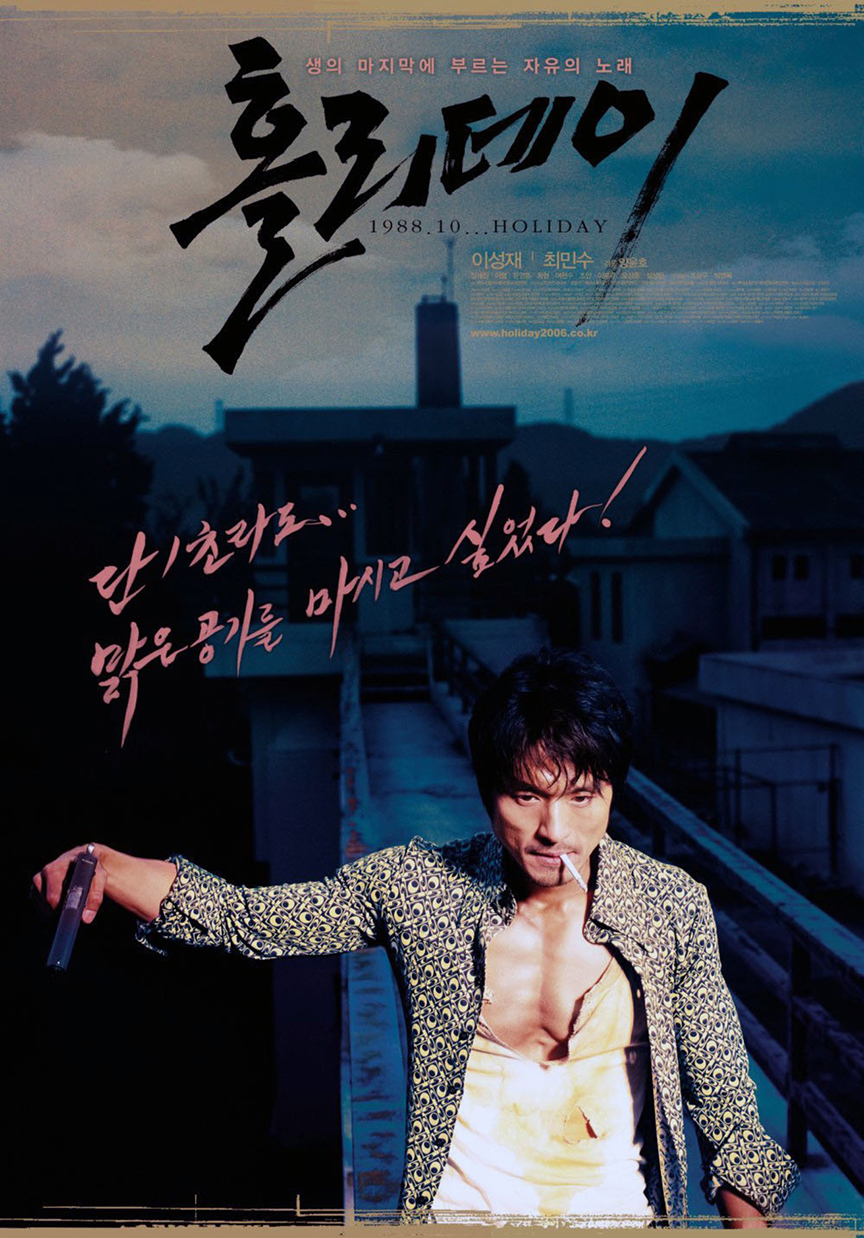
“Holiday” Poster
Onscreen text during the final moments of Holiday states “This film is for the victims of the Preventative Custody Policy”. A policy which was only abolished in September 2005, just 4 months before Holiday hit the cinema in January 2006, it was used to unfairly extend prison sentences under the guise that it would prevent the prisoner in question from going back to a life of crime. In reality it was mainly used on prisoners who were already on the bottom rungs of society, and whose crimes may not have been any more than petty theft. Tensions came to the fore during the 1988 Seoul Olympics, when it was enforced to keep the less advantaged behind bars for longer (the idea being it was best to keep them out of sight from the global visitors), while more well-connected prisoners who’d done far worse walked free with shorter sentences.
Holiday tells the true story of a group of prisoners who, in October 1988, escaped while being transferred between prisons, enraged at the fact they were going to continue to be behind bars simply for being poor. It was a wise move by director Yang Yoon-ho, as nothing gets Koreans into the cinema like the story of the everyman suffering at the hands of the rich elite, and as a filmmaker he was coming off a post-2000 hot streak of helming 2000’s Libera Me and 2004’s Fighter in the Wind. It was perhaps his previous production which gave him a taste for adapting from real life events, with Fighter in the Wind chronicling the life of Kyokushin karate founder Masutatsu Oyama. Here he casts Lee Sung-jae (Carter, Daisy) as a resident of a slum village due to be demolished, the reason down to the fact it’s visible on the journey from the airport to the Olympic village, and the government are keen to portray a South Korea that’s prospering.
In the opening scene Sung-jae and his crippled friend from childhood become involved in a protest, triggered by representatives from the government turning up at the shanty town with bulldozers. True to what actually happened at the time (reflecting one of Korea’s darker historical periods), the authorities enlisted gangsters to round up the thugs who report up to them, their orders being to put the beatdown on anyone who resists, regardless of its men, women, or children. Overseen by an official played by Choi Min-soo (Seoul, Sword in the Moon), when Sung-jae’s friend takes one of the government representative’s hostage, Min-soo shoots him in the head, killing him on the spot. Enraged, Sung-jae finds himself carted off to prison where he loses all hope, however he finds a reason to live again when Min-soo is transferred into the role of warden for the same prison – making it his mission to seek revenge for his murdered friend.
Holiday opens with the caveat that “This film has been reconstructed with fictional elements based on actual characters and a true story”, and it’s just as well, as in reality I suspect Ji Kang-hun (who Sung-jae’s character is based on) didn’t spend his time in prison going up against a cartoon inspired villain. Quite what Min-soo is going for in his portrayal of the prison warden is difficult to pin down, with a gold rimmed tooth, early prototype of a man-bun, and an exaggerated accent that sees every line spoken through a scowl. There are at least 3 instances of him spouting villainous threats that are framed by him walking ever closer to the camera, which result in the scenes ending with his face completely filling the frame. It’s absurdly amusing, however I don’t think it’s supposed to be, since the entire narrative surrounding his performance is played straight.
The gritty prison setting allows us to get to know the group who we come to spend the 2nd half with once they escape the prison walls. There’s the grizzled cell leader played by Lee Eol (The 8th Night, Waikiki Brothers), the youthful Yeo Hyung-soon (To Sir, With Love, The Strangers), the loyal Kim Dong-hyeon (Deep Trap, The Silenced), the towering Jang Se-jin (Ghost in Love, My Wife is a Gangster), and dwarf Moon Young-dong (The Night of the Undead, The Truth Beneath). Pushed to their limits by the harsh conditions Min-soo inflicts on them, together they hatch a plan to escape, and once they successfully pull it off we spend the rest of Holiday watching the walls slowly close in on them as the authorities get ever closer.
The prison escape unfortunately also sees Holiday go completely off the rails, as director Yoon-ho can’t seem to keep a grasp on the histrionics meter, turning it up to 11 far too early and seemingly forgetting (or simply refusing to consider) that sometimes it’s best to tone it back down. Our six escapees spend most of the last hour swimming in a mix of their own blood, sweat, tears, saliva, and mucus while yelling about the injustices of the world, a surprising amount of which takes place in the homes they’ve invaded as a place to stay, their hostages quickly accepting that their fundamentally good guys. It’s also during one such scenario that Holiday takes a disastrous misstep, one that I personally found it difficult to recover from.
Inside Se-jin had a habit of making baby figurines in the glass blowing factory they work in, a reflection of his desire to become a father (although admittedly a somewhat creepy one) once he gets out and reunites with his girlfriend. Unfortunately when he turns up at her door, he discovers she’s found someone else, and not only that, has bore a child with her new man. Understandably devastated, he returns to the house they’ve shacked up in for the night. Less understandably, while everyone else is sleeping he sneaks into the actual residents of the house bedroom and attempts to rape her. Thankfully Sung-jae stops him before it goes too far, but the aftermath of the scene takes a bizarre turn when we’re asked to sympathise with Se-jin, who in one of many histrionic fuelled scenes confesses that he only wanted to rape “that bitch” so he could become a father. Quite what anyone was thinking is unfathomable, and it leaves a bad taste.
By the time the final four end up holed up in another house they’ve invaded (and of whom the residents of course quickly realise what an affable group of fellows they are – this time even cooking dinner for them!), a more fitting title would be Men Crying – The Movie. Perhaps that title would also spare us from the constant orchestral swelling of The Bee Gees Holiday that the movie takes its actual title from, a reference to how in reality Ji Kang-hun requested a cassette of the trios 1967 hit during their final stand. Ironically this is the 2nd Korean production to use the song, with the first being the 1999 classic Nowhere to Hide, of which it plays over the iconic rain drenched opening scene.
Sung-jae does get to recreate the line Kang-hun became remembered for, when as the house was surrounded by police and news crews broadcast the siege live, he appeared at a window and yelled “You’re innocent if you have money! You’re guilty if you have no money!” Unfortunately by the time it’s delivered most will be suffering from over-emoting fatigue, robbing the scene of its impact, and exasperated by the way its shot in a shaky cam style that doesn’t do it any favours. It’s a shame, as there’s clearly a powerful movie in Holiday somewhere, one which feels like it would have had a better chance of being fully realised if a more measured approach was taken. As it is, Yoon-ho increasingly opts for “the more bodily fluids you can have streaming down your face the better” approach, and it ends up being to the detriment of the audience connecting to what’s onscreen.
Despite the overdone dramatics, Lee Sung-jae’s performance keeps Holiday from being a total write off, with director Yoon-ho seemingly on a mission to find as many opportunities as possible for him to be topless (when you see his six pack, you’ll understand why). There’s definitely a drinking game in there somewhere. As it is though, Holiday wants to be a gritty prison flick, a true-life retelling, and a rousing ode to the injustices of Korean society all at once, but instead ends up being a cautionary tale in what happens when the entire cast is forced to overact as if their lives depended on it.
Paul Bramhall’s Rating: 5/10