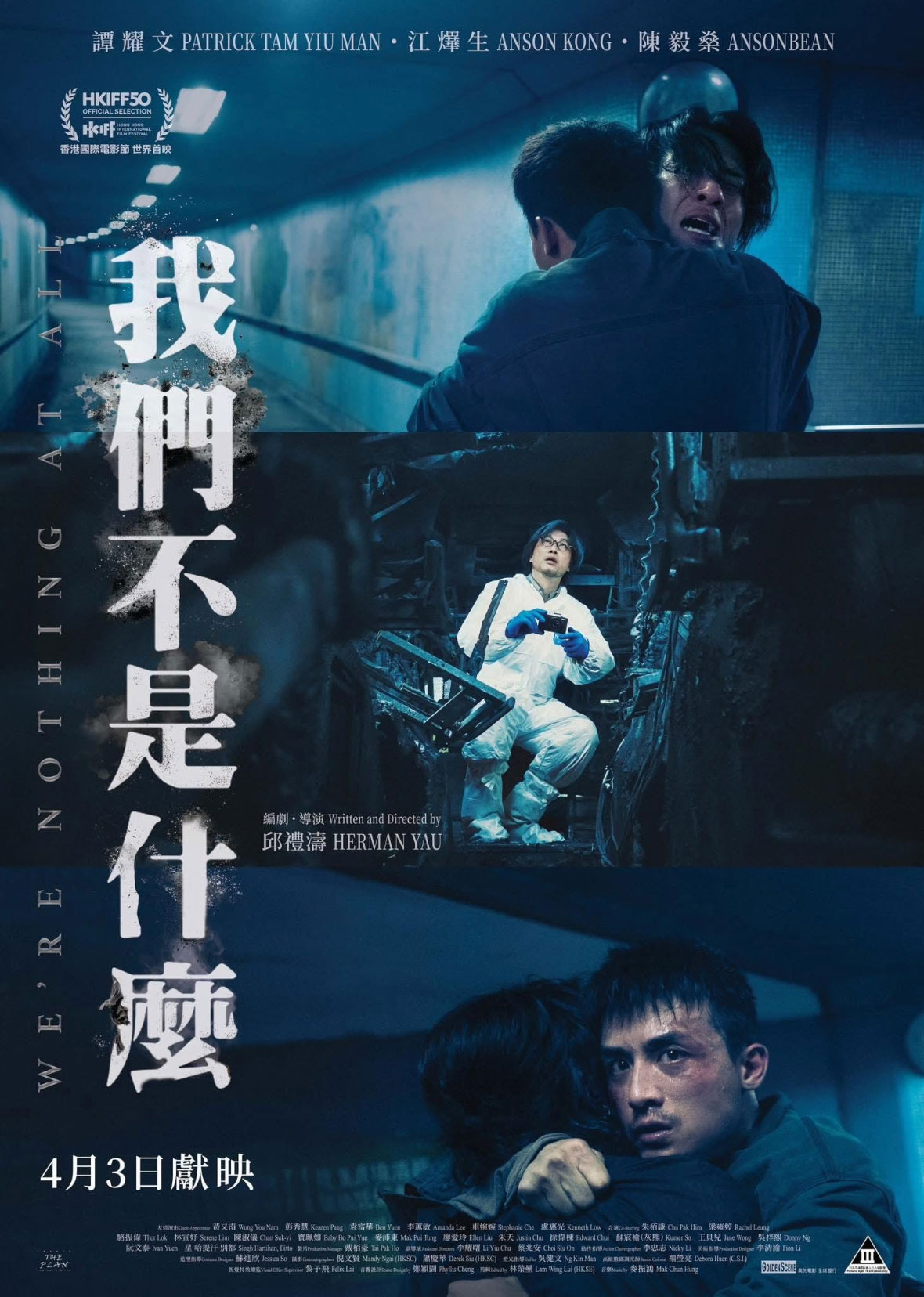
“We’re Nothing at All” Poster
There was a time in the late 2000’s when it appeared director Herman Yau had made the shift from Category III shock master to gritty social drama filmmaker, with the likes of 2007’s Whispers and Moans and 2008’s True Women for Sale set in the world of Hong Kong’s less advantaged parts of society. However in retrospect, the subsequent years would reveal Yau to be a creative force who was difficult to pin down. The early 2010’s saw him jump on the kung-fu band wagon, which included both a young Ip Man biopic (The Legend is Born: Ip Man) and an old Ip Man biopic (Ip Man: The Final Fight), while the mid-2010’s saw him return to Cat III shocker territory with Nessun Dorma and The Sleep Curse. For the past 10 years though, the Herman Yau most audiences will have become familiar with is the action blockbuster version, with titles like Shock Wave and its sequel, the White Storm sequels, and Customs Frontline.
I confess to missing the more grounded, street level works of Yau’s late 2000’s era, when his output felt more comparable to the likes of Fruit Chan rather than Billy Tang. Despite the understandable allure of mainland funding (just ask Dante Lam), and big budget blockbusters rarely having to worry about running into censorship issues, in 2026 Yau has made a return to the gritty social drama with We’re Nothing at All. Taking inspiration from a 1998 incident in Wuhan, in which a gay couple committed a mass murder-suicide on Valentines Day by detonating a homemade bomb while on a bus, Yau transfers the tale to modern day Hong Kong for a tale of discrimination and living on the margins of society.
For anyone familiar with China’s censorship requirements, the elephant in the room of course will be how did such a production get greenlit in the first place? The short answer is it didn’t, with Yau self-funding the project out of his own pocket after the usual investment routes passed on the opportunity to be involved. As a filmmaker it’s an admirable gamble that Yau has taken – the subject matter means it will never be screened on the mainland (or in countries like Singapore or Malaysia for that matter), and even in Hong Kong its automatic Cat III rating means its audience is limited to those who are over 18. However the trade off is one that meant he had the artistic freedom to execute his vision without any compromises, and for long time fans of Hong Kong cinema, there’s the simple pleasure of seeing Yau once more helm a pure Hong Kong production.
Opening with a shot that follows a double decker bus as it weaves its way along its route, the sequence goes on just long enough for it to be a jolt when it abruptly explodes in the middle of driving down a street. What’s even more jarring is that it’s immediately followed by the closing credits quickly scrolling down the screen, and we’re barely 1 minute in. When the narrative resumes we’re introduced to a retired forensics expert played by Patrick Tam (Raging Fire, The Fatal Raid). Now running a barbeque restaurant together with his wife, when he’s called upon by his former colleagues to assist with the investigation he feels obliged to lend a hand.
Since the subject matter of We’re Nothing at All is enough in and of itself to ensure it wouldn’t be screened on the mainland, it also meant there wasn’t a need to consider how graphically the aftermath of the explosion could be depicted. The result is a harrowing scene both in and outside of the mangled bus wreckage, populated by charred black bodies inside, and a mix of bloodied body parts and fleshy heaps strewn across the immediate surroundings. Far from the shock tactics that were employed to make his classics like The Untold Story and Ebola Syndrome so memorable though, here the graphic nature of the scene is grounded in realism, which makes the scene particularly unsettling.
Yau uses the structure to play out 2 timelines, as we follow Tam and his colleagues investigating the remains in the present, and through a series of flashbacks we meet a pair of disenfranchised youths played by Cantopop stars Anson Bean (Table for Six, Rob N Roll) and Anson Kong (Love Suddenly, Back Home). Both characters are having a tough time, with Bean’s sketch artist having his materials confiscated by the police for not being a licensed street vendor, and then getting thrown out of the family home when he confesses to his parents he’s gay. He ends up moving in with Kong, a construction worker and waiter in a local diner (run by a cameoing Ken Lo) who lives in a sub-divided flat, the kind where flimsy pieces of plywood are used to create cramped living spaces in the name of making the landlord more money.
Together the pair find solace in each other, however the world around them is less understanding of their relationship, as a series of run-ins gradually build a sense of resentment towards the world, one which feels like it’s only a matter of time before it reaches boiling point. Of course since the opening already established the bus explosion, as the audience we know they ultimately choose the path of no return, so it’s to Yau and his casts credit that the narrative still remains engaging throughout. Bean and Kong imbue their roles with a certain sense of longing and hope, making them a likeable presence despite the increasing direness of their circumstances, and ensuring Yau’s latest never feels like simply an exercise in nihilism.
Where the plot does stumble is in some of the scenarios Bean and Kong come across, which fail to add anything new to gay representation onscreen, including the mandatory scene of the pair enjoying themselves in a bar, only to be interrupted by a tipsy regular who objects to their displays of affection. Similarly the fleshing out of the supporting cast can feel a little uneven. Thor Lok (Zombie Island, Kick Ass Girls) leaves a lasting impression as a gay male gigolo who’s been burnt by a past relationship, offering up an effective portrayal that serves to smooth out a plot twist in the present day which doesn’t completely land the way Yau probably intended it to. However on the flip side Ben Yuen’s (Hand Rolled Cigarette, The Pig, The Snake and the Pigeon) brief turn as Kong’s father feels cartoonishly villainous and out of place.
Yau also can’t seem to help himself but throw in a couple of gratuitous shocks in the final 10 minutes which feel equally cruel and unnecessary, one delivered via text message which I’m still not clear on what it was intended to add, and another regarding one of the passengers on the bus. While they don’t do enough to derail We’re Nothing at All, they do take you out of the realistic feel the narrative has been grounded in so far, and push the tone more towards Yau’s earlier inclination of the Cat III label being one which is intended to deliver shock value.
Despite these gripes, there’s a simmering anger to We’re Nothing at All that remains ever-present even through the missteps, and that’s a credit to Yau’s ability as a filmmaker. Productions that deal with mass murder-suicides from the perspective of the perpetrators are never easy to execute, with Noboru Tanaka’s Village of Doom from 1983 tackling similar subject matter, and much like the earlier effort, Yau succeeds in neither glamourising nor demonising his protagonist’s actions. Instead there’s a sense he’s using his latest to hold up a mirror to modern Hong Kong society, a theory that’s reenforced when a news report in one scene espouses Hong Kong’s economy, offset by the disgruntled blue-collar worker who’s watching it.
If the 1980’s gave us Don’t Play With Fire, the 1990’s gave us Made in Hong Kong, the 2000’s gave us Spacked Out, and the 2010’s gave us Port of Call, then maybe one day we’ll look back on the 2020’s and say they gave us We’re Nothing at All.
Paul Bramhall’s Rating: 7.5/10