

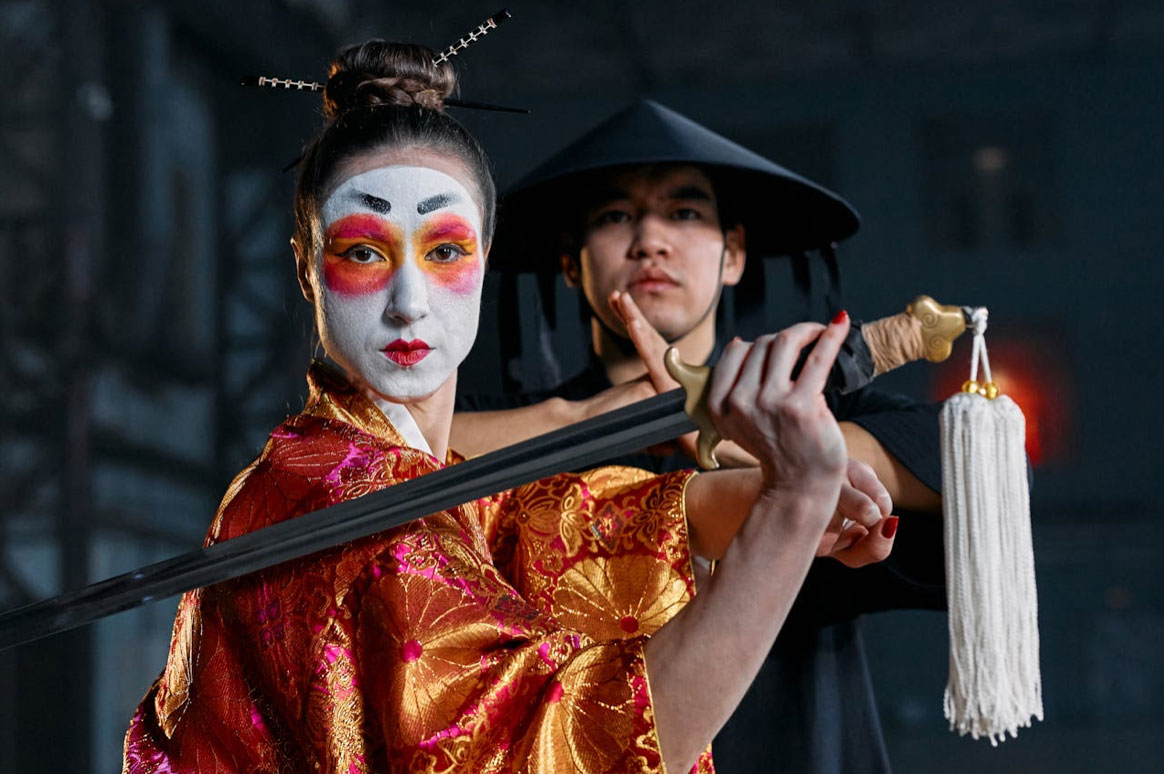
Photo by cottonbro studio: https://www.pexels.com/photo/shallow-focus-of-a-man-and-woman-in-their-game-character-costumes-7780083/
When we think of Japanese samurai films, we often imagine that the focus is on the warrior who appears on screen, sword in hand, honor on the line, and the story unfolds through duels. But for Japanese samurai movie lovers, another presence subtly shapes the atmosphere.
We’re talking about the horse.
A true samurai always has a horse on his side. In many samurai stories, horses may appear only briefly, often carrying the warrior into battle. But these moments are not accidental, that’s for sure.
In Japanese cinema, the horse often represents something deeper than just a transport companion. It signals status, loyalty, tone with nature, movement through history, and the bond between the warrior and the world.
And once you start noticing equine scenes in such films, the symbolism becomes impossible to ignore.
Horses and the Image of the Samurai
When we go back in history, the connection between samurai and horses goes back thousands of years. Yes, before the katana became the finest weapon of the samurai class, mounted archery was all they had.
In fact, the practice of yabusame (ceremonial horseback archery) is still performed in Japan today and reminds us of that tradition and paints a different picture of these warriors.
Since Japanese cinema often draws inspiration from history when portraying warriors on screen, we can see a lot of samurai-horse connections.
It’s just like horse racing that goes back centuries, where the symbolism was so powerful that it took over the world. Nowadays, people are using racehorses as symbols of power, thrill, freedom, and excitement. That’s mainly because of how the sport shaped culture and probably because of how betting on racehorses became so popular.
Nowadays, people are using the best bets for horse racing by TwinSpires to get an advantage and improve their winning chances.
So, samurai warriors on horses share a similar history, and directors often use that to give the story some emotional value, symbolism, and context.
Akira Kurosawa and the Power of the Horse
When it comes to visual symbolism, there is no one better than Akira Kurosawa. In films like Seven Samurai and Ran, horses were used not simply as props but as emotional anchors with huge battle scenes. Kurosawa managed to frame riders charging across a wide landscape, just so they can communicate chaos, scale, and urgency.
In fact, many people don’t know that Ran was actually inspired partly by Shakespeare’s King Lear, where horses carried armored warriors through massive battlefields. So, what does the movement of the horse symbolize? Well, it often mirrors the collapse of order as the story unfolds.
Plus, horses are sensitive animals and get easily spooked, and they are not really designed for battle. But this also adds to the self-control that usually surrounds samurai warriors.
Horses as Status Symbols
Another interesting layer appears when you look at how horses signal hierarchy.
In many samurai films, the highest-ranking warriors arrive on horseback, while foot soldiers move behind them. It’s a visual shorthand that audiences immediately understand.
Ownership of a horse historically required wealth and training. Maintaining one was expensive. That reality carried into storytelling.
When a character rides confidently into a scene, viewers instinctively recognize authority before a single line is spoken.
It’s subtle but effective.
Movement Through Landscape
Japanese cinema has always been about huge landscapes and their connections. Directors love to frame characters that go against mountains, through forests, or across huge open fields.
Why? Well, this symbolizes isolation, journey, and reflection. These are all the main characteristics of a true samurai warrior. That’s why horses naturally fit into this style of visual storytelling.
When a samurai rides across an open field alone, there is something eerie and spooky about that scene. You cannot help but wonder, “What’s going on in his mind?”
So, horses aren’t only about combat. In Japanese cinema, they are also used for self-reflection, emotional balance, and mental strength. This means that samurai are also about wandering, searching, and confronting personal choices.
Horses in Battle Scenes
Of course, the battlefield remains one of the most dramatic places where horses appear.
When we’re talking about Japanese historical films, we often imagine cavalry charging and moments of sudden disruption. Everything is calm until the horses start charging into the battlefield.
These battle scenes are a great way to add some excitement to such films. The horses are there just to amplify the excitement and to build on the hype. They are, without a doubt, part of that chaos.
Final Thoughts
Even though we usually imagine samurai warriors to be alone and one versus the entire world, this doesn’t mean that there isn’t a horse on their side. After all, we are talking about a timeline where horses were used for everything, so it kind of makes sense for a samurai warrior to have one.
But horses often carry a deeper meaning. They represent status, freedom, self-control, emotional balance, and the connection between the warrior and the animal.