



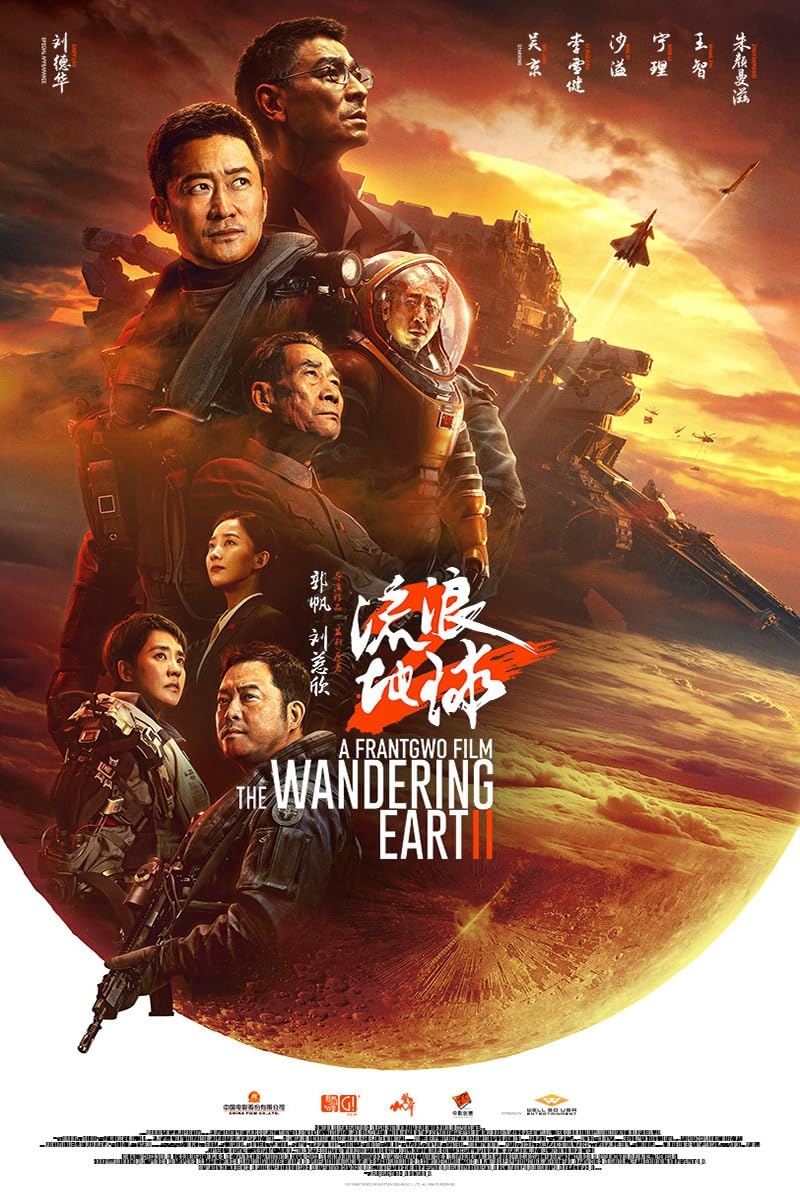
“The Wandering Earth II” Theatrical Poster
Director: Frant Gwo
Cast: Wu Jing, Li Xuejian, Ning Li, Andy Lau, Wang Zhi, Zhu Yanmanzi, Sha Yi, Zhang Yi
Running Time: 173 min.
By Will McGuire
The Wandering Earth 2 represents a new high-water mark for production values in Chinese cinema. One look at the opening credits will tell you that both this film and its 2019 first installment are the product of literally the entire Chinese cinematic apparatus, working in concert to try and produce a spectacle film that speaks to a worldwide audience. The story is sprawling, and by design, it hops madly across the globe in both setting and language. It is China’s attempt to measure itself against the benchmark of Hollywood spectacle and to announce their capability to tell stories that speak to the world.
The nearly three hour story begins with such an in depth summary of the situation at hand: the Sun is becoming unstable and in 100 years, the Earth will be uninhabitable, in 300 years the solar system will be destroyed. The governments of the Earth have unified to construct a propulsion system for the Earth to move it back to a safe distance, but the project and the enormous associated cost has come under fire from political dissidents and is in danger of suffering a fatal setback. This particular installment of the story is a prequel, which means it contains the fatal sin of most prequels that we already know how it’s going to turn out.
It contains most of the virtues and vices from the original film: the chief problem being the scope of the story itself. There’s so much the filmmakers need to get across that there are times, particularly in the first act, where so much exposition is dumped all at once that the film resembles a History Channel documentary or a newscast more than a story where characters grow and change. How can there be any characters when we’ve got so much plot to get through?
Where the film shines is its technical achievement. There’s a commitment to real excellence in science fiction spectacle that’s been missing from Hollywood for some time. The space elevator sequence alone is breathtaking, especially on a big screen, and the film’s final moments find the giddy fun of the first film’s nutty premise.
Special attention must be paid to two veterans of Hong Kong cinema: Wu Jing, who plays a cocky astronaut and Andy Lau who plays a haunted scientist. These two guys really went above and beyond to inject personality into a production that could swallow any actor whole. Wu Jing’s character is never as funny or charming as the script seems to think he is, but his natural charisma shines through even when he’s using broken English. Lau is a tour de force as a heartbroken research scientist who makes the decision to upload his dead daughter’s brain into an AI construct and is just hammered for his sins as a result. I would pay to watch an entire two hour film that dealt only with his plotline and he’s a powerful enough actor that he could carry it off, no matter what the language.
The Wandering Earth 2 is primarily valuable though because it echoes many of the same chords Star Trek does: humanity is worth saving, it has a future, and both of these things are true because humans strive to better themselves and create something to leave to the next generation. The major intellectual difference being that Star Trek always saw 60’s American progressivism as the engine for this evolution where these films cast a higher premium on themes that will be familiar to anyone who watches CCP approved genre films like Wolf Warrior: usually distilled to “self-sacrifice.”
Even with that somewhat sinister postscript, I must confess to being touched by science fiction that is not dystopian or post-apocalyptic. These kinds of popular myths are important and they reveal the anxieties and hopes of a culture and it was nice to see one from people who believe we have a future again.
The film is flabby and at times unfocused, but the effects work and Andy Lau make it a recommendation. It’s got heart, and so its sins are easily forgivable.
Will McGuire’s Rating: 7/10











I’m wondering if it would be better to watch this movie before watching Part One.
“Wandering Earth 2” Movie Review: A “very Chinese” disaster science fiction film
Wandering Earth 2 (2023), directed by Frant Gwo, is a prequel to the 2019 blockbuster Wandering Earth, starring Wu Jing, Andy Lau and Li Xuejian, and adapted from Liu Cixin’s novel of the same name. The whole film is nearly three hours long, telling the story of human beings trying to push the whole Earth away from the solar system to avoid the fate of the sun’s expansion and engulfing the Earth. Before judging whether the film is good or not, we must first clarify what genre it belongs to – it is a typical disaster sci-fi, and this genre itself has a whole set of conventional routines. Only by understanding these routines can we understand what Wandering Earth 2 is doing and whether it is in place.
What are the characteristics of this genre of disaster science fiction?
From Armageddon to 2012, disaster science fiction films have several common characteristics that can hardly be escaped:
First, the threat must be a planet-scale threat – so big that personal efforts seem ridiculous. Second, this type is extremely dependent on spectacle: city collapse, tsunami flooding, engines rushing to the sky; the scene must be large and dense enough. Third, this kind of film is almost always a group narrative (ensemble cast) structure, usually interspersed with a decision-maker line, a front-line engineer/scientist line, and a family emotional line, so that the abstract global disaster becomes flesh and blood. Fourth, they all like to wear a layer of hard science – using many technical terms and “seemingly credible” physical settings to support the absurd premise, although science itself is serving the drama. Finally, this type will never be pessimistic to the end. No matter how miserable the process is, the end must fall on the tone of human resilience and sacrifice.
How does Wandering Earth 2 reflect these routines?
Wandering Earth 2 is almost full of these routines and even goes further than similar Hollywood films in some respects. The threat it sets is too great – neither meteorites nor floods, but the sun itself is about to die, and the entire solar system is about to be destroyed. The visual spectacle hardly stopped: the collapse of the space elevator, the lunar nuclear explosion, the flooding of the Beijing data center, and there is almost no breathing space in the nearly three-hour length – this is obviously a film that wants to prove that “China’s special effects industry can fight”.
Its group picture structure is also a standard configuration, but with a little cultural reversal: Hollywood disaster movies usually rely on one or two lone heroes to support the whole film, while Wandering Earth 2 shares the emotional weight with a whole group of engineers, astronauts, diplomats and bureaucrats. No one can save the world alone. The closest to the “emotional main line” is the engineer played by Andy Lau, who insists on uploading his daughter’s consciousness to AI because of the pain of losing his daughter – this line not only provides the necessary individual stakes (personal emotional fulcrum), but also brings out a philosophical problem that goes beyond the ambition of ordinary genre films. Digital preservation of a person’s consciousness is “alive” or not.
The attitude of hard science fiction can also be seen everywhere: many explanations about engine parameters, orbital mechanics, and population “drawing” schemes put a layer of credibility on the whole film – although the premise of “relying on the engine to push the Earth away” itself is still scientifically untenable. And the ending is also fully in line with the routine of genre films: a cross-border and cross-generational collective effort, not relying on a lone hero, but on enough countries and enough people to choose to cooperate.
Where does it go beyond this type?
What really makes Wandering Earth 2 special in this genre is that it almost deliberately reverses the usual ideological center of gravity of Hollywood disaster films. American disaster films usually end up with personal heroism – a scientist, a pilot and a president make a key decision to save the world. Wandering Earth 2 is almost stubbornly insisting that collective action is the only way to survive – relying on international cooperation, intergenerational sacrifice, and institutional persistence, not a saviour. This is not just a choice of style; it reflects a completely different “hero” cultural framework, and it is also the most recognizable contribution of the film in this genre that is often criticized as “formalized”.
Is it successful or not?
Judging purely from the genre of disaster science fiction, Wandering Earth 2 is a success – it can even be said that it is one of the most ambitious and visually complete works in this genre in recent years. It gives everything that genre films should give: overwhelming scale, excellent visual effects, and a solid enough emotional branch line that can be established independently. Its short board lies in rhythm and restraint – in the nearly three-hour length, the film sometimes seems to regard “more” as “better”, and the philosophical ambition of the line of digital life occasionally slides into surgical sensationalism, rather than relying on the plot to pave out naturally.
However, for a genre that has been filmed by Hollywood for decades and has been a little tired, Wandering Earth 2 still makes people feel new – it does not abandon the routine of disaster science fiction, but does its best to achieve these routines with a scale and cultural perspective that most Western similar works have never tried. To. If you like this genre and can sit down for the length of the film, this movie is worth watching – it proves that the old genre of disaster science fiction film, in fact, still has a lot to say.