


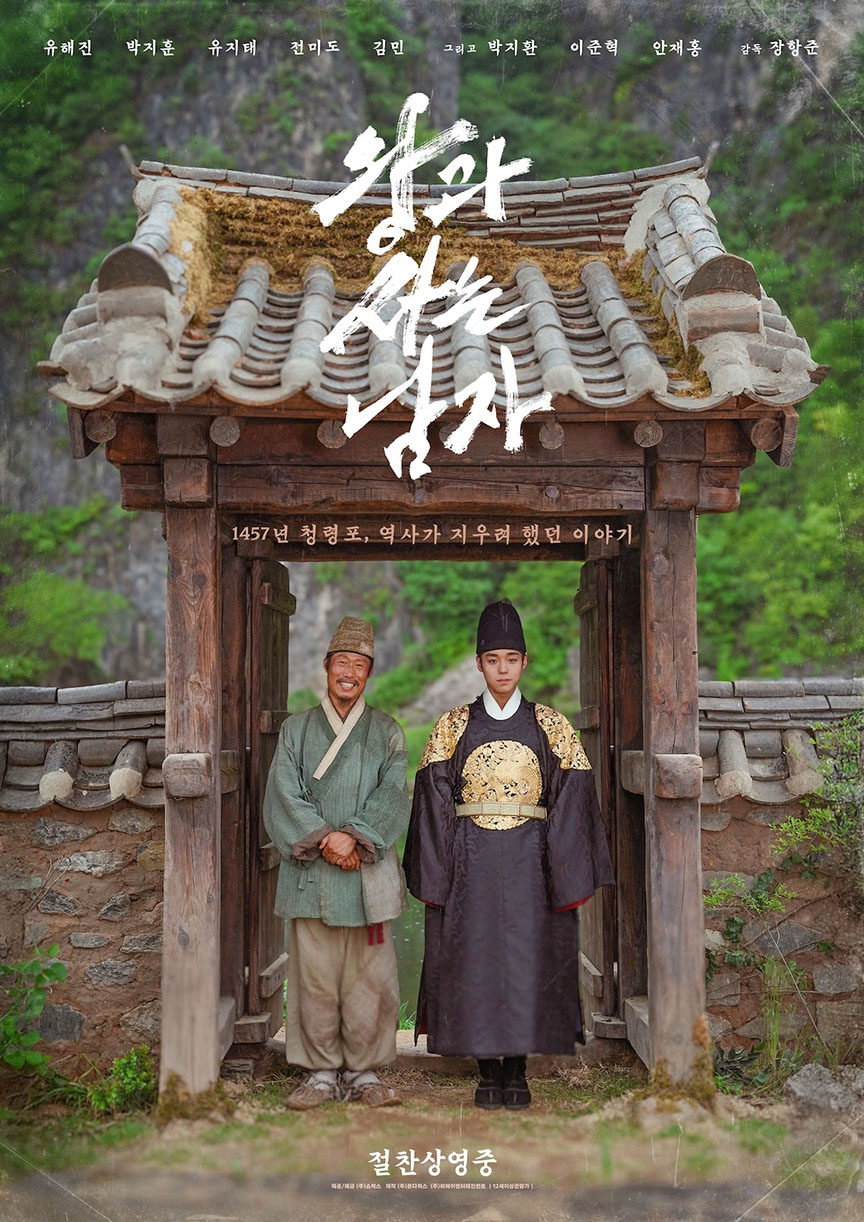
“The King’s Warden” Poster
Director: Jang Hang-Jun
Cast: Yu Hae-Jin, Park Ji-Hoon, Yoo Ji-Tae, Jeon Mi-Do, Park Ji-Hwan, Lee Jun-Hyuk, Ahn Jae-Hong, Kim Min, Lee Joon-Hyuk, Kim Soo Jin, Jung Jin Woon
Running Time: 116 min.
By Paul Bramhall
The latest period piece from Korea has turned into quite the cultural phenomenon on its home soil, one which is continuing to play out as of the time of writing (March 2026). Having recently passed 11 million admissions, that makes it only the 25th movie in Korean history to pass the 10 million admissions mark, but more significant is its impact on the current cinema landscape. Attendance has struggled to get anywhere near its pre-pandemic levels, leading to the local film industry being in the doldrums in a way which hasn’t been seen since the 1990’s. The last time a production hit the 10 million admissions mark was The Roundup: Punishment from 2 years prior, highlighting just how bad the drought is. However while the Ma Dong-seok vehicle had the benefit of being the 4th instalment in an established franchise, The King’s Warden instead opts to tell a relatively unknown (or at least largely forgotten) part of Korean history.
While the story is framed around the events that led to the execution of King Danjong, who reigned from 1452 to 1455, the actual plot itself is focused on the relationship between the deposed king and the chief of the village he’s exiled to. Masterminded by a politician named Han Myeong-hoe, the kings uncle pulled off a successful coup d’état in 1453 which dethroned the then just 12-year-old king, with the councillors who’d been governing the country on his behalf publicly executed. Effectively left as a sitting duck, King Danjong was sent into exile in the remote countryside, while his uncle successfully installed himself as King Sejo. Initially content with having his nephew out of sight out of mind, he gradually began to feel that as his nephew grew older, he could become a threat to his rule, so ultimately ordered his execution.
With the history lesson out of the way, transferred to screen its K-pop artist Park Jihoon (Audrey, Summer Whispers) who plays King Danjong, with the narrative taking the liberty to add a few years to his age, here playing the character as someone in their late teens or early twenties. Yoo Hae-jin (Big Deal, Yadang: The Snitch) plays the chief of the village that Jihoon is exiled to, here continuing his recent run of leading man vehicles, while Yoo Ji-tae (Svaha: The Sixth Finger, Libera Me) steps into the shoes of the scheming Han Myeong-hoe.
Squeezed into a 2-hour runtime, the narrative takes a classically Korean approach to how the story unfolds. When we first meet Hae-jin he’s very much the bumbling Joseon archetype, almost feeling like we’re watching a distant relative of his role in 2005’s The King and the Clown. Attempting to capture a deer, he and the other villagers bumble around indulging in broad comedic brushstrokes, until a tiger shows up and he ends up separated from the group after taking a fall. Rescued by another nearby village, after regaining consciousness he’s amazed at the feast of fresh rice and meat they have at their disposal. Learning their riches are due to the village housing a former minister of justice, an exiled politician whose kept well fed with regular deliveries despite his exiled status, Hae-jin decides to approach the local office to request his own village be considered for harbouring any political outcasts who’ve been banished.
Driven solely by the fact that housing an outcast from the capital will result in his food scarce village being well fed for the time they’re there, Hae-jin’s tunnel vision enthusiasm soon sees the sinister Ji-tae choose his village for Jihoon to be deposed to, knowing they’ll be easy to deal with should anything go wrong. Expecting an elderly politician that would require minimum effort, once the village get wind that the young man in their midst is in fact the deposed king, the realisation sets in that their newest resident could bring them a lot more trouble than any of them could have imagined.
In the director’s chair is Jang Hang-jun, with The King’s Warden giving him the biggest hit of his career. Frequently directing, scriptwriting, and acting, Hang-jun made his directorial debut in 2003 with the action comedy Break Out, and has remained a consistent presence in the Korean film industry over the years. His most successful movie prior to The King’s Warden was arguably the 2017 mystery thriller Forgotten, however in more recent years he’s directed mid-budget productions like the 2023 double bill of Rebound and Open the Door, which were met with similarly middling box office results.
However it’s with his latest that he’s struck gold, and it’s easy to see why. For a large part of its runtime The King’s Warden plays like an amicable comedy, and most of the time its on the mark. When he first comes to the village Jihoon repeatedly refuses to eat any of the meals the villagers have prepared for him, which becomes a recurring joke involving whoever was chosen to deliver the meal ultimately ending up being the one who’s palate enjoys their careful preparation. Upon returning to the main part of the village empty handed they insist Jihoon enjoyed the dishes, only to be given away by their indigestion each time. The supporting cast who make up the villagers make the community feel like they have a natural closeness, with the likes of Oh Dal-soo (No Other Choice, The Wild) and Lee Jun-hyeok (Tazza: The Hidden Card, Hide and Seek) included amongst the ensemble.
Hang-jun wisely chooses to keep the political turmoil on the periphery of the plot, with the main focus being Jihoon’s integration into village life, economically told in a montage that has him meet each of the villagers over dinner to discuss their respective speciality dish. If anything this part of the plot could have benefitted from more breathing room, as Jihoon’s transition from a frail sullen eyed figure to one who’s willing to go head-to-head with Ji-tae (who chews up the scenery in every scene he’s in) feels a little rushed. It also doesn’t help that his journey to re-discover his purpose involves a CGI tiger. Korea have been trying to master the CGI tiger ever since 2011’s War of the Arrows 15 years ago, with a revisit in 2015’s Tiger: An Old Hunter’s Tale, and I could swear it’s the same CGI tiger from both of those productions that appears here in 2026. Unfortunately, it still doesn’t convince (and don’t mention the deer).
However in a tale such as this the political turmoil can only stay on the periphery for so long, and if there’s one thing Korean productions aren’t afraid of, it’s to make a light-hearted comedy veer into histrionic filled melodrama territory without so much as a bat of the eyelid. Inevitably, it’s Hae-jin as the kindly village chief who’s tasked with starting the movie as the jovial but bumbling everyman, and ending it with a bulging red eyed, sweat drenched, mouth quivering, bawling emotional outburst that looks like he’s about to have a brain haemorrhage. He does it well, and anyone who’s watched Korean cinema long enough will know that in scenarios such as these, there is no such thing as “too much”. The more it looks like the veins in an actor’s face are going to explode, the better.
While its runaway success in Korea is understandable, made even more remarkable that it was achieved mostly through word of mouth, outside of the rich cultural context and historical background that it’s built upon The King’s Warden is a perfectly serviceable but hardly groundbreaking Joseon era period piece. Hae-jin and Jihoon have strong chemistry together that makes it easy to become invested in their friendship, and indeed the whole cast clock in stellar performances (including the always welcome Park Ji-hwan as an overwhelmed official working for Ji-tae) ensuring it’s never anything less than watchable. But if anyone was to say they weren’t interested in watching it since it’s already clear how it’s going to end, it would be hard to argue with them.
Paul Bramhall’s Rating: 6/10