
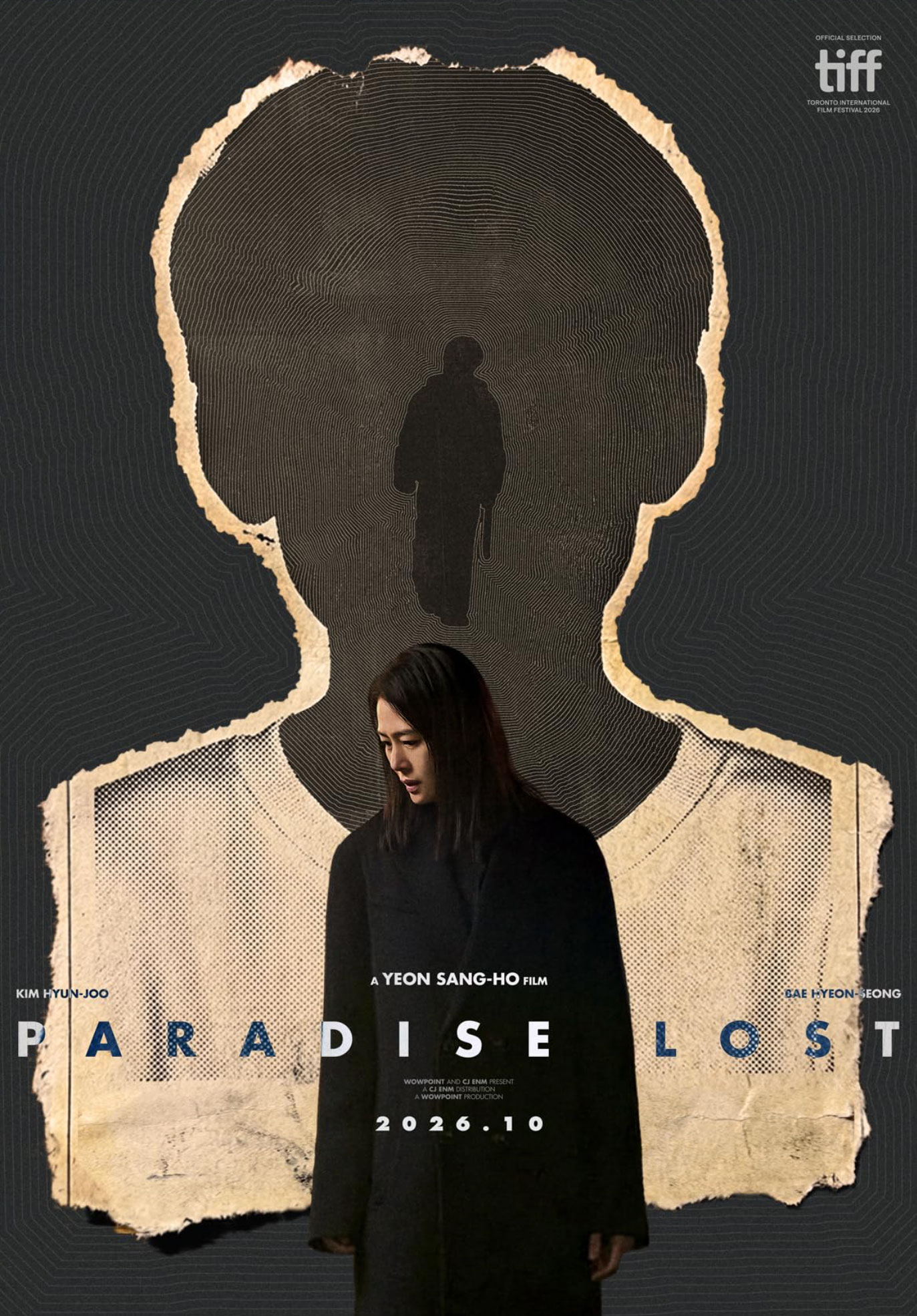
“Paradise Lost” Poster
While many Korean directors struggle to bring their visions to a theatrical release, in 2026 Yeon Sang-ho casually dropped two theatrically released productions within less than 6 months of each other, flying in the face of a film industry still in the doldrums after the COVID-19 pandemic. In May he returned to the zombie genre with Colony, and October saw the release of Paradise Lost. In fairness, after the release of the Train to Busan sequel Peninsula in 2020 Sang-ho spent the next 5 years working almost exclusively with Netflix, the mixed reception the finale to his zombie trilogy received seemingly robbing him of big screen privileges. He’d eventually return to cinemas in 2025 with The Ugly, which became an unexpected box office success. The success of the mid-budgeted The Ugly prompted Sang-ho to continue exploring the kind of cinema he could make without big studio funding, from which Paradise Lost was born.
Don’t quote me on this, but I’m convinced Paradise Lost is the first time for a director to adapt a book written by their mother. The 2025 novel Black Inferno was written by Oh Seung-eun, the concept of which she originally shared with Sang-ho as a three-page outline. He liked it so much he purchased the story rights, proving that it is possible to mix family and business. In the opening scenes we meet a mother played by Sang-ho regular Kim Hyun-joo (Jung_E, Shinsukki Blues) and her school age son, played by Yu Ji-wan, here making his feature length debut after featuring in various K-dramas (including Sang-ho’s own Parasyte: The Grey and the 2nd season of Hellbound).
Ji-wan is off on a school camping trip with 12 of his classmates, the yellow school bus picking him up from their home, however the group never make it to the camp site. Instead the bus is found abandoned at an old coal mine, with a tightly edited together sequence revealing that the bus driver seemingly murdered everyone onboard before killing himself. Seemingly because, while the body of the teacher, the bus driver, and 5 of the kids were recovered, the others are believed to have perished at the bottom of a collapsed mineshaft too dangerous to excavate. Naturally devastated, and with her son being one of the kids whose body couldn’t be recovered, some relief is offered when an AI company named Transhuman enters the picture. Using data from photos and videos of her son, along with extensive interviews with Hyun-joo herself, they create an AI version of Ji-wan that Hyun-joo can interact with by donning a pair of glasses.
For Transhuman it’s a great PR story, with the program dubbed Children of Paradise, even going so far as having a virtual playroom that the AI versions of each kid play in together when not spending time with their respective parents. For the parents themselves the program offers up an opportunity to grieve and say goodbye, providing a level of closure that allows them to move on with their lives. Although unable to physically touch, the AI version of Ji-wan is fully interactive, the result of which begins to blur the lines between reality and fiction for Hyun-joo. When the story skips forward 9 years, her morning routine consists of immediately donning the glasses to spend time with the AI Ji-wan before she heads off for work, even though he’s never grown an inch in the time that’s passed.
Sang-ho has explored the theme of using AI to replace loved ones before in Jung_E, and director Kim Tae-yong covered similar territory in 2024’s Wonderland, however it’s Sang-ho’s latest that strikes the closest semblance to the real world. Grief-bots, as they’ve become known, have become a reality in South Korea, and while they’re still far from the level of interaction portrayed in Paradise Lost, the concept of wearing a VR helmet to connect with a departed loved one is now no longer just sci-fi. This reality is what makes his latest feel particularly dystopian, plugging into the fear of a grieving loved one becoming addicted to a program that resembles a family member who’s no longer there.
I only wish the concept had been explored more, as Paradise Lost successfully sets up an intriguing concept, but like so much of Sang-ho’s recent output, the narrative fails to do anything particularly interesting with it. In fact not even the curveball that his latest outing is sold upon is that interesting, which is that, out of the blue, Hyun-joo’s son turns up alive. Now played by Bae Hyeon-seong (Hansan: Rising Dragon, The Divine Fury), the teenage(?) version comes decked out in a black tracksuit, has no qualms about smoking indoors, and wears a blank expression without saying a whole lot. It almost feels like he’s been beamed straight in from a 2010’s Korean cinema serial killer movie, so it really wasn’t that much of a surprise when, it turns out, he’s a serial killer!
What unimaginable trauma could Hyeon-seong have suffered back then to have completely disappeared off the map, while finding the time in the present to team up with other serial killers and thin the population? Apart from a ludicrous throwaway line (and a blink and you’ll miss it flashback) towards the end, we never know, nor does Hyun-joo seem particularly interested. That’s mainly down to the fact she’s still hopelessly attached to the AI version of her son that exists through the glasses, but it could just as well be that it’s immediately apparent Hyeon-seong isn’t a good guy. It’s all handled very haphazardly, and events happen that often defy any manner of basic logic. Hyeon-seong sees his next-door neighbours kid playing with a ball outside for the first time, and immediately decides to kidnap him for some future murder shenanigans, apparently because he simply can’t help himself.
Or it could just be that the script is painfully unsure of what it wants to say. It soon becomes apparent that the kidnap of the kid is a lazy excuse for Hyeon-seong to present Hyun-joo with a dilemma – she can keep spending time with his AI younger self through the glasses, or she can give them up and he’ll tell her where the kid is. Considering the subject matter it’s a frankly dull predicament to convey, with Sang-ho’s determination to avoid exploring any of the more interesting aspects beyond the surface becoming an increasing frustration over the 100-minute runtime. The much more interesting dilemma would have been that of a grieving mother helplessly attached to a sanitised AI program, and the conflict of accepting the son who’s returned is no longer the same person she’s interacted with every day for the past 9 years. The whole serial killer angle feels misguided, and occasionally like it belongs in a different movie altogether.
Even when Paradise Lost does lean into its AI themes, they often come across as muddled. At one point it’s implied that the AI Ji-wan has become sentient, having developed memories that only the real Ji-wan would have been capable of having, however it’s shot down by the CEO of Transhuman, who explains the perceived memories are simply a result of Hyun-joo’s own interactions with the program. It’s a rare moment of gravitas, with Hyun-joo’s performance doing its best to elevate what feels like increasingly ropey material, but any hard work she puts in is undermined by the fact the memories the AI program mentioned turn out to be true. So has the AI become sentient after all? Is it a result of the AI Ji-wan interacting with the real Hyeong-seong? Both questions are worth exploring, so of course, neither are.
Ultimately Sang-ho’s latest limps towards an ending that feels so rushed and left of field it almost feels laughable, ditching the most interesting concepts Paradise Lost presents in their entirety for a boringly melodramatic closing act. A classic example of an intriguing concept smothered by generic blandness, Sang-ho’s latest may indeed prove that it’s possible to mix family and business, but it doesn’t necessarily mean you should.
Paul Bramhall’s Rating: 5/10