



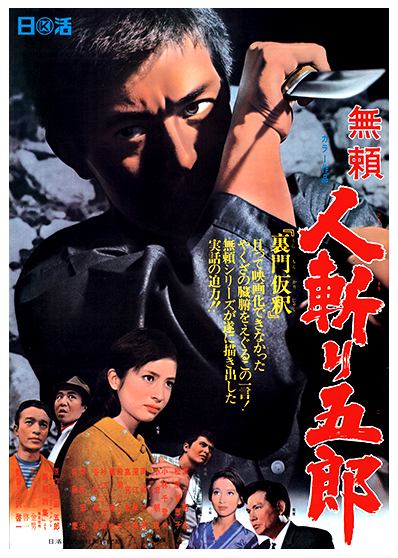
“Outlaw: Goro the Assassin” Japanese Theatrical Poster
AKA: Gangster VIP 4
Director: Keiichi Ozawa
Cast: Tetsuya Watari, Chieko Matsubara, Asao Koike, Jiro Okazaki, Kei Sato, Tatsuya Fuji, Shoki Fukae
Running Time: 87 min.
By Kelly Warner
The Outlaw series dabbles in many genres over the span of its six films. They’re yakuza thrillers, romantic dramas, and action movies with noirish antiheroes. Hell, director Toshio Masuda views the original Gangster VIP as a youth picture. The fourth film, Outlaw: Goro the Assassin, plays like an epic tragedy painted on a film noir’s canvas. It’s gritty and mean and hopeless, often striking out at the ones most deserving of a happy ending. It’s also the best film in the series since the first one.
In the opening, Goro and his friend take out a rival yakuza boss. His buddy is badly wounded in the fight and they’re both sent to jail. Though Goro is eventually released, his friend dies in prison and is buried in the prison cemetery because no family ever comes to claim his body. Vowing to keep his word to his friend, Goro searches for the sister who never visited her dying brother, a search that takes him far from home and into the path of the vengeful gang he’d fought those years ago.
In the search for the dead man’s sister, Goro meets many other women who are in some way impacted by the yakuza. That seems to be the theme here: the cruelty the yakuza inflict on their own men and how they hurt the women in their lives. In addition to the missing sister, there’s Chieko Matsubara’s hotel receptionist (another new character for Chieko) who is hounded by yakuza, plus a young hostess who’s viewed as an untapped “money tree” for her yakuza friend, and dozens of other women who are exploited by the yakuza and tricked into sexual slavery in the red light district.
Goro the Assassin is essentially an indictment of the yakuza and their immoral practices. These men aren’t outlaws so much as they are a cancer in human form, corrupting and/or murdering everything they touch. The victims are often innocent in this chapter, left scarred and bloody because they got too close to the yakuza world. “Why are all yakuza like this?” Goro wonders aloud at one point when the treachery becomes almost too much to bare. And at another point one of the women says something to the effect of, “All yakuza would be better off dead,” a sentiment that the film strongly suggests to be true.
It’s after watching film four where I’m forced to reanalyze the Outlaw series. Gangster VIP and Gangster VIP 2 were closely tied together but the films that followed them seem to be more like ‘episodes’ in Goro’s life. Perhaps it would be incorrect to call them prequels or sequels in the typical sense. With zero ties to the other films and a constantly reshuffling cast, every Outlaw film (with the exception of Gangster VIP 2) stands well on its own. You could watch Goro the Assassin without ever watching the three films that came before it. Same goes for Outlaw: Heartless. And I’m willing to bet the same can be said about the remaining films, Black Dagger and Kill! (But we’ll just have to wait and see.) It’s worth remembering that Outlaw is based on the written work of former yakuza Goro Fujita. This film again opens with a reminder that none of the story is based on truth and characters are all fictional, but of course we know that Goro Fujiwara was a stand-in for Goro Fujita, so fact and fiction likely blend together often in this series. I’ve never read Fujita’s books (I don’t think they’ve ever appeared in English) but I’m left to wonder if his stories were sampled from for the sequels instead of being directly adapted, thus lending to the series’ episodic nature after Gangster VIP 2.
By film four, Tetsuya Watari has settled into the role of Goro to the extent that you forget you’re watching an actor. This is the best I’ve ever seen from Watari. At first considered Nikkatsu’s new Yujiro Ishihara, Watari was now beginning to make a name for himself and step out from Ishihara’s shadow. Watching the Outlaw series, you can basically see the young leading man grow into a more formidable acting talent. Playing opposite Watari is once again Chieko Matsubara. I had some complaints about her casting in the previous film where she played an overly-familiar love interest. I have less to complain about this time around. Though I still might’ve preferred a different actress in the role, Matsubara’s new female lead at least stands out enough from the parts she’d previously played in the series. Here she’s more self-confident and less naïve about how the world works. Like Watari, Matsubara is really good here, giving us the most believable character she’s played in the series so far.
Returning to directing duties is Keiichi Ozawa, who’d previously made his directorial debut with Gangster VIP 2. In the short time since making that film, Ozawa’s apparently figured some things out and brings us a stronger directorial vision with Goro the Assassin. Though his skills filming action do not match what Toshio Masuda did with the original Outlaw film, Ozawa finds nice depth in the drama and elevates his gangster pic to a tragedy. I didn’t think much of what Ozawa did in Gangster VIP 2 but he might’ve redeemed himself with this film. From here on, the series belongs to Ozawa and I’m curious to see how he closes things out.
I thought Goro the Assassin was really solid. I’m putting it a notch below the first film, which featured better action and visual style. That being said, Outlaw: Goro the Assassin may feature some of the series’ best drama, thanks in large part to the work of the performers and a dark screenplay. A great sequel and just an all-around good film.
Kelly Warner’s Rating: 7.5/10