




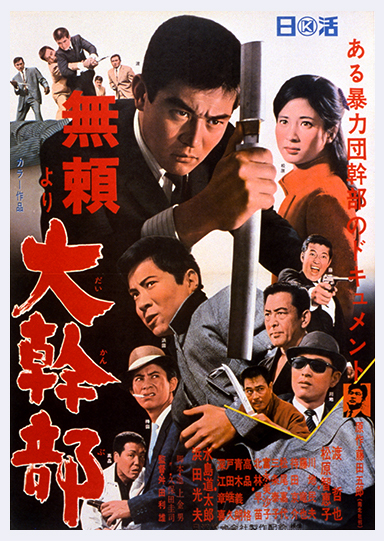
“Outlaw: Gangster VIP” Japanese Theatrical Poster
Director: Toshio Masuda
Writer: Kaneo Ikegami, Reiji Kubota
Cast: Tetsuya Watari, Chieko Matsubara, Mitsuo Hamada, Tamio Kawaji, Kyosuke Machida, Kayo Matsuo
Running Time: 93 min.
By Kelly Warner
There are a huge number of classic Japanese films that most the world hasn’t seen yet. So it’s always great when a home video distributor like Arrow, Criterion, Eureka, and others rediscover some forgotten gem and show it to the world. And that’s exactly what’s happened here, as Arrow Video releases the Outlaw Gangster VIP series for the first time for viewers in the US and the UK.
Gangster VIP is relatively unknown to most film fans in the West. I knew very little about it other than it starred Tetsuya Watari, who is best known as the singing gangster of Seijun Suzuki’s Tokyo Drifter. The first film opens with a disclaimer that everything that follows is fiction and none of the characters are based on any real people. That’s not 100% true, though. The Outlaw series follows Watari’s gangster Goro Fujikawa, a loner that’s partly based on real-life criminal Goro Fujita. After living as a gangster, Goro Fujita wrote novels about the yakuza, and the Outlaw series is a semi-autobiographical version of his life story (he would also write the novel on which Graveyard of Honor is based). I’m sure that there is a great deal of fiction in Fujita’s retelling of his life, but there’s no doubt some truth in there, too.
The film opens with a prologue set after WWII as young Goro struggles through a life of poverty. When doctors ignore his begging, Goro helplessly watches sickness take the lives of his mother and sister. After he’s caught stealing food, Goro’s taken to a boy’s home where he befriends the somewhat older Sugiyama. Time passes and the boys grow into men, soon finding themselves on opposing sides of a yakuza conflict. Goro stabs Sugiyama and is sentenced to three years in prison. When he’s released from jail, Goro plans to go straight, but within 24 hours he’s stabbed another yakuza and he’s back in trouble all over again. His next victim survives but he’s a high-ranking member of the treacherous Ueno gang, the same clan that his old friend Sugiyama pledged loyalty to, and the Ueno clan isn’t going to let Goro get off easy. Though Goro tries to stick to the old yakuza way, his rivals aren’t playing by the same rules. At one point Goro apologizes by chopping off his pinky (a common way for yakuza to apologize for some unforgivable offense), only to have his dead friend’s badly beaten corpse dumped onto the floor as thanks.
Nikkatsu was typically known for its ‘borderless action’ films, hyper-stylized action movies. (Hong Kong’s ‘heroic bloodshed’ action movies would’ve fit right in with what Nikkatsu was churning out in the 1960s.) Gangster VIP’s kind of yakuza drama isn’t Nikkatsu’s regular cup of tea, but I think that everyone handles the concept and the themes wonderfully. In addition to being a yakuza drama, director Toshio Masuda (Red Pier) brings some of that ‘borderless action’ style to the film, filling it with bright colors, unpredictable action, and a welcome dash of humor.
Tetsuya Watari gets to show some range in the role of Goro. The actor could’ve easily let his rogue be super cool, like a gentleman among murderers and morons, but it’s a more honest portrayal than that. The character lacks a heart of gold—Goro’s too cynical, thinks the world’s too rotten—but he’s basically decent. Watari plays him as an oafish thug who’s ultimately redeemed by his fierce loyalty and a need to set things right (I guess the internet would call him a Chaotic Good?). Another highlight of the cast is Mitsuo Hamada (Iron King), who plays Goro’s friend and a hopeless believer in the yakuza code until it asks him to sacrifice too much.
On the negative side of things, I found Gangster VIP’s depiction of women rather weak. There are four major female roles in the film: one’s a hooker, one pleads her ex to beat her because she’s sorry she moved on, one latches onto a perfect stranger like a goddamn remora, and the only woman with some actual depth is basically put in the position of repeatedly reminding the characters that yakuza suck. Maybe weak depictions of women are to be expected from a genre that occasionally looks like male fantasy wish fulfillment, but that doesn’t mean I gotta like it.
Director Toshio Masuda’s film takes on certain operatic qualities in the later stages. In two grand sequences, Masuda splits the film’s narrative, letting two important, contrasting scenes play at the same time. The film’s finale is done this way and actually mutes the action while the background scene is played at full volume. The result is insanely cool. Masuda was well-liked by Nikkatsu for his fast pace and his quality filmmaking—he was the most reliably bankable director the studio had—but he’s not often considered one of classic Japanese cinema’s most stylish filmmakers. One film doesn’t change my mind about how I view Masuda on the whole, but this is a very stylish effort, full of moments that made me sit up and take notice.
The film ends rather ambiguously but we already know that the story would continue. There were six Outlaw films in total and all are include in the new Blu-ray/DVD set from Arrow Video. Since this is my first time viewing the films, I’m going to follow the special feature’s advice and not watch some extras that are said to contain spoilers just yet. Full thoughts on the set and its features will be included in the review for the final film, Outlaw: Kill! As far as the first film’s audio and visual, I can say that I thought the audio was great and the picture quality was… pretty good. It’s not a failing on Arrow’s part, but the print does show some age with flashes of blue crossing the screen a couple times during the movie. It doesn’t happen often, though, and it didn’t take away from my enjoyment of the film.
I started off this review by talking about uncovering forgotten gems and that’s exactly what I think this film is. Gangster VIP is a stellar example of the yakuza film genre and I can’t wait to dive into this set and watch all the remaining films.
Kelly Warner’s Rating: 8/10







Kyle I’m afraid this review suffers from the same problem that many of your other reviews do, in that they often lead to me doing severe damage to my bank balance. In all seriousness though, this series sounds like a hidden treasure, and definitely looking forward to your reviews of the other installments.