


Warning: This feature contains spoilers, so if you’ve yet to see Shiri, please come back later!
As part of the 2025 Korean Film Festival in Australia, on 23rd August the 4K remaster of Shiri was screened during the Sydney leg, the 1999 production that put Korean cinema on the map internationally. I honestly couldn’t recall the last time I watched it, but the chance to see it on the big screen was too good to miss, and I certainly remember the first time. Perhaps like many western audiences, at least those in the UK, my first taste of Korean cinema came thanks to Tartan Video releasing Nowhere to Hide (also from 1999) on DVD in 2002. With a cover that declared “A SURE-FIRE HIT FOR FANS OF ‘HARD BOILED‘” it practically jumped off the shelf into my hands, and while it arguably bares very little resemblance to any John Woo movie, let alone Hard Boiled, it did its job. My interest was piqued enough to want to explore more of this country called Korea’s cinematic output, and I didn’t have to wait long.
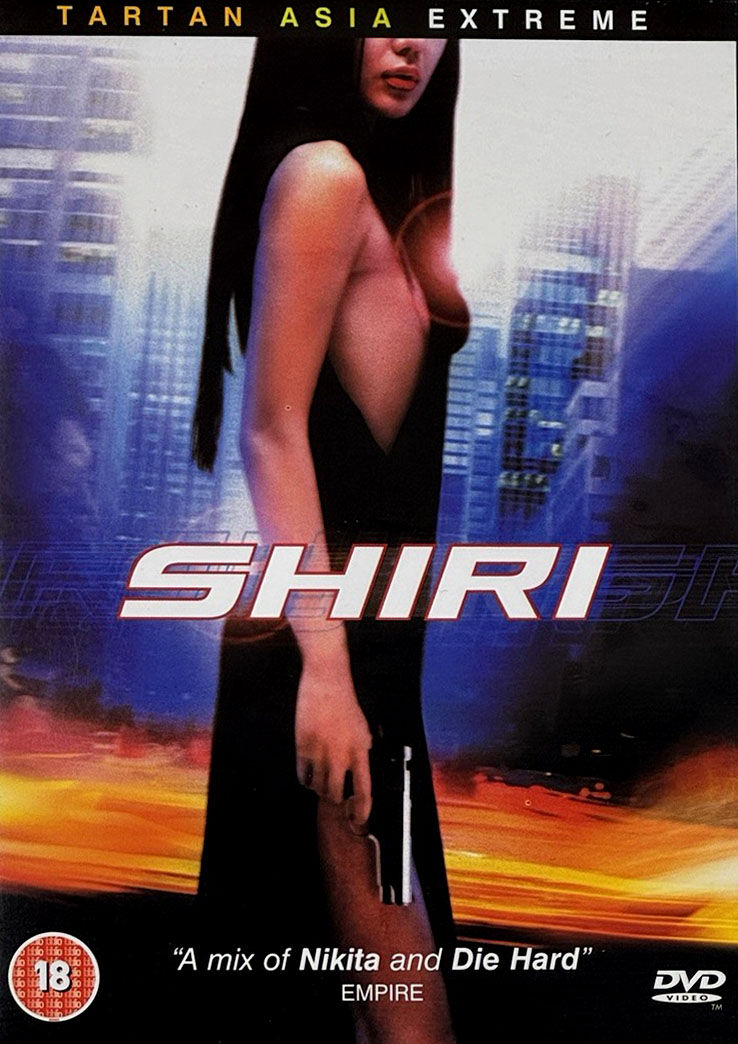
Shiri UK DVD Cover
The following year Tartan Video would release Shiri, and if the cover blurb for Nowhere to Hide was misleading, then this one took it to the next level. Featuring cover artwork that consisted of a woman in side profile, the black dress she’s wearing slit down the side, brandishing a gun and cut off at her nose so you never meet her gaze. It was an arresting image, and also one that doesn’t appear in the movie at any point (neither the scene nor the mysterious woman!). The quote was even better (courtesy of the UK movie magazine Empire) which read “A mix of Nikita and Die Hard”. By 2003 I considered myself relatively well versed in Asian cinema, so such cunning marketing tactics shouldn’t have been able to fool such a discerning cinephile, and they didn’t. I bought the DVD of course because of my previous interest in Nowhere to Hide, and wanting to see more of what Korean cinema had to offer. Discussion closed.
Arguably more accessible than Nowhere to Hide, most of the comparisons Shiri received leaned towards its Hollywood influences, with the one recurring comment that still sticks in my memory being the belief that, if Michael Bay were to make a movie in Korea, this is exactly what it would look like (indeed even this very sites review from 2002, which is worth noting is when it got a U.S. release, states that “Shiri is more The Rock than The Killer.”). Upon watching it, as much as I didn’t want to admit it, I could see where the comparisons came from. Shiri was director Kang Je-kyu’s sophomore feature after 1995’s The Gingko Bed, known for being the first Korean production to make significant use of CGI, and his directorial style intentionally leaned into creating bombastic action sequences in the same vein as Hollywood blockbusters.
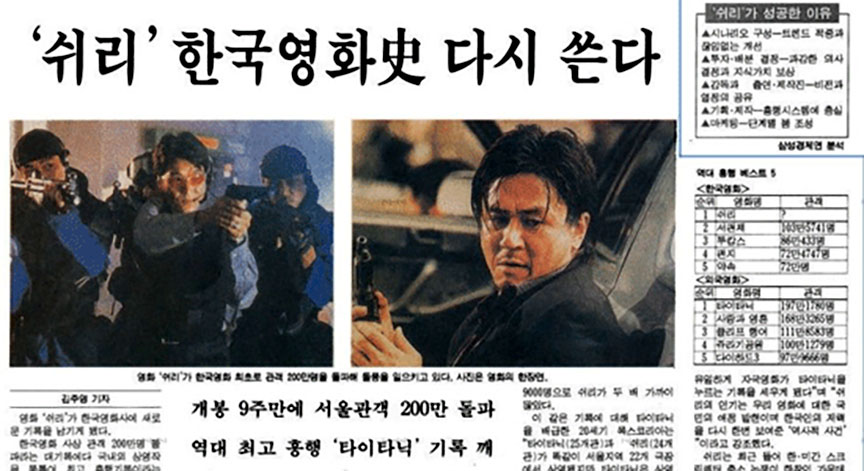
The headline reads “Shiri rewrites Korean film history” referring to its breaking box office records, a turning point in South Korea’s film industry.
It was an approach that worked though, with its modest US$5 million-dollar budget going on to make more than 5 times that at the local box office, and smashing the global box office sensation from the same year, Titanic, by more than 2.5 million admissions. Tickets weren’t the only thing that were selling fast in its native South Korea, with the movies use of fish as metaphors doing for kissing gourami sales the equivalent of what A Better Tomorrow did for toothpicks in Hong Kong a decade prior. The box office returns only grew when it became the first Korean production to get a mainstream cinema release in both Japan and Hong Kong in 2000, which was enough to grab the attention of western distributors, leading to the UK DVD release 3 years later. In today’s climate that kind of gap may seem like a lifetime, but back then it somehow didn’t seem that unusual for a late 90’s movie to get released in the next century.

Sinks Titanic…
Shiri‘s success marked the production as one of particular historical significance, creating an awareness of Korean cinema in the west that was previously close to non-existent, and perhaps more importantly, creating an investment boom in local productions. Shot across 1997 and 1998, it’s easy to forget that the 1990’s were still considered a struggling time for Korean cinema. The country only became a democracy in 1987 following decades of dictatorship, and with the new found freedom the end of the 80’s and early 90’s saw the quota placed on screening foreign productions loosen up, a change which inadvertently left local productions in the doldrums. The decision by Kang Je-kyu to make a Hollywood inspired action movie was a bold one, daring to compete against the very same big budget imported movies that inspired it, but the gamble paid off. That’s not to say there weren’t difficulties along the way.
Featuring a climatic scene set in a stadium during a soccer match between South Korea and North Korea, despite the respectable budget, the production team were unable to get permission to film during any real matches. Knowing there was no way to recreate the atmosphere of a real game, the crew ended up shooting guerilla style in Seoul Olympic Stadium during the match between South Korea and China on 4th June 1998, then filmed the remaining shots by renting a small section of an empty stadium (which they’d fill with extras) in the depths of winter. Whatever hardships were endured though were ultimately worth it, as after Shiri‘s release the floodgates opened for investment into the film industry. Industry insiders called the phenomenon ‘Shiri Syndrome’, and soon movies like JSA, Silmido, and Je-kyu’s own Taegukgi were hitting Korean cinema screens, productions which would likely never have been green lit otherwise.

Headline news clip reporting on Shiri’s success.
The story itself concerns a pair of intelligence agents, played by Han Seok-kyu and Song Kang-ho. Both established actors who debuted in the mid-1990’s, they’d already shared the screen together in the gangster drama’s No.3 and Green Fish, both from 1997, with Seok-kyu also playing the lead in Je-kyu’s previously mentioned The Gingko Bed. The pair were joined by another No.3 alumni in the form of Choi Min-sik, playing a North Korean commander who, six years earlier, had sent a female sniper to integrate into South Korean society with the goal of assassinating several key South Korean targets. Min-sik had also shared the screen separately with the 2 leads before as well, acting alongside Seok-kyu in 1995’s Mom, the Star and the Sea Anemone, and alongside Kang-ho in 1998’s The Quiet Family.

Kim Yun-jin
The ace up the sleeve in Shiri‘s casting though was that of Kim Yun-jin, an actress who’d emigrated to New York aged 10, and spent most of her early acting career in bit parts on MTV and the abc channel. In 1996 she returned to Korea aged 25, and after featuring in a couple of local TV series, it was Shiri that provided the break she was looking for on the big screen. Ironically for the majority of western viewers, it’s not Shiri that Yun-jin is most well known for, but rather her role as Sun-hwa in the American TV series Lost, which she featured in from 2004 through to 2010. For her role in Shiri she plays Seok-kyu’s fiancé, a recovering alcoholic who runs a fish store (the type that sells them in goldfish bowls rather than turning them into sashimi), and remains mostly in the dark as to the danger of Seok-kyu’s work, especially when it’s revealed the assassin has become active again after several years of laying dormant.

Shiri-mania!
Perhaps being someone who grew up on a staple of Hollywood action movies, before watching the 4K re-release my lasting memories of Shiri weren’t of the bombastic action, but rather the more dramatic scenes and quieter character moments. It felt unusual and alien to have an element of melodrama incorporated into what felt like a straightforward action movie, and watching it on the big screen for the first time in 2025 only re-affirmed the power of those memories. However there’s still no doubt that, even more than 20 years of watching Korean cinema later, on the surface level it’s surprising just how un-Korean much of the first half feels.
The trio of Seok-kyu, Kang-ho, and Yun-jin hang out in an Italian restaurant together, with their drink of choice being beer, marking it as surely the only time in Korean cinema history for the distinctive green soju bottle to fail at making an appearance. In another scene Seok-kyu and Kang-ho are sipping coffee in an outdoor café, the setting looking for all intents and purposes like if the camera was to zoom out, they’d be on some street corner in Paris. The intelligence office Seok-kyu and Kang-ho work at has the obligatory Hollywood style ‘quirky character’ whose role is to feed the fish, deriding the colleagues who kill them by throwing cigarette butts and leftover cookies into the tanks, and there’s a lot of serious talk about CTX. The latter is a critical part of the plot, the name of a new bomb that looks like water and is impossible to be detected through normal means, with Min-sik and his comrades intent on blowing Seoul off the map.

Han Seok-kyu and Choi Min-sik.
However after a shootout in an auditorium that almost leaves Min-sik’s North Korean commander cornered by Seok-kyu and Kang-ho, the mysterious assassin makes an appearance, opting for the Chow Yun Fat approach of blasting away with a pistol in each hand, and providing a brief window for him to escape. With the assassin injured in the crossfire, Seok-kyu trails the mysterious figure through the backstreets of Seoul, only to lose her around the same area where his fiancé’s fish store is located. It’s a classic moment in Korean cinema when Seok-kyu ends up on the corner across from the shop, already closed for the day, and as he glances at the building, the lights suddenly come on. A brief expression on his face gives away that he’s contemplating the unthinkable – is the woman he’s planning to marry actually the assassin they’ve been trying to find for all this time?

Han Seok-kyu, Song Kang-ho and Kim Yun-jin.
It’s the kind of melodramatic twist that K-dramas were already known for, and could easily be said to be more bombastic than any of the action in its outlandish nature, delivering the intended gut punch regardless of its feasibility. Seok-kyu ultimately decides to let her go, and we only see he and Yun-jin share the screen one more time before the end credits roll, with the reveal feeling like it fundamentally changes the type of movie that Shiri is. Suddenly it no longer feels like a riff on the Hollywood action genre, with the good guys attempting to stop the bad guys from using a bomb to blow up the city, but rather it narrows down its focus to become a story of 2 doomed lovers heading towards their eventual inevitable confrontation. In short, it begins to feel like Korean cinema.

Shiri newspaper advertisement.
Shiri takes the metaphor of a divided Korea and renders it more heart breaking than any previous attempts, delivering a plot twist only possible now that directors no longer risked being arrested for portraying a North Korean character in a sympathetic light. This was largely thanks to the introduction of then President Kim Dae-jung’s Sunshine Policy, which was introduced only the year prior in 1998, intended to improve the relationship between the 2 Korea’s and move away from hostility. Only a few years earlier South Korean cinema was still subject to significant censorship challenges, with the governments anti-communist stance having a strict policy around how any North Korean characters were portrayed onscreen.

The North Korean training regime.
Whereas now we’ve come to expect North Korean characters that appear in South Korean cinema to be just as multi-faceted as their South of the border counterparts, back in the 1990’s portraying anyone from the North as anything other than one a dimensional villain still felt like a risky proposition. The apprehension was understandable, considering that for decades filmmakers not only risked their films being chopped to pieces or unreleased altogether, but also they themselves risked being branded as communist sympathisers and thrown in jail. As a result Samsung, one of the investors, stayed close to the production throughout in the event they had any concerns over the portrayal between the 2 sides. Luckily they didn’t, and I’d speculate that could partly be down to the opening scenes portraying the North Korean militaries training regime, that even watching in 2025 has lost none of its savagery and brutality.

Will love win?
However the parts which resonate most watching Shiri for the first time on the big screen remain the character driven moments. There are several dramatic standalone scenes in the latter half that have lost none of their power and impact more than 25 years on. The scene in Yun-jin’s apartment when Min-sik questions her loyalties, throwing her a gun with the expectation she should kill herself if she’s really fallen for Seok-kyu. Min-sik’s impassioned speech to Seok-kyu about the conditions in North Korea, becoming increasingly red faced as he furiously rages about parents eating the flesh of their dead children. What hits home the most though is still the closing scene usage of Carol Kidd’s 1985 released cover of When I Dream (originally sung by Crystal Gale in 1975), which in my opinion remains one of the most haunting soundtrack choices to compliment the scene it appears in from any movie, continuing to play as the credits roll.

Bullet time.
It’s a testament to Je-kyu’s script and direction that the most powerful scenes are the ones that take place post what would traditionally be considered the action finale, here a race against time to find the CTX planted in the football stadium. Normally any action movie that continues for longer than 10 minutes after its cumulative scene tends to feel like the ending is being dragged out, with the issue of returning to a more measured pace after the big bang final action scene rarely working narratively. Here though it’s these closing scenes that provide Shiri its emotional core, and are the ones that have remained most deeply ingrained as the lingering parts that stay with you long after the credits roll.
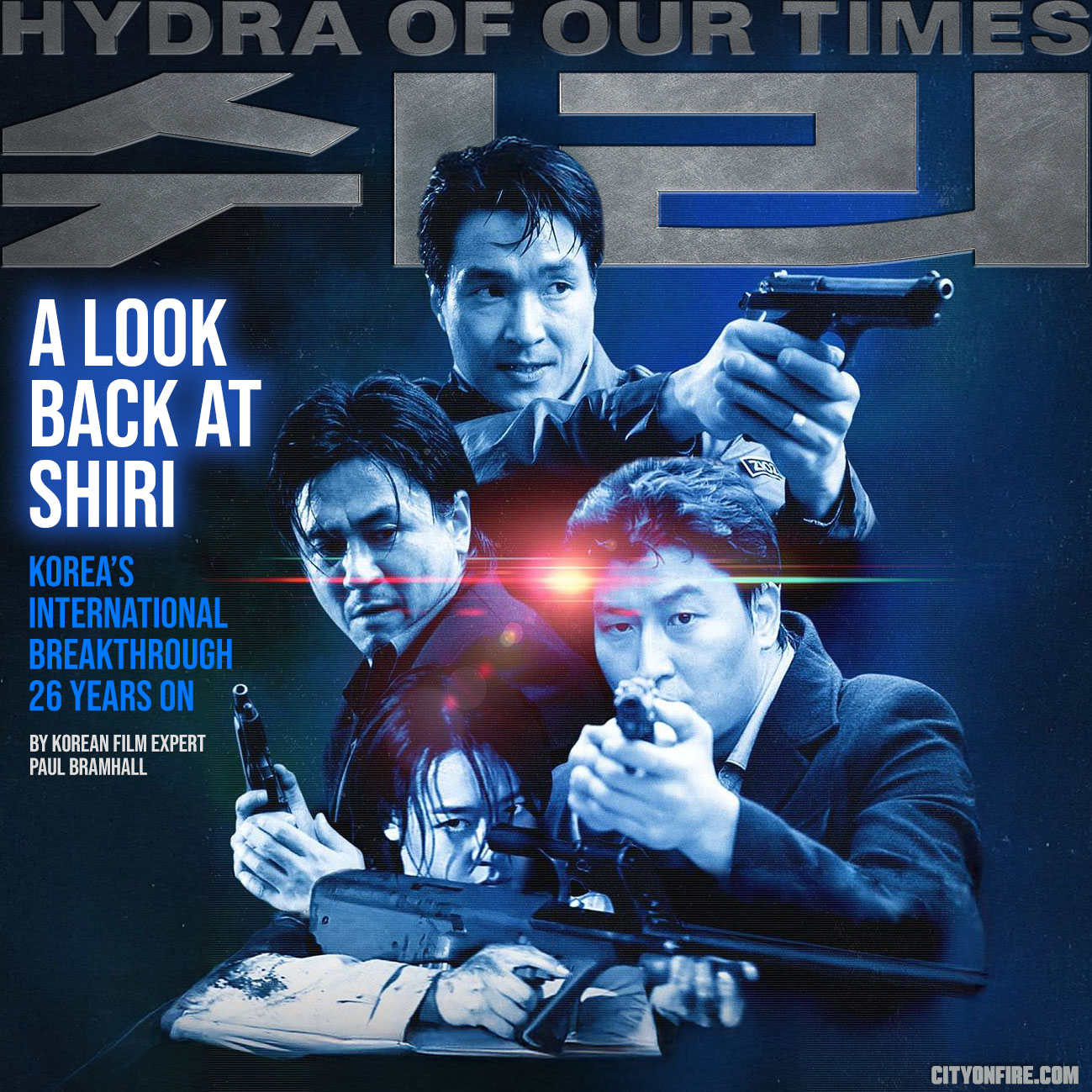
Sat there in the cinema, I could swear I got some dust in my eye during the scene where Seok-kyu returns to the fish store, realising there’s an answering machine message waiting for him. The lump in my throat I have less of an explanation for. Far less dusty is the interrogation Seok-kyu sits through with the Internal Affairs department, played onscreen by a young Hwang Jung-min, with their interaction used to emphasise the metaphor his relationship with Yun-jin represents of a divided Korea. Taking the name of this feature, Seok-kyu refers to his fiancé as the “Hydra of our times”, referencing the Goddess with six heads from Greek mythology, and how both of her personalities represent “the reality of separate Korea”. Writing in 2025 and it’s a reality that hasn’t changed, one which is regularly explored in Korea’s cinematic output, with the question of reunification feeling like it’s as difficult to answer as it ever was.

Shiri 4K Theatrical Poster
As the lights came back on it struck me how, whenever Shiri has come up in conversation over the last 20 years, it’s increasingly been within the context of the role it played in putting Korean cinema on the map, and less about the actual movie itself. Seeing it remastered and on the big screen with an audience that consisted of both the young and old, Korean and local, was a timely reminder of its enduring power and appeal. Much like Seok-kyu’s famous line, Shiri itself can be seen as the Hydra of Korean cinema in the late 1990’s – giving us both a 90’s Hollywood action movie aesthetic, and a distinctly Korean tale of tragedy and longing. The subsequent 26 years since its release have only proven what a unique proposition Shiri is, one that proved the Korean film industry had a place on the world stage.
Writing a few days after the screening, the world we live in now is one where a Korean movie holds the honour of being the first ever foreign language production to win the Academy Away for Best Picture (Parasite at the 2020 Oscars), while the most popular movie ever released on Netflix is one that’s inspired by Korean culture (2025’s K-Pop Demon Hunters). Could any of this have been predicted when Shiri first opened on Korean cinema screens in February 1999? Unlikely, however without it the spark that ignited the early 2000’s K-wave would never have happened, and every subsequent infiltration of Korean culture into the global mainstream in the decades after. Sometimes going back to see where it all began can result in disappointment, but in the case of Shiri, it’s as powerful today as it was upon its first release, and remains essential viewing for any fans of Korean cinema.


Shiri was my first Korean film, and I tracked down the Region 0 HK DVD after reading a glowing review on the former kfccinema website. I loved it then, and I love it now. I was happy to upgrade to the 2 disc DVD special edition which looked great on a giant TV.
I would say the movie beat Hollywood at its own game in that it had all the bombast of a loud summer blockbuster, a musical score that was very much in line with what Hans Zimmer, Mark Mancini, and Harrry Gregson Williams would do, while having me emotionally invested in the story.
I would love a great Blu release of Shiri.