
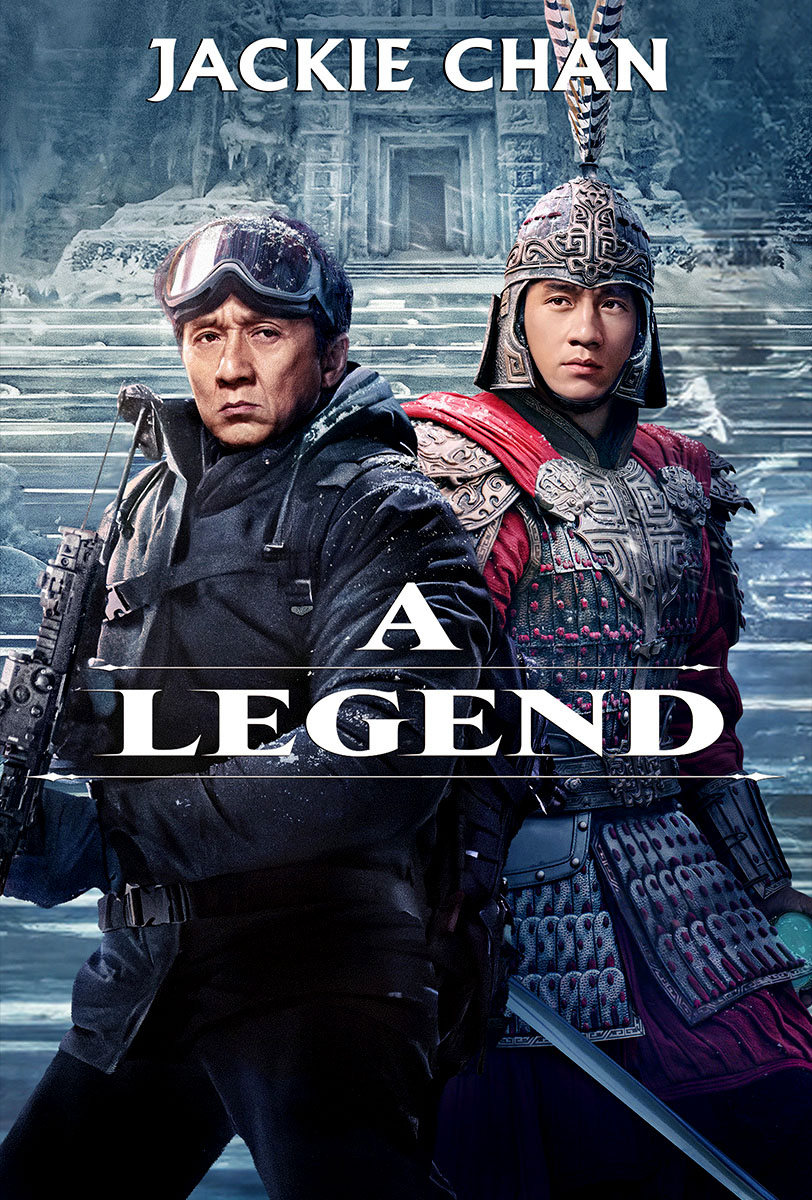
“A Legend” Theatrical Poster
Director: Stanley Tong
Cast: Jackie Chan, Bextiyar Gülnezer, Yixing Zhang, Aarif Lee Zhi-ting, Chen Li, Max Huang, Kim Hee-seon, Shawn Dou Yecheng Zheng, Ray Lui Leung Wai
Running Time: 130 min.
By Paul Bramhall
Back in 2021 I wrote a retrospective on Jackie Chan and Stanley Tong called ‘Giving the People What They Want’, framed from the perspective of how their collaborations as director and star always appealed to the demographic Chan was catering to at that point in his career. In the closing line I’d speculated how “when the pandemic is over we’ll need a movie that gets people back into cinemas for good, and perhaps Chan and Tong will be the ones to deliver it.” Well, writing in 2024 thankfully for most of the world the COVID-19 pandemic is becoming an increasingly distant memory, and it also happens to be the year when Chan and Tong would reunite, this time for A Legend, the official sequel to their 2005 collaboration The Myth.
I say official because their 2017 atrocity Kung Fu Yoga was originally touted by Chan himself as a sequel, however at some point during production The Myth connection was dropped, despite the glaring similarities. Whereas Kung Fu Yoga opened with an extended CGI action sequence featuring a digitally de-aged Jackie Chan, for A Legend the duo has gone all in, with around 2 thirds of the hefty 130-minute runtime consisting of a digitally de-aged Chan as a 20-something year old general in the Western Han dynasty.
The official sequel status is through a thematic connection rather than a character based one, so while Chan is once again playing an archaeologist, it’s not the same one as we met almost 20 years ago. Or at least I hope it’s not, as at no point does he seem phased (or even consider it worth mentioning) that this isn’t the first time to be afflicted with dreams about a past life as a general in ancient China. Instead it’s the dual timeline plot structure that’s the shared connection, with present day events seeing Chan and his team excavating a site related to the Huns, and the timeline in the past involving Chan’s general saving a Hun woman who he falls in love with.
While Tong’s directorial talents are never going to see him labelled as an auteur, his background as a stuntman and action director ensure the movies he helms are at least guaranteed to move along at a brisk pace. Why, at this point in his career, he’s decided to write and direct a 2+ hour epic romance through the lens of a period action-adventure piece is a mystery. Tong’s been responsible for some of the most significant shifts in Chan’s on-screen persona – from transitioning the Ka-Kui we meet in the first 2 Police Story entries to the more family friendly, globe trotting version we meet in the 90’s, to the fish out of water nice guy in Rumble in the Bronx. Tong’s latest influence on Chan though feels like a more sombre one, with the dour faced seriousness of his role in their last collaboration, 2020’s Vanguard, carrying over into his role in A Legend.
In many ways it feels merciful that we don’t spend that much time with the present-day Chan, who when we’re not watching attempt to setup his 2 assistants (played by Lay Zhang – Kung Fu Yoga – and Peng Xiaoran, here making her big screen debut), we’re subjected to following him around on a guided tour of a Chinese history museum. It’s as boring as it sounds. In fact boredom is prevalent throughout A Legend, with Tong’s story of a love triangle that forms in the past between the younger Chan, his comrade (also played by Lay Zhang in a similar dual role, meaning yes, A Legend gives us 2 characters who are having dreams of the past, with the only difference being that Zhang is spared from the digital de-aging treatment), and the Hun woman played by Guli Nazha (Police Story 2013) doing little to spark any interest. Admittedly this could be down to the elephant in the room – the digitally de-aged version of Chan.
At first glance the effect is actually a passable attempt at re-creating Chan’s youthfulness, best described as looking like he just stepped off the set of To Kill with Intrigue. However like any digital de-aging effect, with where the technology stands in 2024 it’s best used sparingly so as to maintain the illusion. Tong makes the regrettable decision to have the majority of the runtime play out in the past, and the more time we spend with Chan’s de-aged version, the more the illusion begins to fall apart. When he’s riding on a horse there’s a bizarre jittery appearance to his face, almost like the effect can’t quite keep up with the movement of the horses pacing, and it soon becomes clear that the colour and overly smooth texture of his skin doesn’t change regardless of the setting or shifts in lighting.
The biggest issue though is whenever the de-aged Chan needs to convey emotion, which simply doesn’t work. When his character gets stabbed the reaction is laughable, as it is when he breaks down over the death of a fellow comrade, which sees Tong make the lamentable decision to film in closeup that should never have made the final cut, as it almost makes the younger Chan look like a wooden puppet. While the behind-the-scenes coverage went to great lengths to show that it is actually Jackie Chan playing the role in the past as well, the final product betrays such claims, as it’s clearly a younger actor in many scenes who’s had Chan’s face digitally pasted over his own. Who it is doesn’t really matter and we’ll likely never know, but I call shenanigans on expecting the audience to believe it’s really Jackie Chan in every scene.
If anyone appears to be having fun in A Legend then it’s Aarif Rahman (Wolf Pack), who plays the Hun villain in the past desperate to claim Nazha as his own, to the point that he’s even willing to kill his own father (played by a cameoing Ray Lui, who’s always a welcome addition). Whenever he’s onscreen A Legend offers some minor promise, but it’s not nearly enough. Adding to the detriment is the fact there’s no discernible villain in the present-day scenes, exasperating the fact they lack any real narrative drive, with Tong awkwardly shoehorning one in during the final 20 minutes so we can finally see the 70-year-old Chan offer up his usual post-2020 brand of Chan-lite action. As expected, just like in the finales of The Myth and Kung Fu Yoga everyone ends up in a sanctuary that’s been hidden away for years, only this time a frozen mammoth is thrown in just for the sake of it.
The last time Chan had an active role (at least credited) in the action choreography department was 7 years ago on Kung Fu Yoga, and A Legend isn’t the production to break the trend, with the action credited to Tong, fellow JC Stunt Team connection He Jun (Ride On), and most interestingly, Yuen Tak (Angels 2). A legendary action choreographer who needs no introduction, in recent years Tak has spent most of his time directing Mainland TV shows, having stepped away from action choreography after 2017’s Journey to the West: The Demons Strike Back. He was also part of the tri-factor of choreographers on The Myth along with Tong and Chan, so to see his name in the opening credits doing what he does best felt like a reason to be excited. It makes it all the more unfortunate that the action is so non-descript, dominated by underwhelming bouts of swordplay in the past, until the finale eventually gives us some present-day action.
One cameo that’ll almost certainly be throwaway for most who watch A Legend is a blink and you’ll miss it last scene appearance from Korean actress Kim Hee-sun, who played the princess Chan’s general is assigned to protect in The Myth. Although they were obviously never in the same room (or even country) together, with Hee-sun likely just told all she needs to do is stand in front of a green screen for a few seconds, from a plot perspective it again raises the question of if Chan is actually supposed to be playing the same character. From a broader perspective, as far as I’m aware this is the first time for a Korean performer to appear (even if it is just a few seconds) in a theatrically released Chinese movie since the governments unofficial ban on the Korean entertainment industry in 2017. We even get a closing credits song in Mandarin, Korean and English, even though there’s absolutely no reason for it to be.
Speaking of closing credits, along with Panda Plan it looks like 2024 is the year Chan is done with showing outtakes, which in fairness I’m ok with. While watching Chan get hurt in his prime only increased the appreciation of his movies, in recent years I found the feeling switched to one of concern when you see someone in their late 60’s taking some serious bumps, even to a point of wishing he’d stop. How many will actually make it to the end credits of A Legend though is debatable, and the question of if Stanley Tong and Jackie Chan are still giving the people what they want even more so. If it’s a mix of Hallmark channel drama, non-stop orchestral swelling, and protracted flashbacks within flashbacks, then the answer is a definite yes, but just like the digitally de-aged version of Chan we spend so much time with, it’s a yes that’ll fail to convince anyone.
Paul Bramhall’s Rating: 2/10





This movie was his biggest flopped in china like Donnie Yen with Come Back Home.
You really tortured yourself with Chan’s recent shit-fests. Give yourself a Christmas present in the form of a good movie that’s at least an 8/10.
Some movies are like candy in that they’re sweet but without nutrition, and I like some of those films. This one here is just pure fermented sugar with a ton of artificial colors and sprinkles to trick people into thinking it’s enjoyable.
I hope Chan fares better in Karate Kid Legends.
“Give yourself a Christmas present in the form of a good movie that’s at least an 8/10.”
I’m thankful Paul squeezed in BANGKOK DOG & STRIKING RESCUE in between these sub par Chan flicks. Now, he can just rewatch LIFE AFTER FIGHTING or stick around in China Web Movie Land and see BLACK STORM to cleanse his pallet:-)
Thanks for the kind advice gents, I definitely plan to follow it. Never thought we’d reach a time where I’d say “please, no more new Jackie Chan movies!”, but here we are.
Since Kung Fu Yoga, Stanley Tong kills Jackie Chan movie.
Panda Plan is much better. Not the great action movie. Just a cool family movie intended for children above all. We have a good laugh.
The one positive here (and it’s a minor one for sure) is that the final fight has a lot of sliding and slipping on the ice, much of it on the knees. That’s a creative element to a fight I hadn’t seen before. And Chan’s character (SPOILER SPOILER SPOILER)
Gets hit with not one but two wince-inducing and fight-ending injuries in a row. Which I also haven’t seen from him before.
Of course, the end of the finale is another gigantic anemic letdown…
This was so boring. Panda Plan was much better than this (I enjoyed that)