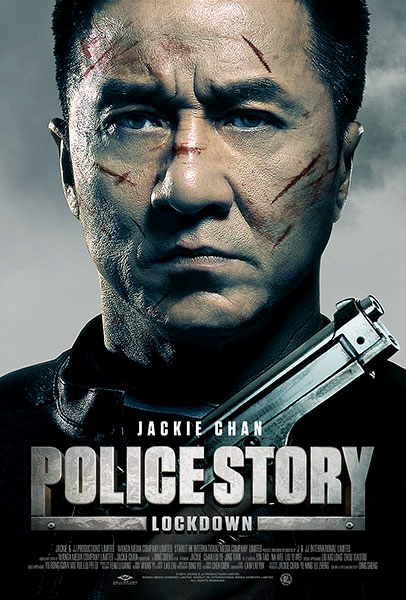
“Police Story: Lockdown” Theatrical Poster
AKA: Police Story 6
Director: Ding Sheng
Cast: Jackie Chan, Lau Yip, Sally Jing Tian, Huang Bo, Yu Rong-Guang, Wang Zhi Fei, Wu Yue, Andy Long Nguyen, Zhang Xiaoning, Ding Sheng, Bruce Law
Running Time: 108 min.
By Kelly Warner
Jackie Chan’s changed. Off-screen his fervent nationalism has had the effect of alienating and upsetting some fans both at home and abroad. On-screen, the actor has had to come to terms with the fact that, since hitting middle age, he cannot do the same sort of movies and stunts that made him such a unique film star. As Jackie’s changed, so have his films. It used to be that a film like 1993’s Crime Story would be considered this gritty oddball entry in Jackie’s filmography that largely consisted of action-comedies. In the past decade, though, dramatic films are popping up with more regularity in Jackie’s output. What’s more, when Jackie returns to the usual comedic actioners that he’s known for in films like Chinese Zodiac, the fun and laughs don’t seem to come as naturally as they did before. Jackie’s made it no secret that he’s trying to reinvent himself as a serious dramatic actor. I might’ve found it funny when he said that he wanted to be thought of as Asia’s Robert De Niro, but perhaps it was wrong of me to doubt his ambitions — because while I might miss the Jackie of old, the new Jackie Chan is still an interesting performer capable of surprising you.
After a brief period in the early 2000s where his starring roles were primarily Hollywood films, Jackie Chan returned home and made New Police Story in 2004, and the film carried a darker, more cynical worldview than any of the previous films in the Police Story series. In New Police Story, Jackie plays Chan Kwok-Wing, a drunken, self-loathing fallen hero instead of the unlucky goof Chan Ka Kui of the first four films. However, despite the edgier tone, the film did have some of the trademarks that reminded you of the series. There was the big action, some colorful set pieces, plenty of collateral damage, and a few instances of slapstick humor along the way. It was different but you could still recognize the Police Story spirit.
That spirit is completely absent from Police Story: Lockdown (originally titled Police Story 2013, but since it’s making its US debut in 2015 a name change was in order). In Lockdown, Jackie plays grizzled police officer Zhong Wei, a failed family man who’s seeking to make things right with his daughter. She invites him to the popular Wu Bar because she has something to tell him: she’s dating the bar’s owner, Wu Jiang (Liu Ye). Zhong tells his daughter that he doesn’t have a good feeling about Wu and is worried about her. Before he knows it, Wu’s bashed Zhong over the head and the other patrons of the bar are getting taken hostage by musclebound thugs. Zhong quickly learns that this was all a trap to lure him there. But who is he to Wu? Zhong sorts through his personal history, trying to pick out a case where he might’ve wronged somebody, while Wu puts his plan into action.
Instead of the Police Story films, what Lockdown most resembles is the original Die Hard, what with the hostage situation and a well-organized villain that’s thought of all the angles. It goes for a claustrophobic atmosphere by giving us an environment of industrial interior design and moody shadows, and wisely denies us a chance to see all that’s happening outside of the bar until later on in the film.
Jackie Chan is good as the haunted cop that’s past his prime trying to prove that he’s still a hero. It’s not the sort of performance that one normally expects from the actor, so some fans will be disappointed, but I thought that he was believable in the dramatic role. In the action scenes, of which there are only a few, Jackie still performs at a high level, even if it’s clear that the editing helps him out on occasion. At the end, in the film’s final shot of Jackie, I’ve never seen the man look so tired. The rest of the cast is pretty good, too, in particular the villain played by Liu Ye. Yu Rong-Guang also makes an appearance as a cop on the outside looking in and the actor makes the best of his limited screen time.
The director of Police Story: Lockdown is Ding Sheng, whom Jackie had worked previously with on Little Big Soldier. I enjoyed that film – actually, I consider it to be one of Jackie Chan’s best from the last decade or more – and they do good work together again here. Ding Sheng also serves as the film’s writer and editor. His shooting and editing style is fast, chopped up action, which gives the film a good pulse, even if it robs some oomph from the punches.
As the film’s writer, Ding Sheng does a good job of setting the table and keeping the audience in the moment, but he loses steam before the finale. In the final act, we get a series of revelations done in a semi-Rashomon-style of storytelling, but these moments are rather limp compared to the rest of the film. At the moment when the film should’ve been kicking into overdrive, the gears grind to a halt to give us some exposition about supporting characters and poorly constructed sub-plots. Things get better right before the end, though, saving the film from ending with a whimper.
I liked this one more than I had expected to. However, I personally think it would’ve been better off dropping the Police Story title altogether. Yes, Jackie Chan plays a policeman, but that’s where the similarities end. The film deserves to stand on its own, and some fans may not take kindly to the dramatic shift in tone and execution.
Police Story: Lockdown arrives on Blu-ray from Well Go USA. The picture quality and surround sound are rather excellent. The special features include 5 minutes of fly-on-the-wall BTS footage and 20 minutes worth of interviews with Ding Sheng, Jackie Chan, and other members of the cast.
Now at age 61, Jackie Chan’s forced to do different kinds of movies. It would’ve made sense for him to gravitate towards pure comedic roles, but he continues to push himself as a dramatic actor. Police Story: Lockdown gives him his meatiest dramatic role since Shinjuku Incident and I thought he really delivered. Jackie has changed. Most attempts to return to the ‘way things were’ have been unsuccessful, but perhaps this late stage of the actor’s career still holds some unique promise. Police Story: Lockdown is not a perfect film, but it’s an interesting one as Jackie Chan continues down this road of reinventing his onscreen image in a darker, more cynical time.
Kelly Warner’s Rating: 7/10



Man, the title has always been annoying to me. It’s a double-edged sword: False xpectations of the series, yet tagging it Police Story 2013 was much more enticing to the ticket buyer. Like you mentioned, even New Police Story, had some of the series trademarks. Maybe they shouldn’t have went for Crime Story 2013, or something.
Not sure how I feel about the Rashomon-style sequence you speak of, but knowing Ding Sheng is a competent filmmaker, I’ll give this one a shot.
What did you think of Shinjuku Incident? To me, one of Jackie’s top 10 of all time.
I liked Shinjuku Incident. I don’t rank it among Jackie’s best, but it’s a good crime drama. Shinjuku Incident‘s one of those films that I’ve always been meaning to rewatch, though. Actually, you know what, I’m gonna do that. I’ll watch it again this week and get back to ya.
But you never did…
LOL!