

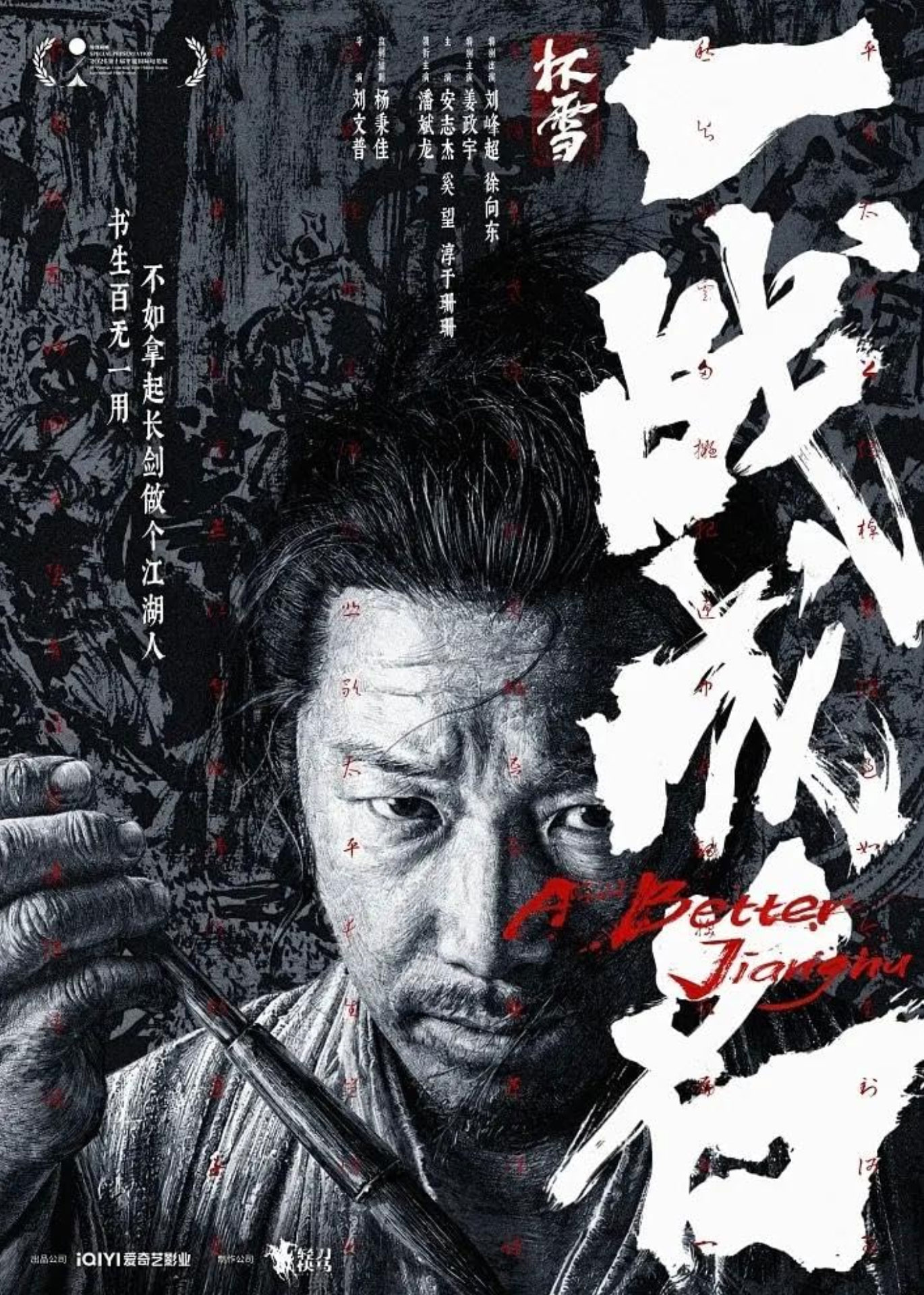
“A Better Jianghu” Poster
The popular Chinese streaming service iQIYI makes the first six minutes of each of its films available for free on its website, which inclines most iQIYI filmmakers to include a rip-roaring action sequence within the initial few minutes of a movie in order to hook a casual viewer’s interest. A Better Jianghu doesn’t really do that; sure, there’s a bit of a chase sequence early on, but director Liu Wenpu (The Butcher’s Blade) holds his cards close to his vest and waits a bit longer to unleash the film’s first turbo-charged wuxia action sequence. This told me right away that A Better Jianghu wasn’t going to be your typical iQIYI movie in the vein of The Scavenger; rather than being content to serve as a mere 70-minute delivery vehicle for a series of bone-crunching fight scenes, this movie has a story it’s genuinely invested in telling.
And it makes sense too, seeing as how A Better Jianghu is an adaptation of writer Xiao Duan’s popular wuxia novel Cup of Snow, which was originally serialized in 2001. I was reminded of 2022’s The Hidden Fox—also based on a novel—in that much of this movie revolves around characters converging at an inn/tavern and the story is told out of sequence. Does A Better Jianghu gain a great deal from its non-linear, chapter-based structure? That’s up for debate, but I can understand why the filmmakers might be keen to use this somewhat convoluted format to build intrigue: our protagonist, played by actor Pan Binlong, is a former scholar turned outlaw, and the film likes to tease the viewer in regards to just how skilled in the martial arts his character has become since putting down his calligraphy brush.
Speaking of martial arts, we should probably talk about the action in this film, which I would argue is very good—but—is also likely to frustrate or turn off some purists. And by that I mean, it’s very clear that the performers have been digitally sped up and otherwise visually manipulated in order to appear as though they’re moving with uncanny speed. Think of it as a very slick update on the old school technique of undercranking: now, instead of speeding up the entire frame, filmmakers can utilize various digital techniques (including AI) to make just one actor—or one part of an actor, like their sword hand—move faster than everything else in the frame. It means the combatants in A Better Jianghu fight in a way that resembles the awe-inspiring boss characters from a video game like Sekiro: Shadows Die Twice. So if you’re put off by a reliance on special FX in order to sell action sequences, if you long for the days when the Chinese martial arts genre relied on actors’ athletic prowess, well, this might not be the movie for you. I think the somewhat artificial nature of the action here works for me in part because we’re already occupying the fantasy-tinged arena of the wuxia—therefore it’s almost expected that characters will be defying the laws of gravity and physics at every turn. (Then again, you’re also talking to one of the lonely defenders of Donnie Yen’s Sakra).
There’s admittedly an inadvertent downside to A Better Jianghu’s reliance on a more complex narrative than what we typically see on offer from iQIYI: and that’s the fact that the service’s English subtitles tend to be functional at best, meaning I can’t be entirely certain that I followed every beat of this film’s intricate story—or the denouement that relies on the viewer’s familiarity with 12th century Chinese historical figures like Qin Hui and Yue Fei. A storyline this complex, culled from a beloved novel no less, deserves a more careful translation; yet even with the caveat that not every shocking reveal or sudden reversal necessarily landed for me thanks to the merely adequate subtitles, I still have few qualms recommending A Better Jianghu as one of the best martial arts-themed offerings of the year. That is, as long as you’re willing to accept a new-school wuxia that uses the latest in digital trickery to convince you of its characters’ superhuman abilities.
Z Ravas’ Rating: 7.5/10