




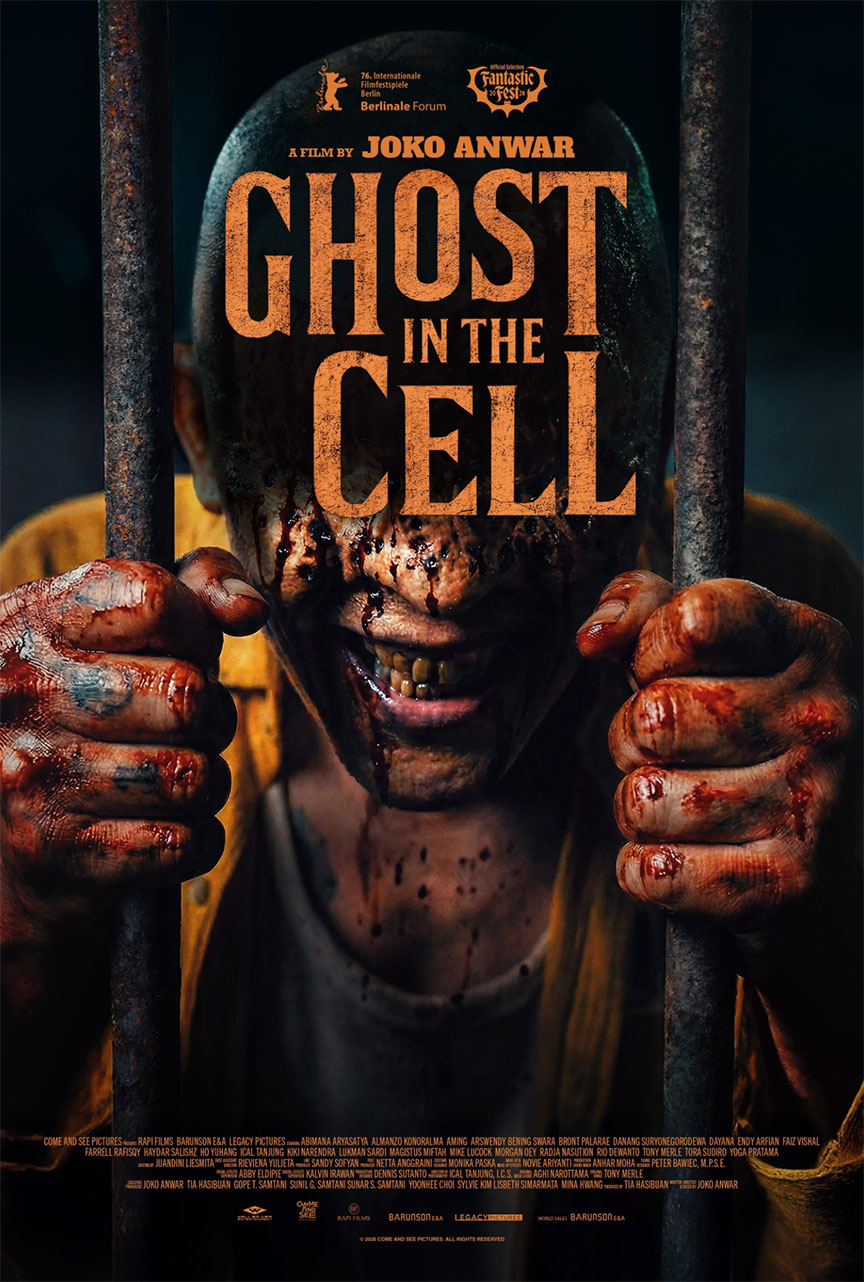
“Ghost in the Cell” Poster
There was a time during the 2010’s when Indonesia got tagged with the much bandied about label of action cinemas next big hope. However here in 2026, it’s become increasingly apparent that the hope which has been realised doesn’t belong to action cinema, but rather the Asian horror genre. A genre that Japan and its slew of long black-haired ghosts seemed to dominate in the early 21st century, it’s taken Indonesia for it to be taken in a direction which feels fresh and new. From the Mo Brothers genre blending efforts like Killers, to Timo Tjahjanto’s solo outings mixing horror and martial arts in the form of The Night Comes for Us, to Joko Anwar’s reimagining of Indonesian horror classics with Satan’s Slaves. The combination of deep-rooted superstitions, and a willingness to embrace the gorier side, has seen Indonesia’s horror output deliver some much-needed originality to a genre that’s never gone out of fashion.
The latest dose of horror also comes courtesy of Joko Anwar, who after making his debut with the well-received “everything that can go wrong will go wrong” 2005 comedy Joni’s Promise, gradually made his horror leanings more and more apparent in the succeeding years. Anwar really came on the radar internationally though in the later half of the 2010’s, first with the previously mentioned remake of Satan’s Slaves in 2017, and going on to cement his horror credentials with the likes of 2019’s Impetigore, and a Satan’s Slaves sequel in 2022. For his latest, the humorously titled Ghost in the Cell, Anwar has opted to revisit the comedic tone of his earlier work, crafting a horror comedy that plays out within the walls of a prison.
Opening in the offices of an embattled newspaper late at night, a journalist (played by frequent Anwar collaborator Endy Arfian – The Siege at Thorn High) has just put the finishing touches on an expose investigating illegal nickel mining. However once submitted for publishing he finds himself berated by his boss, exasperated at the risks publishing the piece would bring upon the already struggling paper. Moments later, the boss finds himself the victim of a graphic stabbing frenzy, before being discovered wrapped around his offices ceiling fan by his own intestines. It’s a gruesome way to kick things off, complete with the classic Indonesian horror freeze frame to splatter the title across the screen, and all evidence points to the attacker being Arfian, who finds himself packed off to prison.
It’s there that he falls in with (in his own words) “a gang of scammers and robbers”, with the level-headed Abimana Aryasatya (The Big 4) acting as their default leader, who also becomes Ghost in the Cell’s real lead. As with any movie set in a prison, Aryasatya frequently finds himself at loggerheads with the sadistic warden, played with entertaining relish by Bront Palarae (Gundala). More than any of the prison staff though, the biggest concern for Arfian comes in the form of his cellmate, a psychopathic pervert strikingly played by Aming Sugandhi (Macabre), with his tattoo covered bald head leaving a lasting impression. It’s through the introduction of Sugandhi’s character that Awar gets to display his latest’s comedy leanings, with Arfian left in the unenviable position of needing to retrieve a bar of soap off the ground while showering next to Sugandhi, a scene which is played to humorous effect in all the right ways.
It’s also within the same scene we learn that whatever killed the boss of the newspaper is also present in the prison, with Sugandhi’s body ripped apart and impaled by various parts of the plumbing, his final moments left as a kind of grotesque sculpture for all to see. The sequence sets the tone for much of Ghost in the Cell, with the audience never quite knowing whether the next scene is going to result in laughter or revulsion, as more and more of the inmates find themselves meeting a grizzly end.
While the tonal shifts feel like they should be jarring, Anwar handles them with a lightness of touch, and despite the horrors on display, the sincerity in which Ghost in the Cell approaches its genre bending results in a unique entry within the horror comedy canon. Much of the entertainment comes from Aryasatya’s clique of cell mates, with Yogo Pratama (The Window) being a particular highlight as the son of a shaman who can see the colour of people’s auras. Upon realising that the presence within the prison is drawn to those with a red aura – representing feelings of anger or frustration – the inmates come to learn that either praying, or alternatively undertaking some kind of creative endeavour, are the best ways to keep such negative feelings at bay.
The concept is milked for all of its comedic value, with a highlight being when, mid-film, out of the blue Aryasatya gets involved in a knock down drag out fight with a rival group member, played by Morgan Oey (Because I Hate Korea). Feeling like it shares some distant DNA with Jackie Chan’s ‘emotional kung-fu’ from Fearless Hyena, Pratama yells out from the sideline every time Aryasatya’s aura turns to red, causing him to break into interpretive dance mid-fight as he attempts to bring his anger under control. It’s a masterclass in blending brutality and slapstick, and one that’s re-visited later during a group brawl, when at one point an assailant sits down cross legged to start praying while being continuously kicked in the head. Anwar fully leans into the absurdity of the situation, seemingly aware that the poker-faced portrayal of such extreme measures is enough in and of itself to deliver the desired comedic effect, and he’d be correct.
This is no more apparent than in the cast of Magistus Miftah, whose day job is actually being a tarot card reader, dancer, and fashion designer, here making his acting debut. With the prisons prayer room quickly becoming overcrowded, the others (which include Aryasatya and his crew) opt to join Miftah’s dance class, which sees the high heeled instructor bust out a dance routine that includes everything from twerking to moves based on “period cramps”. It’s rare enough to feature an openly gay character in Indonesia’s mainstream cinematic output, but perhaps even rarer to witness a room full of prisoners in the middle of a horror movie attempting to twerk in the hope that it’ll keep them off the radar of whatever is killing the other inmates. Sadly for Miftah the frustration he feels toward his newly found students lack of coordination can only mean one thing.
As with all of his features Anwar also pens the script to Ghost in the Cell, and its apparent he has the less desirable aspects of Indonesian society squarely in his sights for his latest, taking aim through a number of sarcastically placed lines. From ruminating on how “Indonesians care more about celebrities than their own lives”, through to the surprise of meeting a prison officer who isn’t corrupt leading to the officer declaring “There’s still hope in 10% of Indonesians.” Everything from religion to the government finds itself in the crosshairs of Anwar’s pointed observations made through his characters, adding to the darkly humorous tone that permeates throughout.
For those not familiar with Anwar’s style, coming to Ghost in the Cell expecting a full-on horror movie is probably comparable to going into his Indonesian counterpart Edwin’s Vengeance Is Mine, All Others Pay Cash expecting an explosive martial arts movie. The gruesome deaths the presence inflicts on whoever’s in its sights are entertainingly graphic and gore drenched, however they’re far from the whole story, with a cynical social commentary bubbling just underneath, and even the occasional detour into kung-fu fighting. The disparate elements ultimately add up to a devilishly entertaining whole, making Anwar’s latest by far his most accomplished work to date.
Paul Bramhall’s Rating: 8/10