


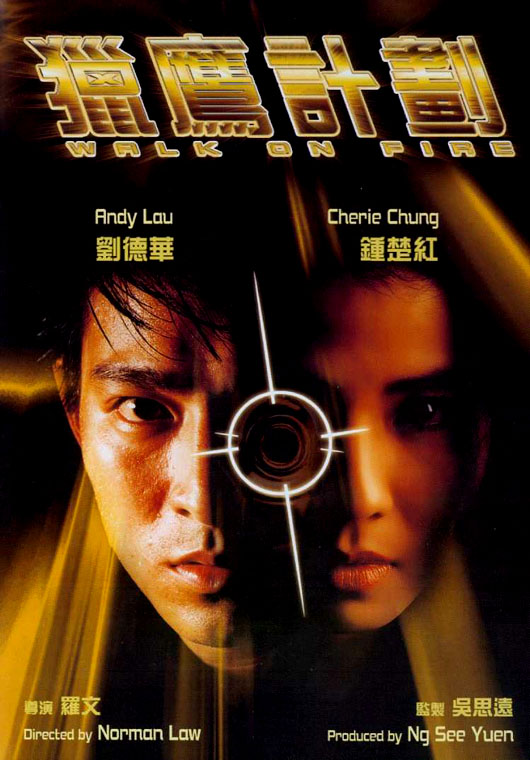
“Walk on Fire” Theatrical Poster
Director: Norman Law Man
Producer: Ng See-Yuen
Cast: Andy Lau, Cherie Chung, Kent Cheng, Ray Lui, Dick Wei, Lau Siu-Ming, Maria Cordero, Shum Wai, Kam Hing-Yin, May Hoh Mei-Ting, Yung Wai-Man, Teddy Yip Wing-Cho
Running Time: 104 min.
By Paul Bramhall
In 1987 iconic Hong Kong director Ringo Lam hit Hong Kong cinema screens with 2 of his bona fide classics, City on Fire and Prison on Fire, creating a pairing with star Chow Yun Fat that’s easily on par with the legendary John Woo and Chow Yun Fat canon. Hong Kong cinema being what it is, soon the ….on Fire naming convention was everywhere, so along with Lam’s own continuation of his themed series, we also had all manner of other previously unknown combustible material being turned into celluloid. Bet on Fire, Love on Fire, Cheetah on Fire, Rock on Fire, 1941 Hong Kong on Fire, Angel on Fire, and Ghost on Fire are just a few that jumped on the bandwagon in 80’s and 90’s. Some directors were simply lazy, such as Clarence Ford’s 1996 drama On Fire, which neglected the need to provide a preceding noun, and the Michiko Nishiwaki starring 1993 Girls with Guns flick City on Fire, which opted to steal Lam’s own title.
One of the first copycat titles to sprint out of the gates in the immediate year following Lam’s movies was 1988’s Walk on Fire. In the director’s chair was Norman Law, who’s career is best described as a journeyman director. Having debuted in 1980 with a failed attempt to launch Mars as a leading man in the old-school kung fu flick Lackey and the Lady Tiger, Law would go onto regularly pair up with actor Kent Cheng. Cheng co-stars in Walk on Fire, and would take on notable roles in Law’s other productions like 1989’s Vampire Buster, and 1994’s The Kung Fu Scholar and Bloody Brothers. Law is also notable, although whether this is a positive or negative is open to debate, for helming one of Conan Lee’s few headlining Hong Kong vehicles, with 1991’s Scheming Wonders (a so-so attempt to recreate the Tiger on the Beat formula).
While Walk on Fire doesn’t come with a particularly strong director pedigree, it does come with the honour of a script by Wong Kar-Wai. It wasn’t uncommon for Kar-Wai’s scripts from this era to deal with the crime genre, with Patrick Tam’s Final Victory and Joe Cheung’s Flaming Brothers from the previous year being prime examples. Kar-Wai himself would make his directorial debut the same year, with As Tears Go By, one of the countless late-80’s productions that cast Andy Lau as a young triad. Walk on Fire also stars Andy Lau, alongside Cherie Chung and Kent Cheng (although cruelly, Kent Cheng isn’t featured on any of the promotional material!), and is one of the rare instances out of the 25 movies Lau cranked out during 1988 – 1989 in which he gets to take a break from being a triad!
Instead, here he gets to play a cop working for internal affairs (referred to as ‘the complaints unit’ in the subtitles). Proceedings kick off with us being introduced to cops Ray Lui (To Be Number One, Flash Point) and Kent Cheng, partners who are tasked with escorting a criminal (played by Lam Kai-Wing) from Macau back to Hong Kong. When they’re intercepted, the criminal ends up getting away with his rescuers, and a car chase ensures that sees Lui doing the unthinkable (at least in 1988) by continuing to pursue across the border and into Mainland China. His antics end up drawing the ire of the Hunan Gang, led by the ever ruthless Dick Wei (The Champions, Project A), who uses one of Lui’s junkie informers played by Cherie Chung (Peking Opera Blues, and somewhat ironically, Bet on Fire from the same year) to lure him out, and after a severe beating make it look like he drove himself into the harbour drunk.
Lau, who was investigating the border crossing incident and happens to be a childhood friend of Lui’s character, smells something isn’t quite right, and ends up teaming with Lui’s former partner and his junkie informer to uncover the truth and get revenge for Lui’s death. The story, as was the case for many a HK flick of the era, is standard stuff. Once it’s established that Lui and Lau are friends from childhood, they end up going to dinner together with Cheng, Lui’s wife, and their kids in tow. Lui’s wife is pregnant and due to give birth soon, which in the 80’s HK Cinema Rulebook, pretty much signals that we can expect Lui to be killed off at any given moment. As it happens, we don’t have to wait long, as Cherie Chung turns up at the restaurant which leads to Lui needing to visit her apartment mid-meal, where Dick Wei and his cohorts are waiting.
After the brutality of the opening events the pace settles down into a typically 80’s HK mix of drama, romance, brief bursts of action, comedy, and thriller elements. For those wondering what the answer is to the million-dollar question, the answer is yes, of course we also get a romantic musical montage! Actually we get 2 musical montages, but the other one is set to Kent Cheng attempting to lose 20kg in 48 hours next to a poster of Rocky. There’s a certain Hollywood influence that can be felt during parts of Walk on Fire, with Peter Weir’s Witness and John McTiernan’s Die Hard (from the same year) being felt the most, which combined with the typical HK tropes of the time, makes for an expectedly jarring experience. While Lau and Cheng have good chemistry and fit their roles well, it’s really Chung who steals the show whenever she’s onscreen, as a cocaine addict whose addiction is a source of both tension and comedy.
In fact Law’s movie really feels like it should be played as a straight-up thriller, which often results in the occasional detours into comedy feel weirdly misplaced. In one scene Chung agrees to go on a date with Cheng’s soon to be father-in-law, who owns a jewellery store they intend to use to lure out the Hunan Gang. Shortly before the date, Lau discovers cocaine in Chung’s purse and flushes it down the toilet, which causes her to suffer from severe withdrawal symptoms just as the date’s about to begin. This leads to a comedic scene where we witness the portly Cheng running all over HK trying to score some cocaine so that the date can go ahead (it’s important to the plot, trust me!), which works by itself, but seems out of tune with the seriousness of the main plot. Despite this though, for anyone that’s even mildly familiar with HK’s output of the era, such reckless tonal shifts certainly won’t be anything new or unexpected.
While there are a handful of brief action beats scattered throughout, the main action set piece is saved for the finale. Having convinced a local gangster (played by go-to sleazy triad boss actor Shum Wai) to hire the Hunan Gang to rob the jewellery store, all the players converge for a shootout that spills out onto the streets and ends on the rooftop of a nearby high-rise. The environment sets the scene for a vicious throwdown between Lau and Dick Wei, who go at each other trading several wince worthy blows and falls, the kind of which have always been unique to this genre and era. Choreographed by the legendary Tony Leung Siu-Hung (who cameos as a policeman), while Lau is certainly no Jackie Chan (who faced off against Wei several times in the 80’s, most notably in Heart of the Dragon), their confrontation is satisfyingly hard hitting, and a reminder of just what made this era of HK action so awesome and irreplaceable.
Walk on Fire falls short of making it into the higher echelons that some of its contemporaries reside in, mainly because it never feels entirely clear what kind of movie it wants its audience to walk away feeling that it was. Part thriller, part action, part comedy, part romance, while it does all these elements in isolation competently, it never really brings them together to feel like a coherent whole. Thankfully the cast all clock in convincing performances, even when most of them where probably filming other productions at the same time, and the pace never lags, perhaps in part due to its disparate elements rather than in spite of them. If you’ve seen all the classics from the triad genre that populate the late 80’s and early 90’s, then definitely give Walk on Fire a chance, and for everyone else, the sight of Kent Cheng as a denim dungaree wearing cop should be enough to make it a worthy watch.
Paul Bramhall’s Rating: 6.5/10





Okay, I may be kind of/sort of down for this, but that cocaine/dinner date scene and the Lau vs Wei fight better be worth it.