

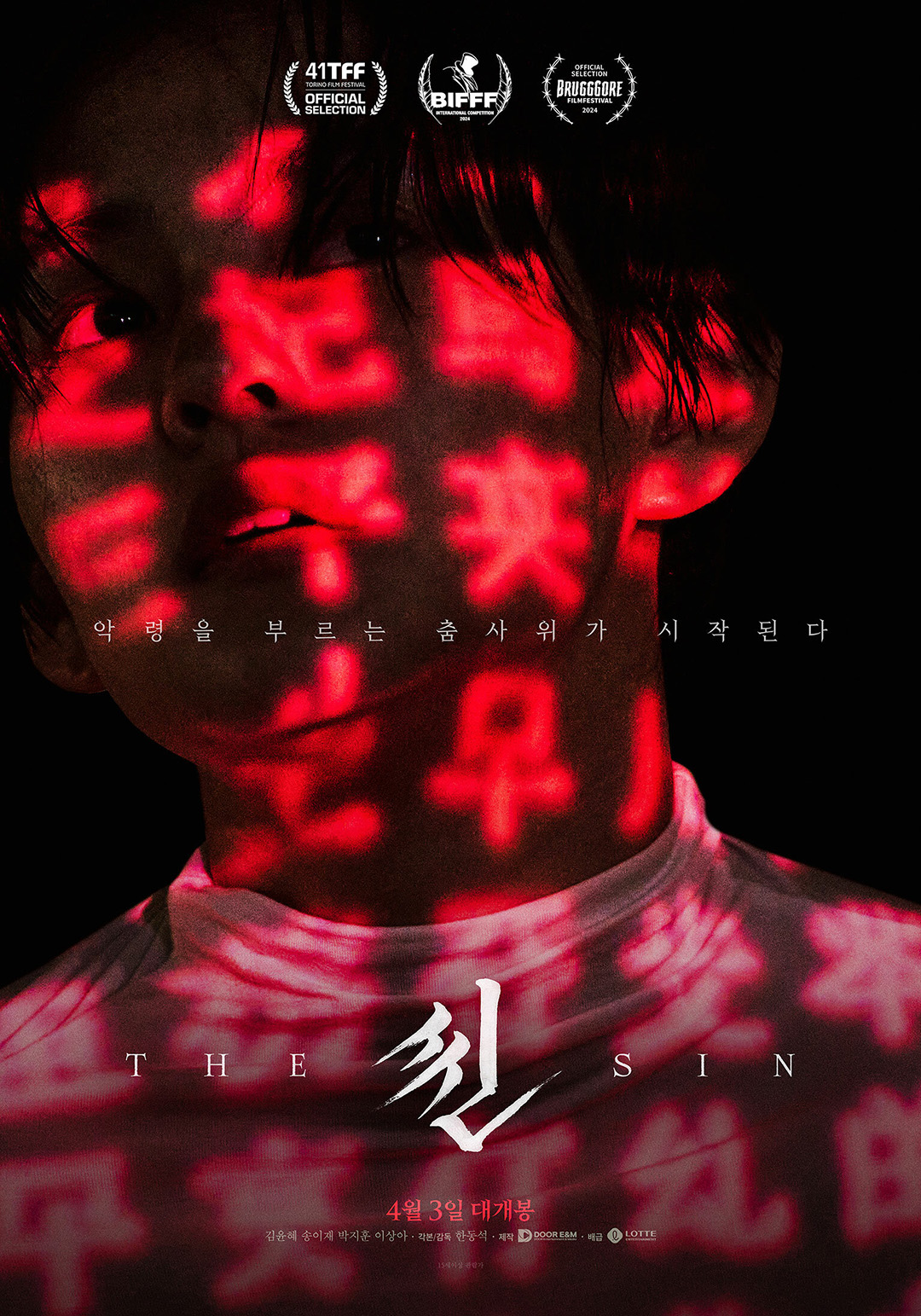
“The Sin” Poster
There are two extremes when it comes to directorial debuts in Korea – on the one end you’ve got the gritty social dramas, tending to focus on those dwelling on the bottom rungs of societies ladder and the struggles of their every day lives. On the other, you’ve got an almost avant garde approach that could best be described as go hard or go home, in which first time filmmakers go for broke in bringing their most creatively ambitious ideas to the screen like they’d never have a chance to make a sophomore feature. Of course, sometimes that turns out to be exactly the case. We’ve never heard from director Lee Sa-rang again after 2017’s wildly chaotic debut Real, nor from Jude Chun after 2022’s Unidentified, however a part of me still hopes that we do. The same applies for Han Dong-seok, who in 2024 made his debut with The Sin.
Best described as a Korean take on the arthouse genre, proceedings open in a suitably meta manner with a director, played by Park Ji-hoon (The Boys, Gentleman), looking to cast a dancer as the lead for his new movie, of which details like story and characters are scarce, except for the fact that it’ll be “experimental”. A budding dancer, played by Kim Yoon-hye (The Advocate: A Missing Body, Ghost Sweepers), is successful in auditioning for the role, and despite the lack of detail over the kind of movie she’s getting involved in, agrees to come onboard. With shooting commencing in an abandoned university, upon arrival it’s clear something’s amiss. For a start it turns out she’s not the only star of the movie, with an acquaintance from her dance academy days already on location in a similar role, played by Song Yi-jae (One Win, Not Out). It’s obvious there’s tension between the pair, but why we don’t know.
Whatever tension there is though is put aside when it becomes increasingly clear that Ji-hoon has no idea what he’s doing as a director, and the film crew themselves are somewhat of a shambles. The disorganisation comes to the fore during a scene being shot on the building rooftop, which sees a member of the production team lose their footing and fall to the ground below. The scene feels like a culmination of a sense of gnawing dread that Dong-seok masterfully weaves into the narrative from the opening credits, using a mix of non-linear storytelling and a disorientating soundtrack, keeping the audience at arm’s length as to what exactly is going on. It’s fair to say though that I don’t expect many who watch The Sin will be expecting the lifeless team member who fell from the roof to suddenly become a reanimated member of the undead, and turn The Sin into the latest Korean zombie outing.
This is exactly what happens though, as the blood thirsty zombie goes on the rampage, while Ji-hoon continues to film. So, what originally appears to be pitching itself as an arthouse flick about a director making an experimental dance film, suddenly turns heel and starts acting like a Korean take on One Cut of the Dead (just minus the comedy element). As it turns out though, the arrival of zombies into the narrative of The Sin is only the first of several unexpected (and I do confidently say almost all of them will be unexpected) twists that Dong-seok’s script (co-written with Kim Soo-young) throws at the viewer. Despite its punchy 100-minute runtime, it’s been a long time since I’ve seen a movie which so relentlessly assaults (and I choose that word very intentionally) the concept of narrative pacing with its twists and turns.
The Sin is a movie which requires complete attention in order to make sense of its eventual conclusion, and while that’s never a bad thing, the issue is some of elements introduced don’t do enough to warrant complete attention. The biggest issue is the sheer number of (what initially seem like) sub-plots, each injected into the narrative in such a way that it becomes a chore to keep track of. Police show up, who are apparently after a stash of drugs located somewhere in the university. A bunch of gangsters show up, led by Lee Sang-ah (Bittersweet Brew, Speed), whose lackeys wear mildly disturbing masks over their faces. There’s a high school romance angle told in flashback that may have something to do with the present. Oh, and the dance that Yoon-hye has been performing may have been a ritual to raise the dead.
While all of these disparate elements ultimately do add up to a cohesive whole, Dong-seok’s position as a debut director and script writer shows through in the way they’re introduced, sometimes to the detriment of the pacing. The whole storyline involving the cops and the gangsters initially fails to engage in a meaningful way, seemingly appearing for no other reason than to be fodder for the increasing number of zombies, padding out proceedings since the film crew themselves wouldn’t be enough to sustain the entire runtime.
However to assume that The Sin is a zombie movie would be a misdirection. It’s actually far from it, but to go into any further detail would involve spoilers. What is safe to say is that the final third brings things together in a satisfyingly out there manner, becoming increasingly outlandish the closer we get to the closing credits. A series of revelations come across like a mix of Park Hoon-jung’s The Witch: Part 1. The Subversion and Na Hong-jin’s The Wailing, upending established assumptions that the plot has introduced so far, with a re-watch practically guaranteed to be a different experience to the initial one. The incorporation of shamanism sends the plot in a completely different direction, and the sheer audacity of Dong-seok’s genre bending as a form of narrative disguise is admittedly to be admired.
As the closing credits did eventually roll, I became aware The Sin left much more of a positive impression on me once all was said and done than what I’d thought when it was only mid-way through, when the non-linear plot at times felt like it probably made sense to Dong-seok but very few others. Thankfully even with the frequently bewildering middle, the chemistry between Yoon-hye and Yi-jae serves as enough of a dangling carrot to keep on watching. It’s never implicitly stated as to why there’s tension between the pair, which makes the eventual revelation as to what the relationship is between them all the more effective, offering up the kind of “I didn’t see that coming” moment that feels increasingly rare in today’s cinema landscape.
While I started this review describing The Sin as a take on the arthouse genre, much like the production itself by the end that’s no longer the case, with the direction the story eventually goes in veering into the realm of psychological horror. Had I known it was a horror beforehand, I’m not sure what my reaction would have been to the artier opening reel, which had me convinced I was going to be watching some kind of exploration of trauma through dance or something equally existential. As it stands, the whiplash induced from the switching up of genres ranging from zombie survival, to gangster thriller, to the supernatural was ultimately worth it, crafting a tale that uses cinema as the medium it’s intended to be – visual storytelling.
Best described as a shamanistic fever dream, while there are undeniably some missteps along the way, ultimately Han Dong-seok delivers on the ambition of his debut work, proving the theory true that sometimes finishing strong is enough to make up for any earlier misdemeanours. A mid-closing credits sequence dares to offer up the proposition of a sequel to The Sin, and while I’m not sure how effective it would be since all the cards have been placed on the table, if Dong-seok did opt to continue the story it’s one that I’d happily clock in for.
Paul Bramhall’s Rating: 7/10