




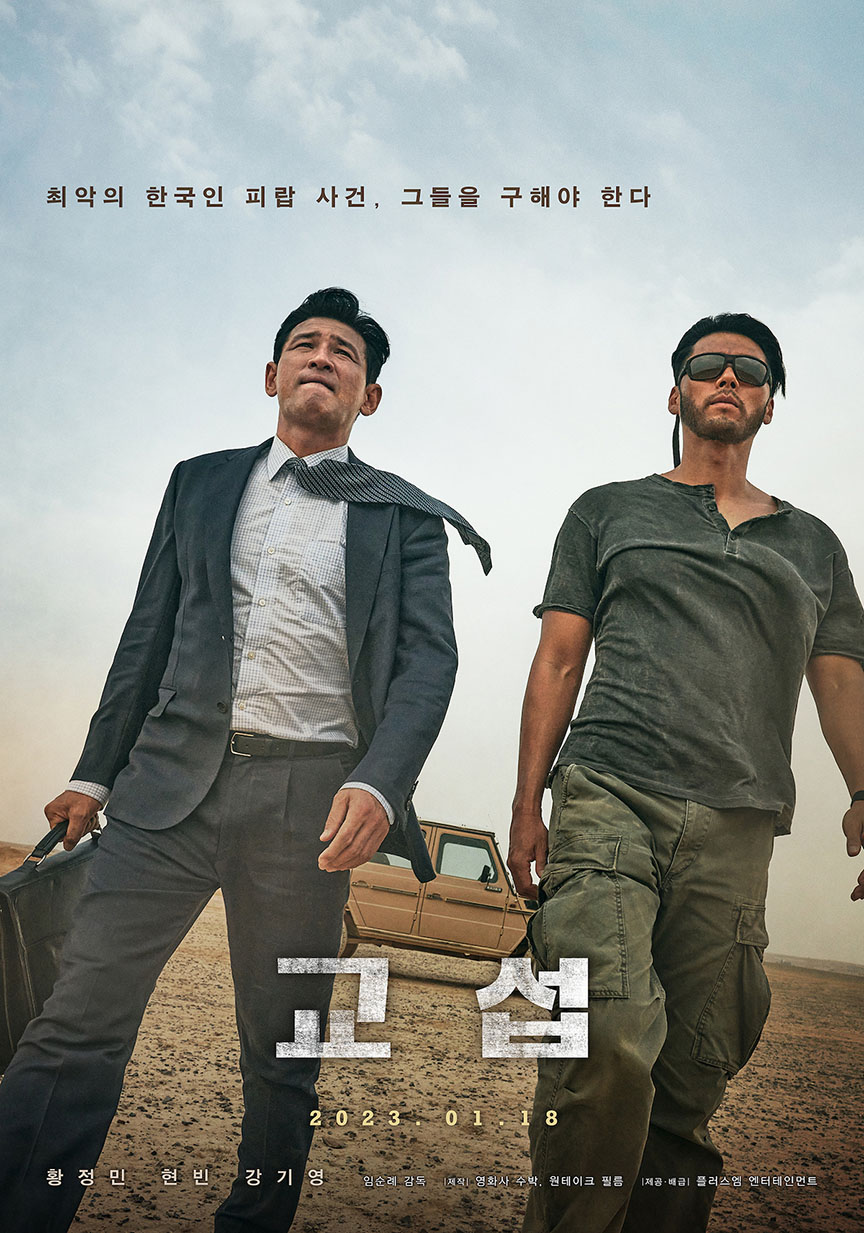
“The Point Men” Theatrical Poster
Director: Yim Soonrye
Cast: Hwang Jung-Min, Hyun-Bin, Kang Ki-Young, Park Hyoung-Soo, Ahn Chang-Hwan, Jeon Sung-Woo, Lee Seung-Chul, Jung Jae-Sung, Seo Sang-Won
Running Time: 108 min.
By Paul Bramhall
In recent years the film industries in Korea and China have seemingly stumbled upon a new goldmine to extract source material for their cinematic output – true stories involving their citizens either being kidnapped and/or placed in danger in troubled faraway lands, and how of course they were rescued. Korea in particular are on a roll, apparently realising just how many of their citizens have been placed in peril overseas through the years. Escape from Mogadishu told the story of how diplomats from the North and the South escaped from Somalia in the days leading up to the civil war, while Ransomed used the kidnapping of a Korean diplomat stationed in Lebanon during its own civil war as its source. Both productions have been reviewed here on cityonfire previously, and between their releases, another hit local cinema screens in the form of The Point Men.
With Somalia and Lebanon both having had their time in the spotlight, this time it’s the turn of Afghanistan. Specifically an incident which took place in 2007, wherein a group of 23 Christian missionaries, having disregarded government travel warnings to avoid Afghanistan, decided to go anyway, and ended up captured and held to ransom by the Taliban. The demands were for an equal number of Taliban prisoners to be released and for Korea to withdraw its troops by the year end, only some of which were met, ultimately leading to 21 of them being released 6 weeks later, with 2 killed during negotiations. The story of those negotiations and the drama which unfolded around them is what acts as the basis for The Point Men’s narrative.
A surprising outing for director Yim Soon-rye, a filmmaker responsible for some of my personal favorite titles from the Korean wave era like 2001’s Waikiki Brothers and 2010’s Rolling Home With a Bull, to see her handle a politically charged thriller like this one was an appealing prospect. Taking center stage is Hwang Jung-min (Deliver Us from Evil, Veteran), playing a diplomat working for Korea’s Foreign Ministry, a role that sees him tasked with travelling to Afghanistan to handle the negotiation. It’s once there that he crosses paths with a brooding NIS agent, played by Hyun Bin (The Negotiation, Rampant), whose local knowledge proves to be an asset in securing the hostages safety. While reluctant to accept Bin’s help, ultimately the pair develop a mutual respect, realising they’ll have to work together if there’s any chance of securing the hostage’s release.
Despite the true story origins of The Point Men, much like its contemporaries the narrative follows a familiar template. The kidnapping takes place as one of the opening scenes, swiftly followed by scenes of frazzled diplomats in their office, then the story begins in earnest as the suited-up diplomat arrives at the foreign airport. Of course, such productions are also guaranteed at least one scene where the line “a governments duty is to protect its citizens” is spoken, and this one doesn’t disappoint. Unfortunately everything else does, with Soon-rye’s latest never feeling anything more than overly familiar, and the issues that plague other productions based on similar events are all here present and accounted for.
Hwang Jung-min, an actor with a level of screen presence that even during his most over-exposed period (he starred in 10 movies between 2013 – 2016, a time which literally felt like he was everywhere!) remained watchable, here seems to visibly struggle to make something of his role. One dimensional characters are an inescapable fact in these productions, but even with already reduced expectations, Jung-min’s diplomat is shockingly wafer thin. He’s the civil servant sent to Afghanistan is the most characterisation we get, leaving a performance that consists almost entirely of pursed lips or gritted teeth. When neither of those, we’re subjected to a lamentable bombardment of poorly delivered English dialogue, which only serves to pull the audience out of what little investment they may have had.
The hostages fare even worse, with most of their screen time limited to huddling in the corner of a cave, their only job to periodically look scared when having a flashlight shone on them. There seems to be an expectation with such narratives being based on reality that this alone should warrant an audience’s investment, but unfortunately cinema doesn’t work like that. We need some reason to care that they’re freed, however for most of the runtime it’s hard to sympathise with a group of missionaries who willingly travelled to Afghanistan knowing they could be kidnapped.
The decision to frame the narrative by periodically displaying how much time is left onscreen should act as a device to ramp up the tension, however the fact that the negotiations frequently stall or go off the rails only serves to render it pointless. Initially given 24 hours to agree to the Taliban’s demands, at one point ‘4 hours left’ flashes onscreen, however an hour later, another ‘4 hours left’ appears onscreen since the timer was reset, skip forward 30 minutes and its days that are being referenced! The constant stop-start saps the framing device of any tension, reducing clusters of scenes to feel more like mini-soap operas, each one ending on its own cliff-hanger, and the only guarantee being that whatever comes next will involve more exasperated outbursts and shouty line delivery than what’s come before. We even reach a point where Hwang Jung-min is reduced to screaming into a pillow.
Confounding everything is some bizarre tonal choices. The inclusion of Kang Ki-young (The Book of Fish, Exit) as a comedy relief interpreter seems like he’s been beamed in from another production all together. Offering up the usual comedic shtick of wanting to avoid translating what one character wants to say to another, Ki-young’s interpreter feels fundamentally at odds with the seriousness of the events at hand, and makes for a jarring presence whenever onscreen. Similarly there’s an equally bewildering inclusion of an action scene, one that sees a motorbike riding Hyun Bin give chase to a duplicitous British businessman (played by Brian Larkin – Chasing the Dragon, I Am Vengeance), and culminates in a stunt straight out of John Woo’s Hard Target that grates against the grounded tone of everything else.
At the heart of it, back and forth negotiation is really what The Point Men is all about, ending in a painfully protracted negotiation scene between Jung-min and the Taliban leader (played by Fahim Fazli – Kill Boksoon, 12 Strong) that mistakenly believes tense facial muscles translate to tension for the audience. For most it will have been such a slog to reach this point that it feels like a small mercy when the negotiation finally reaches its conclusion, although even this scene is overstretched thanks to the Taliban having one final condition, offering up Hyun Bin one last opportunity to simmer for the camera.
Arguably the biggest misstep arrives in its final scene, wherein having watched an adaptation of a real life event that involved 2 hostage deaths, we’re faced with a scene that proposes The Point Men as a potential franchise worthy of a sequel. Back in Korea news breaks of Somalian pirates hijacking a Korean cargo ship, and the Korean government need someone to defuse the situation and ensure the safety of those onboard. Cue the camera panning to Jung-min, before the end credits appear onscreen. Frankly it’s so misguided I found the scene to be mildly humorous, as the thought that there could be a negotiation themed franchise with a frazzled diplomat as its main character is so ridiculous it may just work. So who knows, in 2025 we could be reviewing The Point Men 2, but for now, Soon-rye’s foray into the ‘diplomat in peril overseas’ genre is as predictable as it is monotonous.
Paul Bramhall’s Rating: 5/10
https://www.youtube.com/watch?v=8GOuBIDtENc









Just waiting for that Soth Korea/China crossover….The Point Men vs Wolf Pack. They spend most of the runtime argung its its kimchi or paocai. Meanwhile the hostages have already been excecuted
Considering relationships between the 2 countries at the moment I think we may get a South Korea/North Korea crossover first, but either way, I’d be first in line!
Why is this sub-genre so hard to make a good movie out of?