


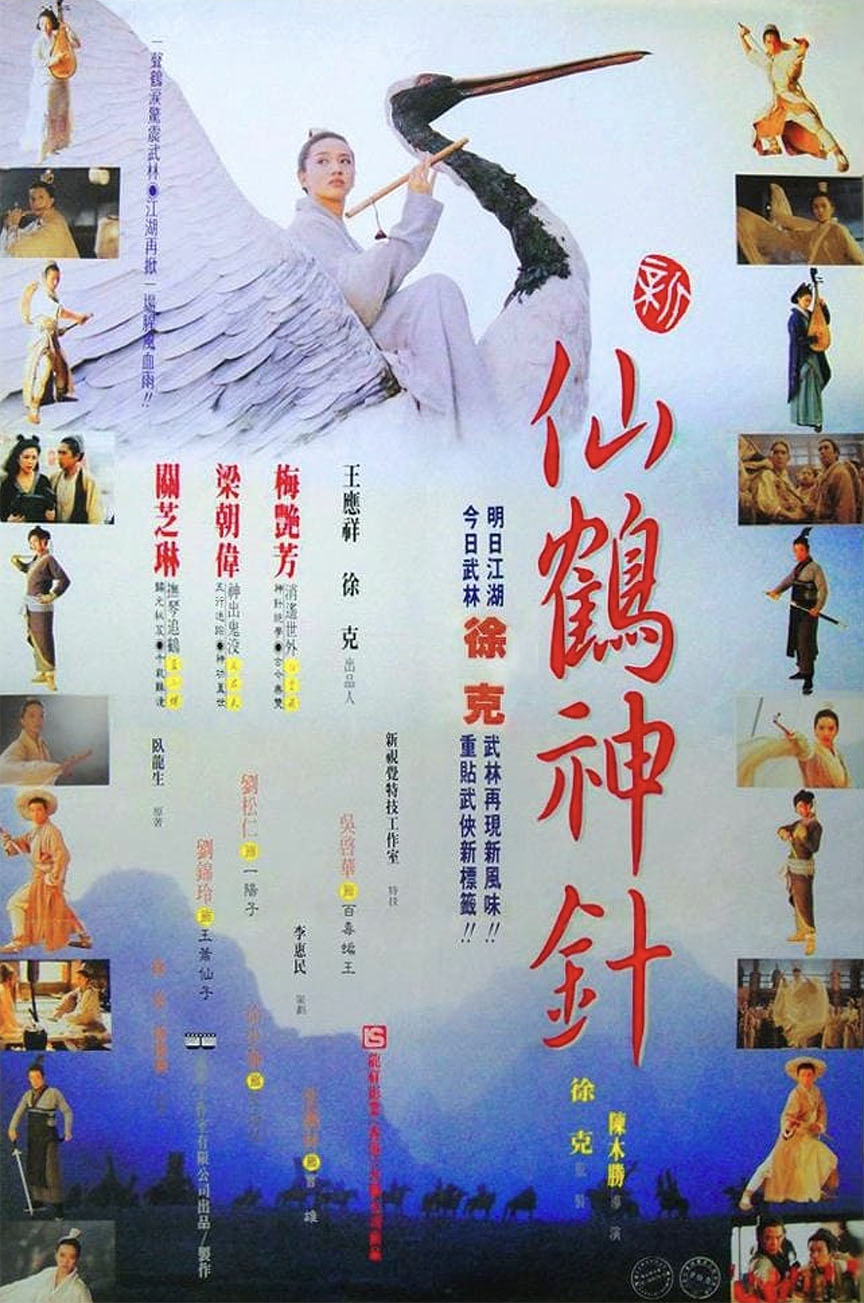
“The Magic Crane” Theatrical Poster
Director: Benny Chan
Cast: Tony Leung Chiu-Wai, Anita Mui Yim-Fong, Rosamund Kwan Chi-Lam, Damian Lau Chung-Yan, Lawrence Ng Kai-Wah, Norman Tsui Siu-Keung, Zhang Tielin
Running Time: 96 min.
By Paul Bramhall
In 2017 the late director Benny Chan unleashed Meow onto the world, the tale of Louis Koo and an oversized ginger cat from space, a production which had much of the action maestro’s fanbase scratching their heads as to what exactly was going on. For long-time fans of Chan though, as tough as it is to admit, Meow wasn’t the first time for the director to dabble in the world of oversized animals. Admittedly you have to go back almost 30 years, however the fact remains that in 1993 the world was gifted with The Magic Crane, which saw Hong Kong icon Anita Mui flying around on the back of a, well, gigantic crane.
After his debut co-directing 1988’s Let’s Rage the Gangland with Chik Kin-Chung, Chan dabbled in various genres during the first 5 years of his directorial career, but all shared a contemporary setting. The Magic Crane would be the first and last time he’d helm a new wave wuxia flick, and he did so working from a script written by Tsui Hark, who also sat in the producer’s chair. If any one man was responsible for igniting the new wave wuxia genre then it was arguably Hark, and by 1993 it felt like he’d penned so many movies that he realised he’d never be able to direct them all himself. So while he did helm Once Upon a Time in China III and Green Snake, for the rest of the year he let other directors take the reins, and took a step back as producer.
Yuen Bun got to make his directorial debut with Once Upon a Time in China IV, Raymond Lee and Ching Siu-Tung shared directing duties on The East is Red, Yuen Woo-Ping took on Iron Monkey, and it was Chan who’d be trusted to bring The Magic Crane to the screen. Surprisingly, the titular crane in question isn’t actually all that important to the plot. It’s kind of like if Moon Warriors from the previous year was called Killer Whale instead, although at least in that movie the whale was real. Here the oversized crane relies on a mix of miniature puppetry for shots of it flying in the distance, and for its close-up appearances we get a slightly clunky but impressively to scale mechanical model.
Like most wuxia’s based on novels (this one is based on one by Wolong Sheng), the plot is a convoluted affair with a plethora of characters. Essentially it involves the equivalent of a martial arts business conference, with 9 schools meeting up to agree on the dividing up of territory, and hopefully live in peace. Tensions are running high though, with mistrust between certain factions, and an aggressively ambitious master played by Lawrence Ng (To Be Number One, Lethal Panther) keen on taking over more territory than what he came in with. Tony Leung Chiu-Wai (Hard Boiled, Europe Raiders) plays the only student of the most pitiful school, and it’s when he accidentally falls off a cliff that he finds himself rescued from certain death by the giant crane.
From there, the plot throws itself around like a pinball table in heat. Anita Mui (Rouge, A Better Tomorrow III) rides around on the crane with a flute, and has to deal with her vengeance seeking sister who she never knew she had, played by a lute brandishing Rosamund Kwan (The Head Hunter, Undeclared War). The different martial arts schools end up at each other’s necks through a series of both comedic misunderstandings and straight-faced double crossing. One of the masters played by Zhang Tie-Lin (Once Upon a time in China II and V) is forced to eat half of a secret scroll and accidentally turns into a superpowered madman that wants to kill everyone. There’s a kaiju sized tortoise that has its gall bladder ripped out (comparatively Gamera had very little to worry about!). Oh, and rubber bats, lots of them.
If you’re looking for coherent plot structure and clearly defined motivations, then The Magic Crane probably isn’t the movie for you. On the other hand if you’re looking for the typically manic paced energy that so many of the new wave wuxia’s of the early 90’s were imbued with, then you’re definitely in luck. Many of these movies can be split into 2 categories – those that cast legitimate martial artists in the lead roles, and those that didn’t. While Swordsman 2 and Butterfly & Sword benefitted from casts that included the likes of Jet Li and Donnie Yen, others like Three Swordsmen and The Dragon Chronicles: The Maidens of Heavenly Mountain relied on the presence of popular actors of the era like Andy Lau and Brigitte Lin. Thankfully the wirework heavy nature of the new wave wuxia genre didn’t necessarily call for martial arts expertise, however there can be do doubt that their physical talents certainly helped.
The Magic Crane falls into the latter category with no real martial arts talent so to speak, however choreographer Lau Chi-Ho (Duel to the Death, A Chinese Ghost Story II) makes up for it by going big on the spectacle front. The faceoff between the giant crane and tortoise is probably the closest a Hong Kong production has gotten to a kaiju showdown, and sets get blown up with gleeful abandon once everyone starts to take flight (which is frequently!). Having Tsui Hark in the producer’s chair seems to have allowed for a sizable budget, and it’s used to create some memorable imagery. In one scene Anita Mui and Rosamund Kwan face off on the deck of a ship, while the ocean that surrounds them explodes in geysers of towering water, an epic shot that acts as a reminder of the power of practical effects.
Compensating for the lack of martial arts prowess, both Anita Mui and Rosamund Kwan rely on the deadly musical instruments that they carry with them to attack their enemies (and each other), with Mui opting for a flute, and Kwan brandishing a lute (pre-dating the deadly lute in the following years Deadful Melody). The wirework doesn’t quite reach the heights of what we were seeing from Ching Siu-Tung and Yuen Bun at the time, however the sheer volume of it makes it difficult to not be entertained, and you know things aren’t afraid to get crazy when at one point the actual flute and lute fight each other in the air.
The final battle in particular is a hoot, as the ladies, Tony Leung Chiu-Wai, Norman Chu (playing the father of Anita Mui and Rosamund Kwan), Damian Lau (playing Tony Leung’s master), and the crane all come together to fight Zhang Tie-Lin, who’s come to the party brandishing a massive metal bell the same size as he is. The ensuing battle is an entertaining mix of high-flying energy blasts and wonton destruction, including the crane taking a somewhat kamikaze approach to its contribution in defeating the enemy. If you thought the flute action in American Pie was a unique use of the instrument, I challenge anyone to watch The Magic Crane and not be impressed by how Tie-Lin is ultimately disposed of. Definitely a classic example of “things you can only see in a Hong Kong new wave wuxia flick” (right after Donnie Yen being reduced to half a skeleton in Dragon Inn!).
By the end of the 90’s Benny Chan had established himself as a successful commercial director of contemporary action flicks thanks to the likes of Big Bullet, Who Am I? and Gen-X Cops, so if anything The Magic Crane is a rare opportunity to see him apply his craft to the wuxia genre. While there’s not much on display to separate it from the rest of its energetically paced peers of the era (well, ok it’s the only one with a giant crane), there’s still plenty to enjoy, and the action comes thick and fast. Plus, kudos goes to Rosamund Kwan for the way she breaks up with Tony Leung after they’ve slept together, telling him not to worry because “What you’ve left inside my body’d be squeezed out by my Kung fu!” Brutal.
An entertaining genre effort and the only time Anita Mui got to headline a wuxia flick (and of course sing the theme song, which she did with Jacky Cheung), for fans of both new wave wuxia’s and the impressive cast, The Magic Crane is worth a watch.
Paul Bramhall’s Rating: 6/10







These wuxias are a lot of fun. The faces and talent make these pictures sparkle, unlike the pedestrian CGI efforts these days. #oldman