
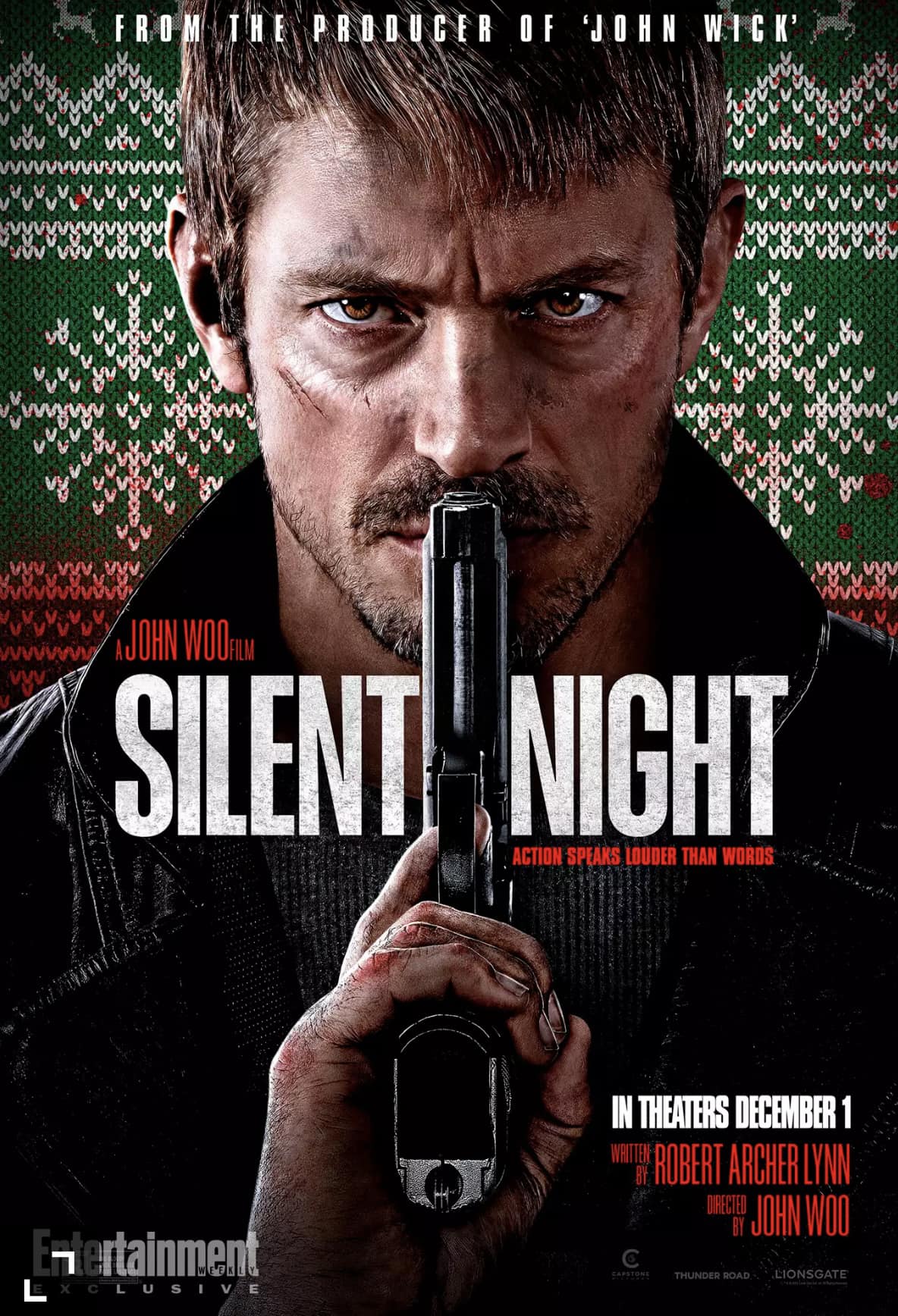
“Silent Night” Theatrical Poster
Director: John Woo
Cast: Joel Kinnaman, Scott Mescudi, Harold Torres, Catalina Sandino Moreno, Yoko Hamamura, Vinny O’Brien, Anthony Giulietti, John Pollack, Angeles Woo
Running Time: 104 min.
By Will McGuire
Silent Night represents John Woo’s return to Hollywood after a twenty year absence. Trailers breathlessly proclaim him to be “the Michelangelo of the Action Film”, and this film is clearly meant to re-introduce him to an American audience before his long awaited English language remake of The Killer drops next year. As a long time fan, I was heartened to see the respect paid to the Maestro, but most intrigued by the specifics of the film itself. You see, Silent Night is a dialogue free 90 minute revenge story, and the idea of one of the most dynamic living visual storytellers having to carry the narrative of a feature film without words was irresistible.
Does the film actually live up? Mostly.
I got very excited during the first third of the film because it felt like we were watching a great film develop. The very first sequence reveals the dramatic potential of the gimmick: Joel Kinneman, decked out in a bad Christmas sweater, is running at top speed down an alley. He hops a guardrail, slides down an embankment to a lower street and stops, listening for something. Far in the background we see two cars exchanging gunfire and there’s a beat where we think “Ok, he’s safe.” Then after a big ambiguous close up he takes off towards the gunfire, and we realize he’s not running from anything…he’s running after these people.
The story is absurdly simple: Kinneman plays Brian, a young father whose son is killed on Christmas Day as an innocent bystander in a gangland shooting. When Brian runs down the gangsters, he’s shot in the throat and rendered mute by gang leader Playa (Harold Torres). Brian recovers physically, but cannot find a reason to go on living until the following Easter where he resolves himself to avenge himself the following Christmas. The final act is his rampage of revenge through Playa’s organization.
The first two thirds are inventive: filled with slick transitions, and made with a lot of trust that the audience is watching closely and thinking about what they’re seeing. It should be noted that the film doesn’t have quite as much trust in the audience as one would like: it uses diegetic radio broadcasts and text messages to establish setting and to “stand in” for dialogue in places.
Even with that small caveat, the first hour creates momentum at a maniacal pace. The symbolic “death” and “resurrection” of Brian (which Woo, one of our great Christian filmmakers, times to Christmas and Easter) coincide with a moral dissolution as he neglects his grieving wife to the point where she is forced to abandon him. Finally after all the training montages we could want December 24th gets circled and we’re ready to see the payoff for all this investment.
And…it’s just good.
The action reminded me very much of Woo’s 2017 film ManHunt with the free combination of vehicles and gunplay but without that film’s tendency to wink at the audience during every big action sequence. There’s a lot of kinetic impact but it lacks the high style of Woo’s Hong Kong oeuvre, there’s a great emotional investment from Joel Kinneman but once the shooting starts he becomes just another action hero. Admittedly, there is one truly great moment in the third act for a Woo fan where his trademark “criminal and cop find mutual respect for one another on the battlefield” trope is basically condensed into a thirty second silent bit of sustained eye contact, but other than that I felt that the ending let down the set up.
The problem, to me, seems simple enough to diagnose: they had a neat narrative gimmick in the service of a very simple story and in the first two acts the gimmick livened up familiar tropes and made everything feel fresh. That said, when the shooting started the gimmick became a hindrance and since the no dialogue limitation had to be in service to the story, they never asked themselves “What kind of third act would work best for a film without dialogue?” rather than “How can we get to the big shootout we need at the end.”
Now don’t get me wrong: two-thirds of a really good movie and one-third of an acceptable movie adds up to a pretty good movie. This is an easy recommendation, and should be a hearty “Welcome back!” to one of our greatest living directors, and it mostly is. I just can’t help but think another draft, with a stronger finale, would have elevated this from good to incredible. Woo got a lot of good shots in, but he left with bullets still in the clip.
Recommended.
Will McGuire’s Rating: 7/10



Excited to see this film upon reading the review
I’ve probably been Woo’s biggest defender for the last several years. While most people hate his non Heroic Bloodshed films, I’ve liked them just fine, and it was unfortunate that many people didn’t want to give Silent Night a chance.
Frustratingly, I like the film, but it’s flawed. The reference to Face/Off where Joel hugs a kid who reminds him of his son just shouldn’t have played out like that, especially since we know he’d be super pissed off if some stranger was hugging his son.
I wouldn’t say that Joel was just another action hero as he certainly did not have the refinement of one. He’s sloppy and awkward in combat just like a real life regular person would be, and that was a good change of pace from the norm. I do wish that his character went to a martial arts school instead of copying YouTube videos though.
The end felt anti climatic in that the crazy heroin lady should not have given him so much trouble, and the final confrontation with the villain should have been more satisfying. I also have mixed feelings about what Joel’s endgame was, as I don’t think it should have been the kind of mission it ended up being.
I am sad about the terrible 3 million dollar opening. For that I have to ask for the millionth time, what is wrong with modern audiences?
Theres nothing wrong with modern audiences.
This movie was awful and nobody cares about John Woo.
watched it myself yesterday and I must agree with Will’s review on the key points.
my surprise was that for the first time in his career, Woo seemed way more invested in the reverberating echo of personal trauma and pain of loss of the son than anything else, and that included the rest of the story, Brian’s relationship with his wife, any details of the gangs, and even the action when it finally came.
if you look carefully, almost all of his fun bag of editing signatures and unusual visual tricks were saved for moments of memory or trauma. The weird freeze fades, match cuts, shot overlaps, odd transitions and the like richly reinforced the absent present of Brian’s son throughout. Everything else is a sketch at best.
I rewatched Better Tomorrow, Manhunt, Hard Target, Paycheck, and the half Woo knock off Replacement Killers before this just so I’d get a fresh memory of Woo at different points in his career plus an imitation for comparison. It’s weird because when compared to these, Silent Night is both pure Woo in the dramatic bulidup and hardly Woo at all in the action. It resembles A Better Tomorrow most in the oppressive, constant anger and sadness over injustice, but shockingly it was possibly even less Woo than Replacement Killers in the action department (shocker!). It’s also the total opposite of his last film, Manhunt, where he was indulging his own visual identity egregiously near parody levels at the expense at any kind of genuine emotion or character building within a generic impersonal story, and had endlessly clunky trilingual dialogue. He way overcorrected. I read some people likened it to Hard Target, but watching the workprint, it struck me how top of his game Woo still was back then, and the complexly orchestrated action there was only second to Hard Boiled in its uncut form. Silent Night on the other hand is a regression to something more basic and unrefined before even the first Better Tomorrow. Its action is so far removed from what I associate with Woo, with none of the timing, choreography, finesse, framing, camerawork and editing that made him such a peerless master. Where were the multi-angle overlapping staggered cut ins for dramatic emphasis? The fast-slow-fast cuts? The debris and sparks and the layering of flying bodies between different depths? The balletic matching movement of camera and character that connected unexpected shots? He either wasn’t trying, limited by time and budget, or deliberately distancing himself from his usual. The editor he worked with here, Zack Staenberg, was the editor on the first Matrix movie, and it shows in how he lingers on slow mo action shots long enough to kill momentum, where slo mo in old Woo they always serve as brief emphasis between much faster motion. And like most American studio movies coming out these days, the lighting is way too dark for no apparent reason.
All in all, a disappointment, but I’m glad I got to watch my first Woo movie on a big screen and I’ll always be a fan.
BONUS: If you want to see some peak Woo-like action in 2023, go watch the Indian film Animal. It’s not an action movie overall, more like a crime epic ala Scarface, but in the middle there’s this insane billion bullet hotel shootout between four guys and a hundred goons that resembles Woo gunplay in rhythm, editing, movement and style more than anything Woo has made in the last 20 years.
Interesting thoughts. As far as Woo’s take on action goes for Silent Night, I do think he was distancing himself from what he’s done before, and in that regard, he succeeded in making something unique. There was a YouTube video that actually did a breakdown of how Woo still used his Peckinpah-esque approach, and I’m kicking myself for not being able to find it again.
Woo’s Heroic Bloodshed movies are like a ballet of carnage, while Silent Night is something else while maintaining what made Sam Peckinpah films special. Unfortunately, that doesn’t seem to sit well with a lot of people who want their action to be slicker and done by a protagonist with high skill.
If it doesn’t do well in theatres, I hope Silent Night does better on streaming and home video.