

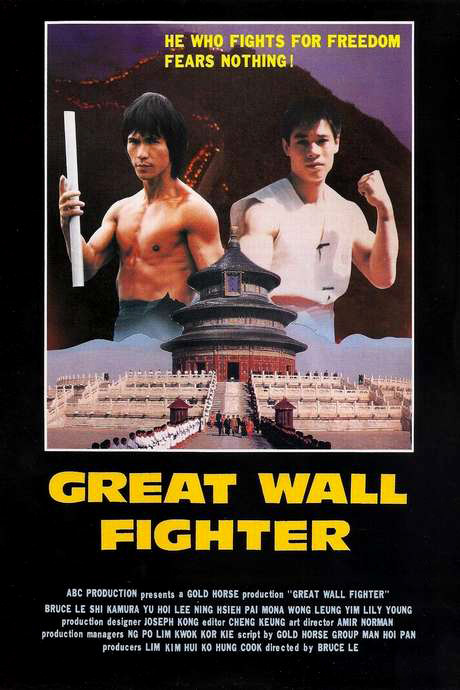
“Ninja Over the Great Wall” Theatrical Poster
AKA: Fire on the Great Wall
Director: Bruce Le
Cast: Bruce Le (Huang Kin Long), Li Ning, Yu Hai, Leung Yim, Shikamura Yasuyoshi, Cheng Yuen Man, Xue Bai, Gao Jian-Hua, Ma Zheng, Yang Li-Xin
Running Time: 90 min.
By Paul Bramhall
After spending 10 years playing various incarnations of Bruce Lee within the infamous Bruceploitation genre, Huang Kin-Lung (or Bruce Le as he’s more commonly known) directed what could be considered his first production which didn’t rely on the connection to the Little Dragon. Out of all the clones that sprung up in the wake of Bruce Lee’s death, it’s Le whose filmography most represents someone attempting to take control of his own career. Originally hired by the Shaw Brothers studios and cast as a supporting player in the likes of Rivals of Kung Fu and Big Brother Cheng, Le quit before being given a shot at lead role, and subsequently found himself inadvertently cast as a Bruce Lee clone. What was the job of a Bruce Lee clone? To put it simply, it was to have a passing resemblance to Bruce Lee, some martial arts training, and be cast in Bruce Lee-esque movies to try and fill the massive void the stars passing left behind.
Compared to his contemporaries – the likes of Bruce Li and Dragon Lee – Le featured in some truly bottom of the barrel fare. Usually shot in the Philippines, watching titles like Return of Bruce and Treasure of Bruce Le are often touted to be more effective torture techniques than waterboarding. However in the 1980’s Le seemed to take more control over his career, and began directing as well as starring. Seemingly aware that the Bruce Lee schtick was his money maker, if you’re going to be a clone, you may as well try and be a good one. So it was the likes of Bruce – King of Kung Fu enlisted Sek Kin as its main villain, a role he’d also played in Enter the Dragon, Challenge of the Tiger saw him battling a bull (and Hwang Jang Lee) in Spain, and Bruce Strikes Back saw him rampaging through Italy and Paris. Le’s movies began to feel more like they’re inspired by Bruce Lee rather than blatantly copying him, and they became fun!
After 1982’s Bruce Strikes Back Le went quiet for 5 years. Maybe he went up a mountain to find himself, or simply tired of the global gallivanting, but it wasn’t until 1987 that he’d return with Ninja Over the Great Wall. Le’s return was an unexpected one. In 1987 Bruceploitation was essentially a thing of the past, at least in the form of actors attempting to be passed off as Lee, or playing a character he’d portrayed. Bruce Li had wrapped up his clone career with 1981’s The Chinese Stuntman, and Dragon Lee concluded his Bruce Lee phase with 1983’s Martial Monks of Shaolin Temple. The world was no longer interested in seeing impersonations of Bruce Lee, with stars like Jackie Chan, Sammo Hung, and Yuen Biao representing the new faces of Hong Kong action cinema. For a Bruceploitation star, to attempt a comeback didn’t make a whole lot of sense on paper.
But Le had other ideas. Ninja Over the Great Wall ditches both the European and South East Asian filming locations (and Hong Kong itself for that matter), and moves things to the Mainland. Taking place during the Japanese occupation in the 1930’s, after his village is raided by the Japanese army Le flees to Beijing, where he meets other patriots eager to get rid of them. The opening credits are preposterously bombastic, with onscreen titles like ‘LEE NING – THE WORLD CHAMPION OF GYMNASTICS’ and ‘LEUNG YIM – THE FAMOUS VOLLEYBALL PLAYER’. Lee Ning was actually a famous gymnast, and had a brief film career that also saw him star in Ching Siu-Tung’s Wonder Seven 7 years later. Here he appears as a kung fu instructor in little more than a cameo that gives him a (literal) stage to bust out some gymnastics moves, but at least he looks good doing it. Shamefully, I have no idea who Leung Yim is or who he (or she?) was playing.
Arguably the best thing about the Mainland setting though, is the casting of Yu Hai, the Praying Mantis champion who at the time was hot on the heels of featuring in Jet Li’s Shaolin Temple trilogy (Martial Arts of Shaolin was made the year prior). Hai’s one of those martial artists who, even if you only saw his silhouette, once he starts busting out the mantis boxing you’ll immediately know its him from the fluidity of his movements. A joy to watch in everything he’s appeared in (yes, even Man of Tai Chi), here he plays the archetypal Chinese master who’s goaded into a duel with a Japanese master played by Yasuyoshi Shikamura (God of Gamblers, Casino Raiders). It’s a great fight, and the kind that makes you do a double-take to make you remember you’re watching a Bruce Le movie.
Foul play ensues, throwing in some clear nods to Fist of Fury (US distributor Ground Zero went so far as to amusingly retitle it Shaolin Fist of Fury), sending Le into beast mode and gate-crashing the wedding of Shikamura for some serious beatdowns. After letting Shikamura know that if he ever sets foot in China again he’ll kill him, the tail whipped groom makes his way back to Japan, where he immerses himself in the ways of bushido. The more he trains though, the more he increasingly becomes obsessed with returning to China for a rematch. Le himself spends his time practicing kung fu in the Yalu River to learn its “greatest secrets”, until eventually the stage is set for the inevitable showdown, pitting the principles of bushido versus those of kung fu. Or in other words, another tale of the Chinese taking on the Japanese.
Ninja Over the Great Wall is a great little kung fu flick. There, I said it. Not something I’d imagine ever writing about a Bruce Le flick. It’s lean and mean, and I admit I like the look of the older more mature Le. He’s ripped as anything, but his face has a few years of experience etched on it, making him look like a legitimate bad ass rather than a D-movie version of Bruce Lee. The choreography, also handled by Le, is notably several steps up from any of his previous work. I don’t want to say that as too much of a compliment, because at the end of the day it’s 1987, so its contemporaries are productions like Armour of God and Eastern Condors. The bar had been lifted on action choreography for a number of years, so if he’d come in and performed like he was still in a 100 peso production from the mid-70’s, of course that wasn’t going to fly. So while the fights may not be as complex as the top tier stuff of the era, they’re still damn good.
Le gives himself plenty of opportunities to let loose, and in terms of fights Ninja Over the Great Wall can definitely be considered his swansong more so than 1990’s Black Spot (which is entertaining for other reasons). One particularly gratuitous scene has the Japanese send a whole army of ninja after him, which translates to Le walking around various environments, then constantly have a small army of ninjas jump out of nowhere to take him down. Knock them all out, cut to the next scene of him strolling somewhere else, and repeat the process. The sequence goes on for so long that even the seasons seem to change, with the last one being set in snow-covered countryside. A highlight of this sequence involves a ninja that gets set on fire, and when I say set on fire I mean he really goes up in flames, but then continues to fight Le despite his imminent incineration. I guess you could call it the bushido way.
Considering the plot Le also doesn’t squander the opportunity to put his spin on the dojo fight from Fist of Fury. I mean is there anyone who doesn’t enjoy 1 vs many dojo fights? (Not withstanding the awful one from Legend of the Fist: The Return of Chen Zhen). Events eventually culminate with Le and Shikamura agreeing to a one on one fight on the Great Wall of China. Ninja Over the Great Wall is also known as Fire on the Great Wall, and in the lead up to the fight you can really tell why, as there seems to be a cast of thousands lining several miles of the great wall with lit torches. The helicopter tracking shots go on just long enough to drop the hint that yes, this must have been expensive, so we’re going to spend a few mins just looking at it. In fact the production values overall are surprisingly decent, and one particular shot at the start showing war torn fields full of skulls had me almost expecting an endoskeleton to turn up.
The final fight delivers a satisfyingly brutal ending, starting off with Le armed with two metal batons vs Shikamura’s katana, it eventually segues into an empty handed beatdown, with Le throwing in the animated x-ray shots to show the impact of certain blows that he first utilised in Challenge of the Tiger. It’s noticeably undercranked, but not to the point that it spoils the enjoyment of the fight, and if anything it only adds to the ferociousness of it. Sure Bruce Le has made plenty of trash in his time, but don’t let that put you off some of his later work. If you’re in the mood for a straight-faced kung fu flick that delivers where it counts, Ninja Over the Great Wall more than fits the bill.
Paul Bramhall’s Rating: 7.5/10
https://youtu.be/3OKTZ1Bk_AA?fbclid=IwAR0ZwQ32C3B90mKqCEPJ4NX4twCxHC8FtzXy6jpuwvYHNesOFlG6fbWnkRY






Ageing definetly helped Bruce Le. In his early films, he looks like Disney’s Mowgli on steroids!
“In his early films, he looks like Disney’s Mowgli on steroids!”
Now that image is in my head I don’t think I’ll be able to watch any of his early efforts quite the same way!
Perhaps no more fitting a soundtrack to Le’s Bruceploitation career than “I Wanna Be Like You” :-P.