




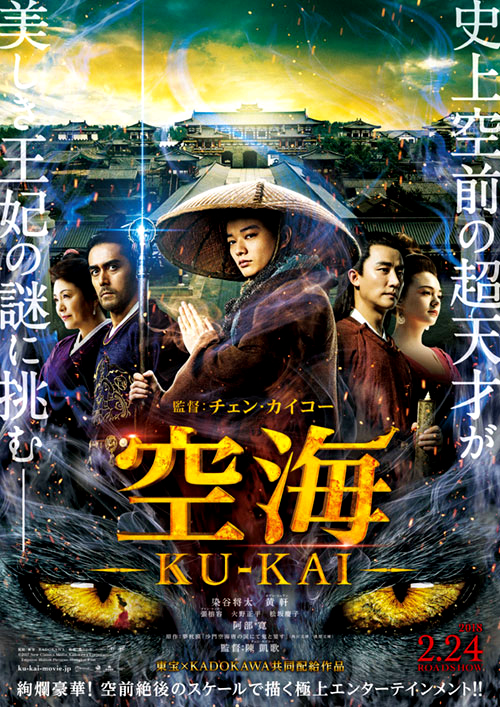
“Legend of the Demon Cat” Japanese Theatrical Poster
Director: Chen Kaige
Cast: Shota Sometani, Huang Xuan, Hiroshi Abe, Sandrine Pinna, Keiko Matsuzaka, Shohei Hino, Zhang Luyi, Baiqing Xin, Tian Yu, Qin Hao, Crystal Zhang Tian-Ai
Running Time: 132 min.
By Paul Bramhall
It’s been 3 years since fifth generation alumni Chen Kaige made his ill-advised wuxia caper Monk Comes Down the Mountain, however far from looking like a director licking his wounds, Kaige’s latest storms out the gates as his most commercially ambitious production yet. Legend of the Demon Cat is a rare co-production between China, Hong Kong, and Japan, with all three well represented either in-front or behind the camera. Considering the elements that make a movie marketable in each territory vary significantly, it’s fair to say Kaige had a lot on his plate to bring LOTDC (as I’ll refer to it from here on in) to the screen, but then it’s good to be remember that this has been a personal project of his for a number of years already.
Set in the capital of the Tang Dynasty in the 8th Century, it was reported that Kaige and a team of designers spent over 6 years constructing a replica set of the city, eschewing the CGI cityscapes that period pieces in recent times tend to resort to. As an interesting aside, the set is so large and elaborate, that even before filming began it was negotiated that once production wrapped, it would be maintained and developed into a theme park. In China, they don’t make movies based on theme parks, they make theme parks based on movies. Pirates of the Caribbean take note.
LOTDC is an adaptation of a four volume Japanese novel, written by Baku Yumemakura, who notably stated he was “moved to tears” when he came to visit the spotlight stealing sets. A prolific sci-fi and historical fantasy writer, Yumemakura’s tale playfully reimagines two revered characters in Asian history – the Japanese monk Kukai, who founded the Shingonshu school of Buddhism, and Bai Juyi, a Chinese poet held in the same regard as Shakespeare. In LOTDC, Kukai visits China to exorcise a mysterious curse that’s kept the emperor from sleeping for over 2 weeks, and while there he meets the palace scribe, in the form of Bai Juyi. Forming a mutually respectful bond, when they discover the presence of cat hair in the palace grounds, the pair become a sort of Tang Dynasty version of Sherlock Holmes and Dr. Watson, and begin to investigate the origins of this apparent ‘demon cat’.
The combination of Japanese supernatural mystery meets Chinese blockbuster certainly makes for an interesting tone, and could almost be argued to come across as a kind of Kwaidan meets the Detective Dee series. The Japanese investment seems to have allowed for several supernatural elements, and even a little gore, to bypass the dreaded Mainland censorship restrictions, allowing for a lavish tale of palace intrigue the type of which we haven’t seen for quite some time. Proceedings are suitably anchored by the pairing of Shota Sometani and Huang Xuan, as monk and poet respectively, in an equally rare case of a Japanese actor sharing co-lead status in a predominantly Mainland influenced production.
Sometani, a Sono Sion (Himizu, Tokyo Tribe) and Takashi Miike (Lesson of the Evil, As the Gods Will) regular, is almost unrecognizable with a completely shaved head, and makes for an appealing lead as the monk hoping to find enlightenment during his time in China. Xuan similarly makes for a likeable lead, having come hot on the heels of his stellar turn in Extraordinary Mission, as a poet who finds himself questioning the truth behind the events that influenced his character Juyi’s masterpiece, ‘Song of Everlasting Regret’. While historical revisionism is often frowned upon, when done correctly it can also be a lot of fun, and here the integration of historical facts blended with fantastical fiction work well. While it’s certainly not a prerequisite to know the characters that Sometani and Xuan are playing to enjoy LOTDC, knowing the context of who they are makes the experience that little bit more rewarding.
The cat itself of course is also a central player, and any questions of its demonic nature are addressed almost immediately in the opening scene, when it appears armed with a fluent Mandarin vocabulary, and an affinity for eating fish (and later human) eyeballs. A mix of both real cat and CGI, thankfully we’ve come a long way since the kung fu fighting animatronic feline found in Lam Nai-Choi’s The 1000 Years Cat, which came as a huge relief. In fact all the CGI work in LOTDC is of a high level, perhaps indicative of Kaige looking to redeem himself after the ropiness of 2005’s The Promise, but also of the quality that the various Japanese FX houses tasked with creating the effects have produced.
Ultimately the appearance of the titular cat leads Sometani and Xuan deeper into the past, as they look to reassess the death of a beautiful consort (played by French Taiwanese actress Sandrine Pinna), who was believed to have sacrificed herself for the greater good 30 years ago on the emperor’s orders. However the deeper they dig, it becomes increasingly clear that there was more at play than how history has remembered her, and LOTDC begins to become increasingly populated with a variety of characters, each with their own motivations and interests. Indeed the latter half of the 125 minutes runtime largely consists of an extended flashback to 30 years prior, during which both Pinna is introduced for the first time, along with a Japanese courtier, played by Abe Hiroshi (Chocolate).
While the flashback allows for various moments when Kaige can go all in on the visual splendour, particularly at a lush birthday celebration, which almost tilts into sensory overload with its displays of decadence, it also feels somewhat disconnected from the first half. It’s a bold move by Kaige, as essentially we go from following Sometani and Xuan as a third-party spectator, to seeing things from their perspective, learning the truth at the same time as it unfolds for them. On a first time viewing the introduction of new characters at the half way point may seem a little jarring, but it’s easy to see how LOTDC would make for a more rewarding watch on subsequent viewings. The most interesting element of the narrative structure though is how it’s not only a whodunnit murder mystery, but also places equal emphasis on how Xuan can reconcile the poem he considers to be his masterpiece, with the actual truth of what’s behind it.
Kaige and his co-writer Wang Hui-Ling (a regular collaborator with Ang Lee and John Woo) have crafted an interesting script, one which I struggle to think of another production as a comparison point, at least from the perspective of the period LOTDC takes place in. The way Xuan is forced to face the reality, that the facts the work he’s most proud of are based on may all be a lie, is conveyed as a relatable dilemma onscreen. It would be easier to go by the motto that ignorance is bliss, and while the plot naturally dictates that he’ll eventually decide to uncover the truth, it’s still effectively realised thanks to Xuan’s nuanced performance. Plus of course, when you have a demon cat in your corner, there’s always that extra little bit of motivation.
LOTDC is a confident return to form for Kaige, and while it may not be the return that the fans of his 80’s and 90’s masterpieces want, it’s reflective of a director that’s proven capable of adapting to the times. It’s likely to be a tricky movie to market overseas, since it’s neither an outright action movie in the vein of League of Gods, or a spectacle driven mystery like Young Detective Dee: Rise of the Sea Dragon, however LOTDC certainly deserves an audience. Proving that spectacle doesn’t need to always be created by CGI (Crystal Zhang’s Uighur dance is a highlight), nor require the presence of screen filling fantastical beasts or demons, LOTDC shows that sometimes all you need is a well told story. Well, that, and a talking feline.
Paul Bramhall’s Rating: 7.5/10








It sounds like Chen Kaige made the type of modern blockbuster he was comfortable with.
When he first attempted fantasy adventure, I was hoping for him to make a movie as emotional as Farewell My Concubine and just as exciting as Zhang Yimou’s wuxia films.
The Promise was just a mess and Sacrifice was completely lackluster. I thought he was incapable of filming an action movie.
The Monk Comes Down the Mountain had some decent action, but it didn’t feel like his film. That seemed more apparent when I saw an interview where Chen said he takes commercial projects so that he can fund the movies he really wants to do.
I’m not sure how he feels about shooting action scenes, but if Demon Cat doesn’t need them, I can’t complain.