




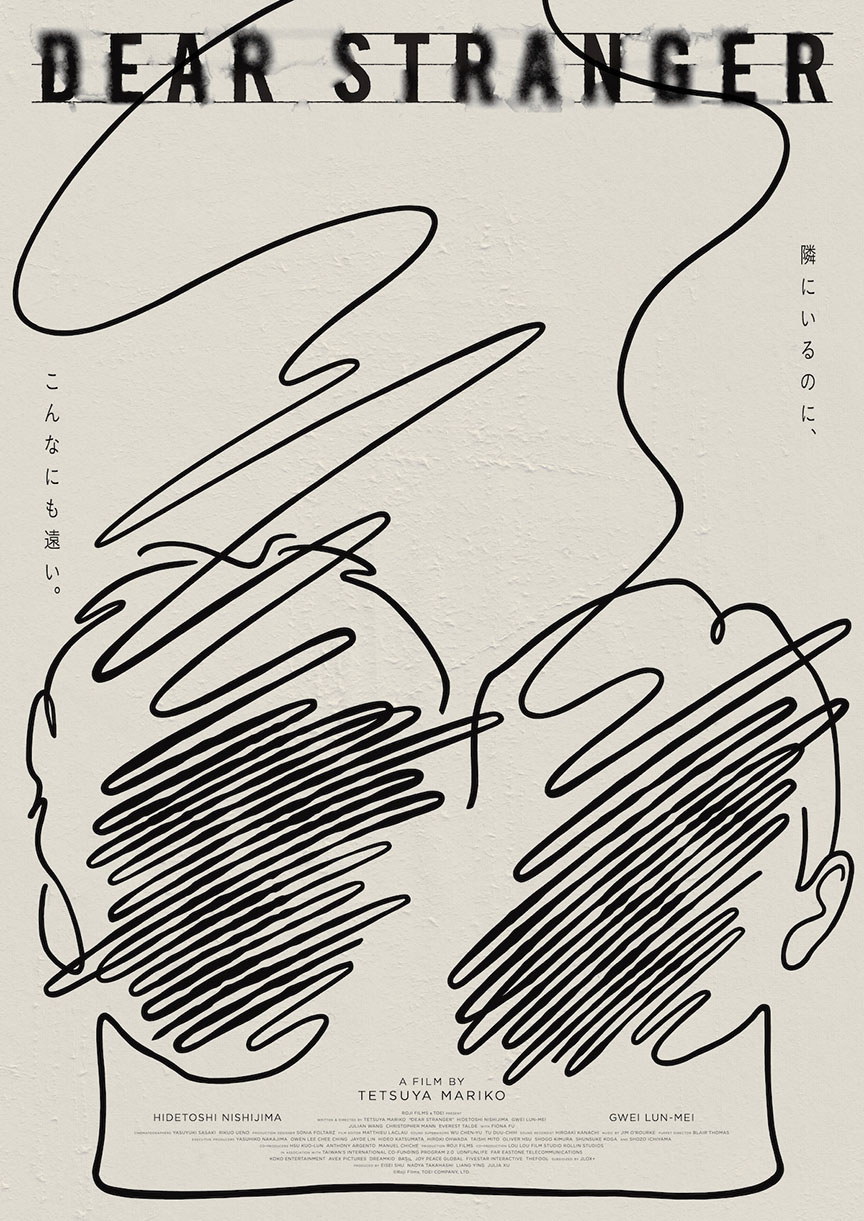
“Dear Stranger” Theatrical Poster
Director: Tetsuya Mariko
Cast: Hidetoshi Nishijima, Gwei Lun-Mei, Christopher Mann, Everest Talde, Fiona Fu, Mia Reece, James Chu, Aitor Martin, Lanett Tachel, Matt Golden
Running Time: 138 min.
By Paul Bramhall
The plot of a missing child is a staple of the thriller genre, however with 2025’s Dear Stranger director and writer Tetsuya Mariko eschews the thriller route, instead opting to use the scenario as a catalyst for framing the tensions that lay just beneath the surface of a couples seemingly functional exterior. No stranger (and no pun intended) to subverting expectations, Mariko has been active behind the camera since the early 2000’s, however in the west is likely most known for his 2016 feature Destruction Babies, which received a physical media release thanks to UK label Third Window Films. A relentlessly nihilistic and graphically violent assault on the senses, as a movie it took Mariko’s typical style to the extreme, and now close to 10 years on while I wouldn’t go so far as to say he’s mellowed, Dear Stranger is certainly indicative of a filmmaker who’s matured.
Toei clearly agree, since his latest feature also marks the first time for the studio to back a feature length production where the primary language is English. The plot centers around a Japanese and Taiwanese couple played by Hidetoshi Nishijima (Mozu: The Movie, Creepy) and Gwei Lun-Mei (Black Coal, Thin Ice, The Stool Pigeon) who live in New York with their son. Nishijima works at the local university, with his area of expertise being architecture, specifically, ruins. Believing that the ruins of buildings hold a certain truth about life, he’s close to achieving tenure and has a soon-to-be released book on the horizon, securing his future employment. Lun-Mei on the other hand has only recently returned to work after being a full time Mum since their son was born, juggling looking after her elderly parent’s Asian grocery store with her full-time commitment and true passion – directing a puppetry-based theatre production.
There’s been a trend of productions in recent years that focus on the Asian diaspora living in the U.S., weather it be kung-fu infused head-trips like Everything Everywhere All at Once, quietly heartbreaking dramas like Past Lives, or tales of resilience in the face of adversity like Minari. What makes the productions mentioned work so well is that the fish out of water element is used purely as a framing device on which to hang the story, being an integral part of the narrative while never dominating it, and Dear Stranger can sit confidently alongside them. With a runtime of 140 minutes it becomes clear early on that the abduction of Nishijima and Lun-Mei’s son is not so much what Dear Stranger is going to be about, but rather how they’ll react to it, exploring their relationship through the lens of the immigrant experience and impacts of past trauma.
For much of the initial third we simply spend time with them as a couple, allowing the audience to get a feel for the world they live in. Despite nothing particularly eventful happening, Mariko’s script and the way the scenes are captured, always at arm’s length to what’s onscreen, creates a subtle sense of uneasiness and foreboding dread. When they visit Lun-Mei’s parents who live nearby, Lun-Mei only speaks to them in Mandarin, suggesting that they move in together, which her mother rejects with the explanation that “Not a good idea. It’s not convenient with Kenji around”, despite the fact he’s only sat at the table in the next room.
Indeed the unseen borders that language can create feels like it plays a large part in the world of Dear Stranger. While some may find fault in the English dialogue, it could equally be argued that it serves its purpose in effectively conveying the occasionally stilted feel dialogue can have, especially when the primary language being spoken isn’t that of the characters’ mother tongue. It’s to both Nishijima and Lun-Mei’s credit that they both impart the cultural nuances of their respective countries into the characters that they play, with Nishijima coming across as dedicated yet slightly distant, juxtaposed against Lun-Mei’s more expressive and emotionally open dialogue. At one point when Lun-Mei questions how many memories they have together, she scoffs to herself on the couch stating that “…this language we use, it’s not ours”, as if to admit that it’s impossible to express their true selves through their main form of communication.
There’s a heavy use of metaphors in Mariko’s latest, with the intentional choice to have Nishijima drive around in a car that’s clearly seen better days, and Lun-Mei’s rehearsal space resembling an abandoned building, both clearly leaning into Nishijima’s thoughts on the meaning that lies in ruins. The question within the context of the narrative becomes one of if the pair will be able to find their truth within their decrepit surroundings, or if they’ll continue to decay away until there’s nothing left worth salvaging. Furthermore though it gradually becomes clear that the puppets Lun-Mei manipulates and brings to life act as projections for her own life, their speechless mannerisms capturing her emotional state in a way that language can’t, a fact which is reenforced when at one point Nishijima hallucinates the puppet she controls, reaching out to something that isn’t there.
Performance wise Lun-Mei is easily the highlight, embodying her character with a level of self-awareness that knows they’ve sacrificed a significant part of themselves to be a mother, and now looking to find a way back to the person she believes herself to be. Nishijima is similarly effective, however either through his performance or because of the script (perhaps both), once their child goes missing there are decisions made by his character that don’t always resonate, both logically and emotionally. It’s likely not helped by the fact his role here is similar to that of his character in 2021’s Drive My Car, which interestingly saw him playing a stage director, the same job that Lun-Mei has in Dear Stranger. Scenes like where he has a meltdown during a parent-teacher meeting, and the old classic of consoling yourself at the bar with a glass of whisky, tend to do more harm than good, pulling the viewer out of the world we’ve been immersed in.
On the other hand though the introduction of a detective played by Christopher Mann (Creed II) makes for an entertaining addition to the cast. Seeking to get to the bottom of exactly what’s gone down with the missing child, his frequent visits to Nishijima and Mei-Lun see him channel a classic case of Columbo, often stopping just before he exits a scene with a “oh, one more thing” that leads to another question or clarification. For the audience the way the abduction plays out only reenforces the fact that Mariko never intended for Dear Stranger to be a kidnap thriller, with the perpetrator being clear from the get-go, and indeed the whole kidnapping element is resolved long before the end credits roll.
As a result the key focus on Nishijima and Lun-Mei’s dynamic sees an important plot point involving newcomer Julian Wang’s character fail to land with as much impact as was probably intended, simply because there’s minimal investment in his character (and what we do get to know of him is unfortunately delivered through an unconvincing exposition dump by his girlfriend). Instead, the best moments of Dear Stranger come from the moments that give brief glimpses into the resentment sitting just under the surface of their relationship, no better example being when Mann interviews them separately, and they both give different reasons for choosing the apartment they live in. It’s the rare kind of scene that practically simmers off the screen with bitterness.
For all of the positives that Dear Stranger has going for it, from the wintery New York setting where you can almost feel the chill in the breeze, to the immersive atmosphere of creeping dread, a few missteps along the way keep it from being the classic that it had the potential to be. Still, for its portrayal of a relationship gradually unravelling, and subsequent attempts to piece it back together again, Mariko’s latest deserves to be commended. At one point a character says, “I know that sometimes you have to destroy one thing to make another.” The question is when the thing being referred to is the relationship you’ve invested years into building, is it still worth it? Perhaps the answer can only be found in the ruins.
Paul Bramhall’s Rating: 8/10



I’m excited to see this movie!
Does anybody know where this is streaming?
It had its international premiere at the Busan International Film Festival today, so we can expect a streaming/physical media release announcement over the coming months!