

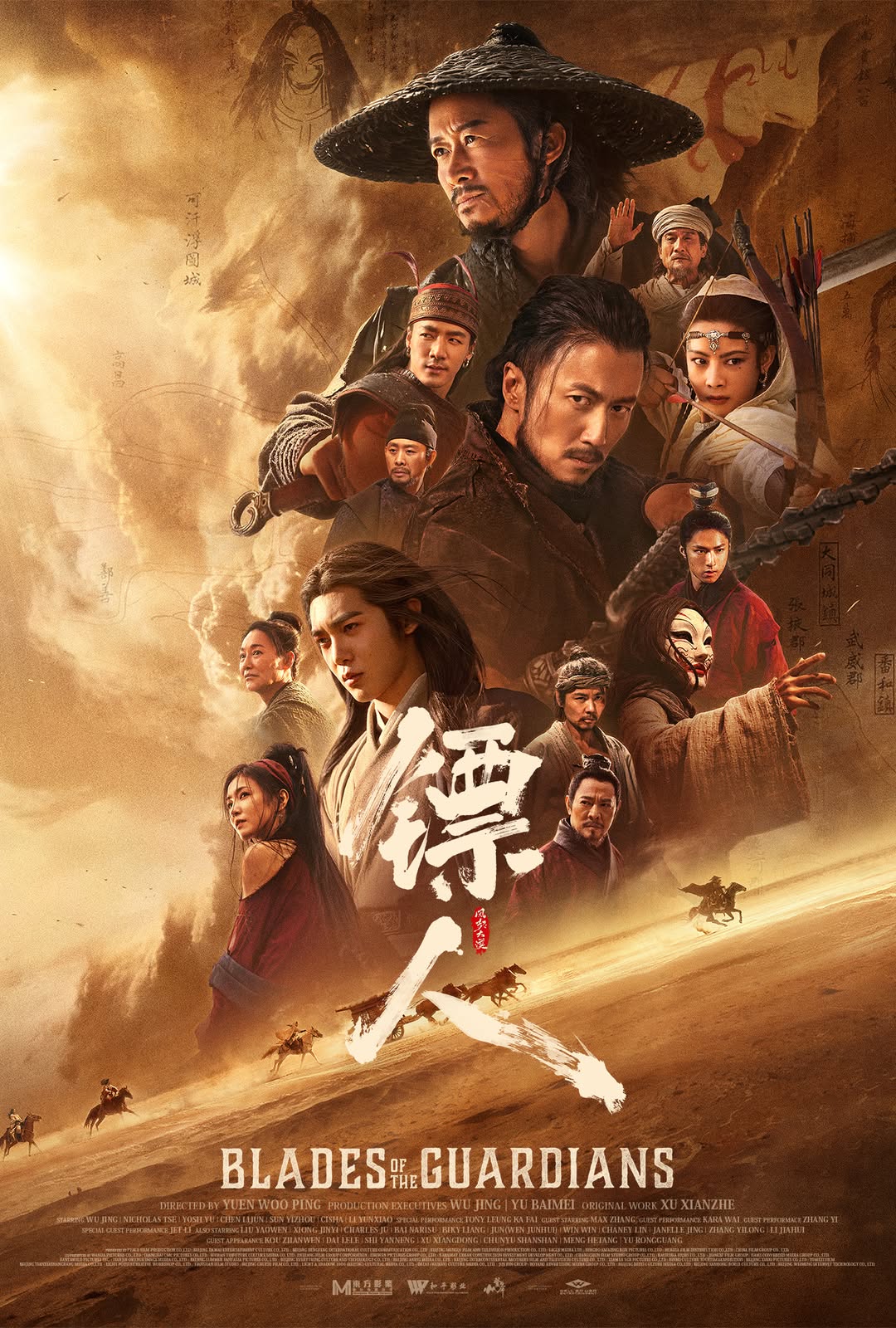
“Blades of the Guardians” Poster
Director: Yuen Woo-ping
Cast: Wu Jing, Nicholas Tse, Yu Rong-Guang, Tony Leung Ka-fai, Max Zhang, Kara Hui, Jet Li, Zhang Yi, Yosh Yu, Chen Lijun, Sun Yizhou, Cisha, Li Yunxiao
Running Time: 125 min.
By Paul Bramhall
On paper Blades of the Guardians reads like a wuxia fans dream – Yuen Woo-Ping in the director’s chair, paired with the likes of Wu Jing and Jet Li, for an adaptation of the manhua of the same name. It was Woo-Ping who gave Jing his big break in 1996’s Tai Chi Boxer, and this production marks the first time for them to reunite in the capacity of director and star since, marking 30 years that have passed. For Woo-Ping and Li it’s been even longer, with the last time the pair collaborated as director and star being 1993’s The Tai Chi Master (which, ironically, Tai Chi Boxer was marketed as a sequel to in some territories). Despite such reunions being enough to get anyone’s excitement levels up, in more recent years the cold hard reality is that there are plenty of reasons to feel a sense of trepidation.
Woo-Ping’s time in the director’s chair over the last 10 years has been more miss than hit – comprising of the misguided sequel Crouching Tiger, Hidden Dragon: Sword of Destiny, the abysmal fantasy The Thousand Faces of Dunjia, and the underwhelming spin-off Master Z: The Ip Man Legacy. Now in his 80’s, the question is a legitimate one of if it’s too late to rekindle the magic of his 20th century output. Thankfully the answer is a positive one, with Blades of the Guardians (or Blades of the Guardians: Wind Rises in the Desert to give it its full onscreen title, indicating we can likely expect future instalments) proving to be a rip roaring chase flick echoing similar recent big budget outings like Tsui Hark’s Legend of the Condor Heroes: The Gallants and Luo Yi Wei’s Invincible Swordsman.
Featuring the usual opening voice over spiel that’ll be long forgotten once the narrative kicks in, the plot is set in the twilight years of the Sui dynasty, with Wu Jing playing a former royal soldier who’s now become a bounty hunter, roaming the desert plains with a young orphan in tow (bringing to mind the dynamic between Xie Miao and Yang Enyou in Eye for an Eye 2: Blind Vengeance). Despite being a fugitive himself, an old friend played by Tony Leung Ka-Fai (The Shadow’s Edge, Eye In the Sky) provides Jing with a home in the village he’s the elder of, and also tasks him with his latest job – to safely transport the leader of the Flower Rebellion, played by Sun Yizhou (The Queens, Under the Light), to the capital. Reluctantly joined by Ka-Fai’s headstrong daughter (played by a debuting Chen Li Jun), together the 4 set off on a perilous journey across the desert.
With the narrative getting straight down to business, one of Blades of the Guardians biggest strengths is its brisk pace, with the 125-minute runtime populated with the core foursome encountering a variety of characters, often unaware of if they’re friend of foe until swords are drawn. The other major plus point is Wu Jing himself, here returning to a leading man martial arts role for the first time since 2017’s Wolf Warrior 2, close to 10 years ago. Now in his 50’s the older Jing makes for a suitably grizzled protagonist, carrying an air of authority about him, and a level of charisma that’s developed as he’s aged. Complete with a wide brimmed hat and assortment of weapons stored in a rolled sheet of cloth, he very much looks like the classic wuxia hero who, in this case, has literally “come right out of a comic book.”
Woo-Ping has enlisted the services of Ku Huen-Chiu (a regular collaborator who first worked with Woo-Ping on Tiger Cage III) and Dang Shanpeng (who’s also worked with Woo-Ping more recently on the likes of The Thousand Faces of Dunjia and Ip Man 4) to choreograph the action beats (although I’m sure Woo-Ping himself also offered some input!). A highlight takes place during an early scene that features special appearances by both Jet Li and Max Zhang (The Brink, Invincible Dragon), with the former returning to an action role for the first time since 2013’s Badges of Fury. Playing a senior official who wishes for Jing to become a trainer for the soldiers under his charge, while Li’s role is brief he makes for a commanding presence, and I’d dare say is a revelation. Zhang on the other hand is in the classic role of a retired assassin now trying to live a quiet life by running an inn, one which Jing very intentionally turns up at.
Circumstances converge in a face off between Jing and Li, providing them with their second rematch after an all too brief exchange in 2008’s The Mummy: Tomb of the Dragon Emperor, and a lengthier one in 2013’s Badges of Fury, as the pair go at it sword in hand. The fight eventually segues into a two on one with Zhang joining the fray in an attempt to take Li down, and it’s safe to say anyone who’s a fan of martial arts cinema will find it almost impossible not to enjoy seeing the trio of wushu royalty go at it, particularly with Li playing against type as the villain (something I wish he’d done more of in his prime considering his performances in The Warlords and Lethal Weapon 4). While purists may cry foul at the wire enhanced moves, within the world of Jianghu that the story takes place in it’s entirely fitting.
The scene acts as a taste of what’s to come, with the plot introducing a small army of supporting players, the runtime thankfully allowing for proceedings to never feel overcrowded. Creation of the Gods alumni Yu Shi and Ci Sha are particularly memorable, with the former playing a rival bounty hunter who joins Jing for a significant stetch of the journey, and the latter the leader of a rival clan who’d been betrothed to wed Chen Li Jun, until she broke it off. The relationship between Sha and Li Jun serves to portray Sha as the villain of the piece, who’s spitefulness at being rejected gradually manifests itself into a murderous rage, driven by a desire to expand his clan’s territory. With the hometown of Li Jun, Leung Ka-Fai, and Jing squarely in his sights, the decision must be made to either continue escorting Yizhou to the capital, or turn around and attempt to save the village from Shi’s spare no one approach to clan dominance.
Wu Jing has his own personal nemesis to contend with though in the form of Nicholas Tse, who served together with Jing in the same military unit, and for some reason is after the orphan who accompanies Jing wherever he goes. Similar to Jet Li, Tse is an actor who rarely gets to play the villain, but when he does he always nails it, from Dante Lam’s The Viral Factor to Benny Chan’s Raging Fire. He was also on villain duty in 2011’s Shaolin where he got to briefly exchange blows with Wu Jing (and their roles would switch for 2007’s Invisible Target), but here they get to go at it full force in the finale, as the truth comes to the surface about why he’s in pursuit of Jing. It’s just a shame their backstory feels like it’s given short shrift in terms of how little time its given compared to how important it is to the plot, leaving their confrontation as one that’s understood, but not necessarily one that’s as emotionally invested in as it could be.
This is a minor complaint though in a production that never allows more than a few minutes to go by before an ambush, pursuit, swordfight, or hail of arrows rains down the sky to light up the screen. There’s even a guy who get’s his manhood bitten off. Unfolding across landscapes that range from combustible oil fields to sandstorm ravaged deserts, Woo-Ping and his team have crafted a wuxia epic that rarely lets up once the journey begins, backed up by a cast that never let the spectacle overwhelm their screen presence. Woo-Ping clearly still carries weight in the martial arts genre, with cameos from the likes of Kara Hui (My Young Auntie), Xing Yu (Striking Rescue), and Yu Rongguang (Iron Monkey) ensuring that even characters who only appear fleetingly consist of familiar faces from kung-fu movies of days gone by.
As a bonus Woo-Ping himself appears in front of the camera during the closing credits, decked out in Sam Seed attire along with a couple of other legendary figures (that I won’t spoil here), offering up a fitting epilogue to a production that strikes the balance between honouring the past and embracing the future. Delivering a compelling story, relatable characters, and a healthy dose of wuxia themed action, Blades of the Guardians is top tier entertainment that proves the genre still has much to offer, and so does Yuen Woo-Ping.
Paul Bramhall’s Rating: 8/10



Fantastic! Thank you for the review. “While purists may cry foul at the wire enhanced moves, within the world of Jianghu that the story takes place in it’s entirely fitting.” This is poetry in my ears.
I am surprised to see none of the Yuen Woo Ping brothers working on this movie with him. His brothers used to working on all of the movies he either directed or action directed.
This looks great. Glad you enjoyed it.
I finally watched Blades of the Guardians, and I loved it. I didn’t know it would be so epic in scale with the story taking place in seemingly huge locations and action scenes going from personal fights to huge battles. Just about everything was top notch, and seeing Jet Li fight and only be doubled for when his character gets thrown or smashed was a real joy. It’s like he never stopped training.
After the last 2 movies where Jet Li vs Wu Jing were completely wasted and treated as jokes, it was wonderful to see such a competitive fight scene with Max Zhang adding to the greatness. I even appreciated how we got a break in the action for everyone to talk and take it easy before it started up again.
It will be interesting if there will be a sequel which will presumably be directed and choreographed by others. There’s a lot of material in the manhua and anime that can be adapted.