




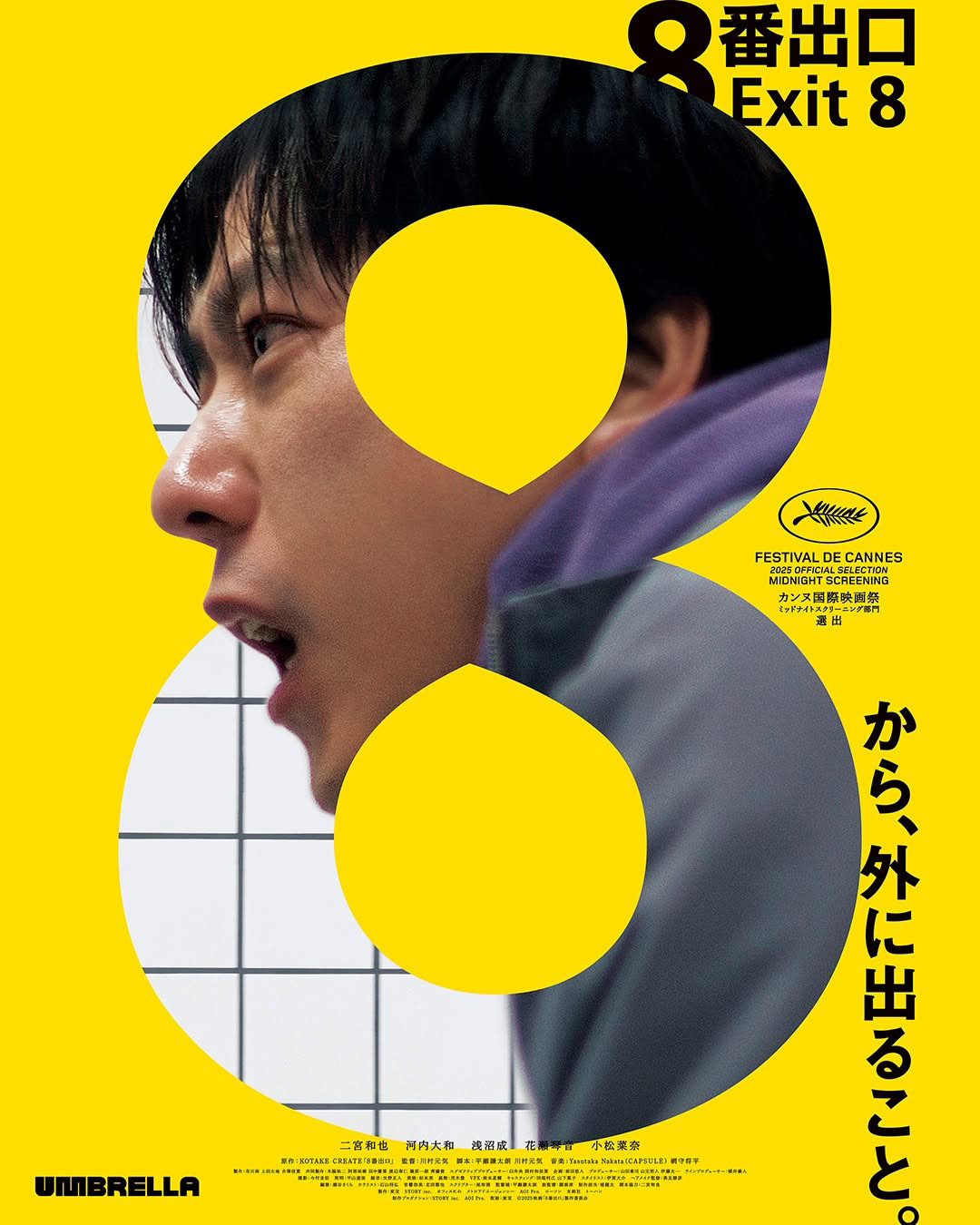
“Exit 8” Poster
The concept of liminal space horror has been all the rage in the 2020’s, one that can be traced back to a single photo posted on 4chan in 2019 that kick started The Backrooms phenomenon. Essentially about the feeling of dread and unease created through experiencing transitional spaces when stripped of their usual activity – think empty airports, hotel corridors, or stairwells – for many the COVID 19 pandemic made the concept of liminal space a reality as whole countries were told to stay home. When the pandemic was over American YouTuber Kane Parsons made a Backrooms short film, the popularity of which gradually grew into a 25-episode web series, and eventually a feature length theatrically released movie in 2026.
In 2023 independent Japanese video game developer Kotake Create also decided to get in on the liminal space action, creating a game called Exit 8, which can best be described as a game of spooky spot the difference. For full disclosure I’ve never played the game, however the concept of it is a simple one – the player is a character trapped in an endlessly looping subway tunnel, and to escape, each time they walk through they have to look out for anomalies that may have changed since the last time. If they spot a change, then turn back, but if there’s no change, they can proceed forward. Each time they do this successfully the exit number on the wall increases by 1, and once it hits 8 they can exit. Get it wrong, and it resets back to 0.
How to transfer such a simple concept into a 95-minute movie is a good question, and for director Genki Kawamura, here clocking in his sophomore feature length production after 2020’s A Hundred Flowers, the answer is a straightforward one – don’t overthink it. The result is one that gets off to a promising start, as proceedings open from the viewpoint of a crumpled salaryman played by Kazunari Ninomiya (Assassination Classroom) on the subway. Told entirely from a first-person perspective, we watch as he passively observes a businessman berating a young mother about her crying baby further down the carriage, before receiving a call from his ex in which she tells him she’s pregnant. Still on the phone when he gets off, her question of what they should do about it causes enough of a distraction that he almost fails to notice the corner he keeps turning brings him back to the same exit sign from moments earlier.
Billed simply as the Lost Man, and afflicted with an asthma induced cough that sees him regularly reaching for an inhaler, Ninomiya proceeds to cough and splutter his way through the station, before coming across a signboard that spells out the rules of the strange space he finds himself trapped in. Kawamura opts to keep the big screen adaptation as close to the game as possible, and the fluorescent tube drenched, white tiled tunnel and its eerie lack of commuters serve its purpose of instilling a sense of slowly mounting dread in the viewer. There’s also a creepy businessman who’s walking around the station in the opposite direction from Ninomiya (appropriated billed as Walking Man, played by Yamato Kochi – The Samurai and the Prisoner), and occasionally turns up directly behind him with a deeply unsettling grin on his face.
However the nature of the never-ending loop also serves as one of Exit 8’s narrative pitfalls, as considering the whole 95 minutes is spent there, the more time passes the less scary it becomes. To a degree Kawamura seems to acknowledge this, as at one point he changes things up and the lights begin to flicker, before an army of mutated oversized rats appear out of the darkness. In another loop there’s suddenly a tsunami of muddy water that fills the corridor (filmed in such a way that the nod to Stanley Kubrick’s The Shining is impossible to ignore!). But with such a slight premise (spot the difference every couple of minutes), these sudden ramp ups end up feeling more like they’re there to keep audience attention rather than serving as an organic part of the plot.
Indeed when it comes to the plot itself, it’s likely to be perceived as either heavy in allegory or lacking any real depth – depending on how much audiences buy-in to what unfolds onscreen. It’s vaguely implied that the station tunnel is some kind of purgatory, representative of Ninomiya’s divided state of mind over what to do regarding his ex’s pregnancy, and that to escape it he must accept his place in the world as a father and be a generally decent guy. However for myself at least, this explanation alone doesn’t satisfy why he’s chosen to be tested in such a way – I mean, surely there’s other ways than playing spot the difference in a subway tunnel? While I’ve no doubt the concept is an entertaining one as a game, and doesn’t require much additional context to enjoy other than needing to spot the “anomalies” to escape, within the framework of a movie a little more narrative depth is required.
Once the horror element gradually ebbs away (be it intentional or not) Exit 8’s rigid singular premise becomes one where audience’s mileage will vary. As the character of the Lost Man Ninomiya doesn’t have much depth, so the narrative never truly gets to a point where you care about him reaching the all-important 8th exit, leading to a feeling of monotony setting in with the frequent repetition. Ironically other Japanese productions like director Junta Yamaguchi’s Beyond the Infinite Two Minutes and River, despite having a budget far lower budget than Exit 8, arguably execute the endlessly repeating loop trope more effectively.
Kawamura admittedly makes a valiant effort to sustain the momentum, expanding the plot so that not only The Walking Man gets his own story, but the eventual introduction of a young child also lost in the same looping tunnel adds a different perspective other than Ninomiya’s. The script, co-written by frequent Kawamura collaborator Kentaro Hirase (who also wrote A Hundred Flowers), does an effective job of tying the characters together, and at one point even dares to hint at what could be going on. A highschooler (played by Kotone Harase – The Parades) offers up a brief glimpse at the sinister nature of the environment they’re in, however much like the mutated rats, her appearance is a fleeting one and never elaborated on further.
I can’t help but feel that if I gave Exit 8 a re-watch, not going in under the expectation of it being a horror movie, would there be more to enjoy? Ultimately any horror movie that relies on repetition is setting itself a tall order to be able to sustain a level of dread for 90 minutes or more. Much like the characters we meet are locked in a routine of familiarity, as an audience that routine of watching constant repetition breeds the same familiarity, and familiarity is rarely scary, even with anomalies! Perhaps the best approach is to not consider it a horror at all, but to look at is as a metaphor for how easy it is to miss changes around us when we see the same thing day in day out.
For myself though, this realisation already comes too late. Whichever way you approach Exit 8, what can’t be denied is that it acts best as a singular viewing experience, and there’s little motivation to come back for a re-visit. With his sophomore feature length production Kawamura has delivered a competently crafted puzzle with precision set design, a perfectly executed concept, and a faithfulness to the game that can’t be faulted – however none of these stop it from ultimately being a victim of its own limitations. If there was to be one rule for liminal space horror, then it would be that the spaces are at their most terrifying when the time spent in them is momentary. While Exit 8 successfully instils a sense of dread for much of its first half, like the name of its main character, the second half begins to feel increasingly lost.
Paul Bramhall’s Rating: 6/10












I assume you’ve also seen Backrooms. Is Exit 8 as frustrating as a movie going experience as Backrooms was. Do you have to “get” the premise or is there not much to “get” in the first place. Do you have to do homework and play the game and read up on the lore before watching the movie to get the most out of it?
I haven’t! However in this case there’s nothing to get – endless looping train tunnel, spot a difference then go back, don’t spot any difference then proceed forward. Rinse and repeat for 95 minutes. No lore, no homework, and no game play required! 🙂
I feel the same way about this movie that I do about Backrooms. It is effective to a certain point but then boredom does kind of set in! I guess I don’t have the type of fear that these movies tap into. A meaningless, repetitive, mundane 9 to 5 as purgatory until we find the meaning in the details probably spoke more to the 20 year back in the day.
Its not bad though. I’d say its better than Backrooms because it commits to the concept fully and doesn’t cut away from the premise. Also, to me, it doesn’t jump the shark in the last third.
It’s not too often that I watch the movie adaptation of a video game that I haven’t yet played, but I quite enjoyed this one; I’d probably give it closer to a 7.5/10, although I totally understand that certain aspects of it can be grating (it wasn’t the repetition that got to me—it was the damn coughing that you mention!).
I have to admit, the coughing kind of got to me too. 🙂 By the last splutter I felt like, yeah, we get it – he has asthma! It’s 2026 and I think ‘Steel Rain’ remains the only movie that we’ve both weighed in on at COF where you’ve enjoyed it less than I did!
What’s also funny is that ‘Steel Rain’ retroactively looks like ‘The Man From Nowhere’ if I compare it to the abysmal ‘Steel Rain 2,’ an in-flight movie I watched that was so bad I was looking for a parachute!
It must be a ‘Steel Rain’ thing, as I not only enjoyed the sequel, I thought it was superior to the first one! Admired the boldness of switching up the action-centric original for a completely different, almost ‘Dr. Strangelove’-esque chamber piece that has 3 world leaders squabbling with each other while being held under duress in a submarine!