



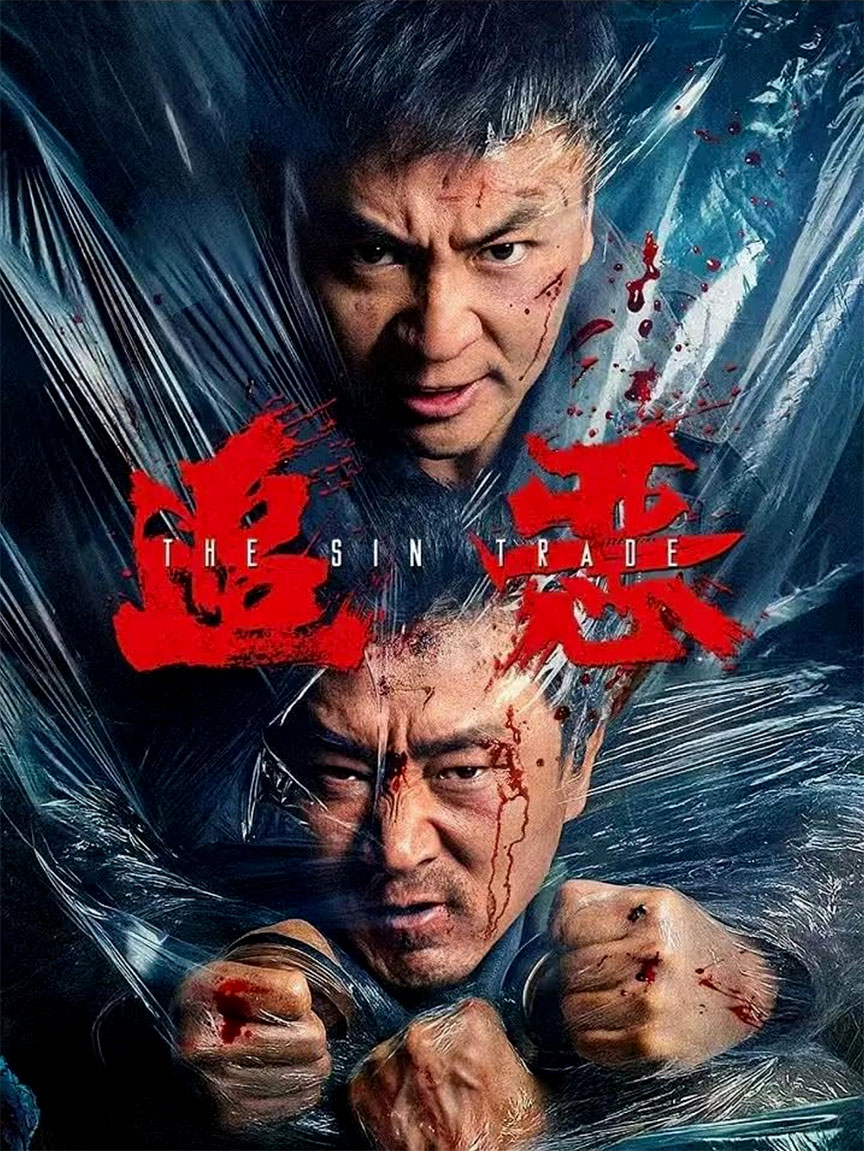
“The Sin Trade” Poster
Director: Siyu Cheng
Cast: Ashton Chen, Lin Fengchao, Wang Zhen Er, Michael Mao, Liu Yitong, Rui Xiu
Running Time: 98 min.
By Paul Bramhall
An unexpected phenomena occurred in the 2020’s that I’d dare say won’t be fully appreciated until we have enough hindsight to look back on them – the Chinese streaming industry (or web movies as they’re known locally) elevated its action genre offerings to a level that effectively filled the void Hong Kong cinema left behind two decades earlier. When former HK action alumni like Xie Miao, Andy On, Ashton Chen, and Liu Fengchao started showing up in streaming movies made by the likes of iQIYI and YOUKU during the 2010’s, the general sentiment was that they were appearing in productions unworthy of their talents. However the streaming space hasn’t stood still, and from the format’s beginnings in the 2010’s, the 2020’s has seen the rise of directors like Siyu Cheng and Qin Pengfei who’ve breathed new life into the action genre.
The only tragedy is that many fans looking for a fix of Hong Kong style action may not even know of their existence. While HK cinema of old aimed to be as marketable to overseas territories as possible due to its small population locally, with a population over 1 billion productions made to appeal to Chinese audiences in the 21st century have no such concerns – if anyone watches them outside of China that’s just a bonus. Thankfully, astute fans have kept their eye on the web movie space, and the aforementioned Ashton Chen has become one of the genres legitimate leading men. Much like Xie Miao, Chen also got his break as a kung-fu fighting child actor. At just 6 years old he’d headline 1994’s Shaolin Popey and its sequel, and would get to appear alongside such legendary names as Donnie Yen in 1995’s Saint of Gamblers (and again in Ip Man 2 15 years later!) and Yuen Biao in 1996’s Dragon from Shaolin.
After spending the 2000’s in low budget outings that are best left forgotten (Kung Fu Cooker or Black Mask VS Gambling Mastermind anyone?), Chen would get his first taste of being a web movie lead with 2021’s Demon Hunter Yan Chixia and hasn’t looked back since. His latest comes in the form of The Sin Trade, which maintains the contemporary setting of recent outings like Detective Chen and Black Storm. Per usual for these productions Chen is playing a cop (who works for a branch of “the public security organs” – as the awkwardly worded subtitle points out), this time one who’s specialty is breaking up human trafficking rings. His character was almost a victim of trafficking himself as a child, only rescued due to his sister’s intervention, but at the cost she was taken, a trauma that sees him personally invested in his job.
When one of the college student girls from his hometown village is reported as missing, an elder makes a plea to Chen to help out, so he does exactly what you’d expect him to do – starts investigating and punching a lot of people in the face. In many ways The Sin Trade feels like the spiritual successor to the Wilson Yip and Donnie Yen collaborations from the 2000’s – Sha Po Lang and Flash Point. Like those productions, we’re told that the story unfolds in the 1990’s, allowing for a greater degree of violence and more criminal activity to be on display than if it was set in present day. There’s specifically a very clear nod to Flash Point in Chen’s wardrobe of a black leather jacket and jeans, as if we’re watching an unofficial sequel that continues the adventures of Yen’s angry cop from almost 20 years ago.
Directed by Siyu Cheng, along with Qin Pengfei he’s become one of the most reliable filmmakers to exclusively work in the streaming arena, responsible for the likes of Tai Chi Master and Striking Rescue. The latter saw him working with Tony Jaa for a story set in the fictional country of Palivina Republic, with fictional Southeast Asian countries being a prominent element of any web movie with a contemporary setting, providing a functional get out clause to pass the Chinese censorship board. In The Sin Trade it’s refreshing to see that the 1990’s setting now seems to be enough to appease the censors, allowing the story to play out in China, as here the plot is very much tied into Chinese traditions.
A trafficker played by Lin Fengchao (The Butcher’s Blade, The Four 3) has his underlings kidnap prostitutes from the brothels in the nearest city, receiving payment from the villagers in the remote mountains to have their young men married off to them. Forced into marriage, with the most important factor being they can bear a child to continue the bloodline, the child is then used as a cruel form of ensuring the kidnapped bride never leaves the village. Rough around the edges and sporting a dangerous temper, Fengchao plays his character like a distant relative of Kim Yun-seok’s Yanbian gangster in the 2010 classic The Yellow Sea, channelled through someone who knows kung-fu.
Interestingly The Sin Trade offers up two sets of villains, with a nightclub owner played by Wang Zhen Er (Monster Run, Sea Monster 2: Black Forest) and her fearsome bodyguard, played by Michael Mao (Blade of Flame, Golden Spider City) adding another layer to the story. It turns out one of Fengchao’s underlings is in love with the same girl Chen has been asked to look for, and decides to go on a rogue mission to rescue her from the club she’s being forced to work at so he can marry her himself. When Zhen Er finds out who was behind one of her employees being taken, it sets her on a collision course with Fengchao, and Chen is left to desperately track the girl down before she’s sold off to one of the remote mountain villages, after which it’ll be like finding a needle in a haystack.
It’s a somewhat convoluted set of circumstances, however it works well, as Chen’s cop is expectedly one-dimensional, so cramming the plot with a number of villains who are far more interesting keeps the pace moving. Most importantly though, it also offers up plenty of opportunities for fists to start flying, and on that front The Sin Trade definitely doesn’t disappoint. The action is choreographed by Yulong Guo, who contributed to the action on display in Striking Rescue (and is a director himself, whose credits include the fantastically named Rising Boas in a Girl’s School), and its brutal stuff. There are various one versus group melees with a noticeable focus on impact shots, as kicks satisfyingly send lackeys flying into the nearest immovable object. The filming of the fights is fluid and clear, and they’re performed with a franticness that once more shows how much more time these productions now have dedicated to the action.
It’s actually Fengchao who arguably gets the lion’s share of the action highlights, when a visit to Zhen Er’s club to negotiate his captured underlings return segues into a vicious throwdown against Michael Mao, one that sees bones broken and faces pummelled into a swollen mess. Essentially pitting one ferocious bad guy against another ferocious bad guy, if there was a limit to how much violence was seen as acceptable to be shown onscreen before, it’s safe to say that whatever that was has now been lifted. The true highlight of course goes to the inevitable showdown between Chen and Fengchao, offering up a re-match from their brutal showdown in Black Storm, with the latter’s form of resisting arrest resulting in an epic fight both inside and outside a small restaurant. There’s a subtle nod to the epic Donnie Yen versus Collin Chou finale in Flash Point thrown in at one point, and if you enjoyed that one, there’ll be plenty to enjoy here.
There’s been plenty of quality coming out of China’s streaming platforms in 2026, from The Butcher’s Blade to Fight Against Evil 3, however I’m willing to put it on the line and say that The Sin Trade represents the pinnacle so far of what can be done within the genres limitations. The storyline is gritty, the characters are despicable, but most of all, the action delivers every time it hits, which is frequent. Check it out, it’d be a sin not to.
Paul Bramhall’s Rating: 8.5/10




This is a great review for the movie and for this subgenre of a subgenre that is the Mainland contemporary action movie. This movie and Black Storm and the first Fight Against Evil are the peak of the genre so far. Its a bit of a guilty pleasure for sure especially since China is out of favour geopolitically and these movies are often not so subtle soft propaganda for how awesome China and its law enforcement are. Even so when these movies hit hard they absolutely bring back memories of HK action cinema at its finest. You just need to go into these movies knowing the ending is going to be comprimised and your protagonist is never going to be an anti-hero or someone with an interesting backstory.
You also have to raise an eyebrow when you read the onscreen text at the end of the movie saying that there are no more crimes in China because the police are so awesome. Instead of being so cagey about the truth imagine if they actually leaned into recent cases. Like the streamer that went to the banjo playing country bumpkin house to give the guy all the donations for being an awesome single dad, only to find his wife being chained in the garden shed. That would make an awesome action thriller. Instead it was all swept under the carpet so to speak.
And like you say who knows in 20 years time we might look back and retroactively reevaluate all of this as another golden age of action cinema. Ok probably not but these are objectively better than all those shitty Wu Jing patriotic bullshit movies like Wolf Warrior and Lake Changjin, My Country My Parents etc etc.
Thanks SM. I actually stuck around to the end of the credits (bad habit!) and was amused that there’s thanks given to not 1, not 2, not 3, but FIVE Propaganda Departments! But hey, at least they’re not hiding it, and there’s clearly a lot more leniency towards the amount of crime and violence that can be shown onscreen compared to the mid-late 2010’s.
I’m actually amazed by how much they show that is definitely not propaganda. Grimy city scapes, housing hellholes, rape, murder, corruption…these films present the worst of China – like The Wire but Chinese. Really the only propagandistic piece of it is the fact that you can count on the awesome police to save the day and that justice will be served – which is something that all films tend to do, including and especially the ones here in America. Let’s put it this way – these films do not make the case for tourism!
Where can this be found to watch?
It’s on the iQIYI streaming service.
https://www.iq.com/play/the-sin-trade-2026-16k95hcqf80?lang=en_us
“patriotic bullshit movies”
Not worse than patriotic US bullshit propaganda/agenda movies.
Thanks for the recommendation – indeed, an excellent contemporary martial arts crime movie!
Some observations:
1) Aston Chen’s jacket is dark grey denim, not leather.
2) The classic HK vibe was increased by the lovestruck nerdy criminal looking very much like Stephen Chow in the late eighties/early nineties.
3) Fengchao had only two big action scenes, Aston Chen does most of the heavy lifting throughout the movie actionwise.
I thought this would be the iQiyi film to break the losing streak for me. While it is a step in the right direction and not as bad as Blind War, Hunt the Wicked, and To Live Through Death, (And not cheap looking) it still has many of the same problems as other iQiyi films with a constant miserable tone, too much focus on the scumbags and their activities, and a lot of sloppiness in the story.
Yes, a film about cops vs traffickers shouldn’t be light hearted, but it’s dialed up too far. I was more interested in Ashton Chen and his colleagues hunting the criminals, but too much time was devoted to the traffickers. It was also pointless to show the traffickers putting other scumbags in their place like we’re supposed to be cheering for them.
The fight scenes are great, but a real annoyance in them is how little it occurs to anybody to try and strip the knives from the hands of their opponents. Ashton Chen has Michael Mao in an arm bar, yet it doesn’t occur to him to break his arm, but it occurs to Fenchchao.
Once the exciting aspects of other Asian action films is watching the main character try and disarm their opponents, so this problem was very noticeable here.
People who seem to be used to iQiyi’s output and have given up on criticizing it seem to have a better time with this film and the aforementioned ones. Thats cool if people are used to their formula, but I’m tapping out to it.