


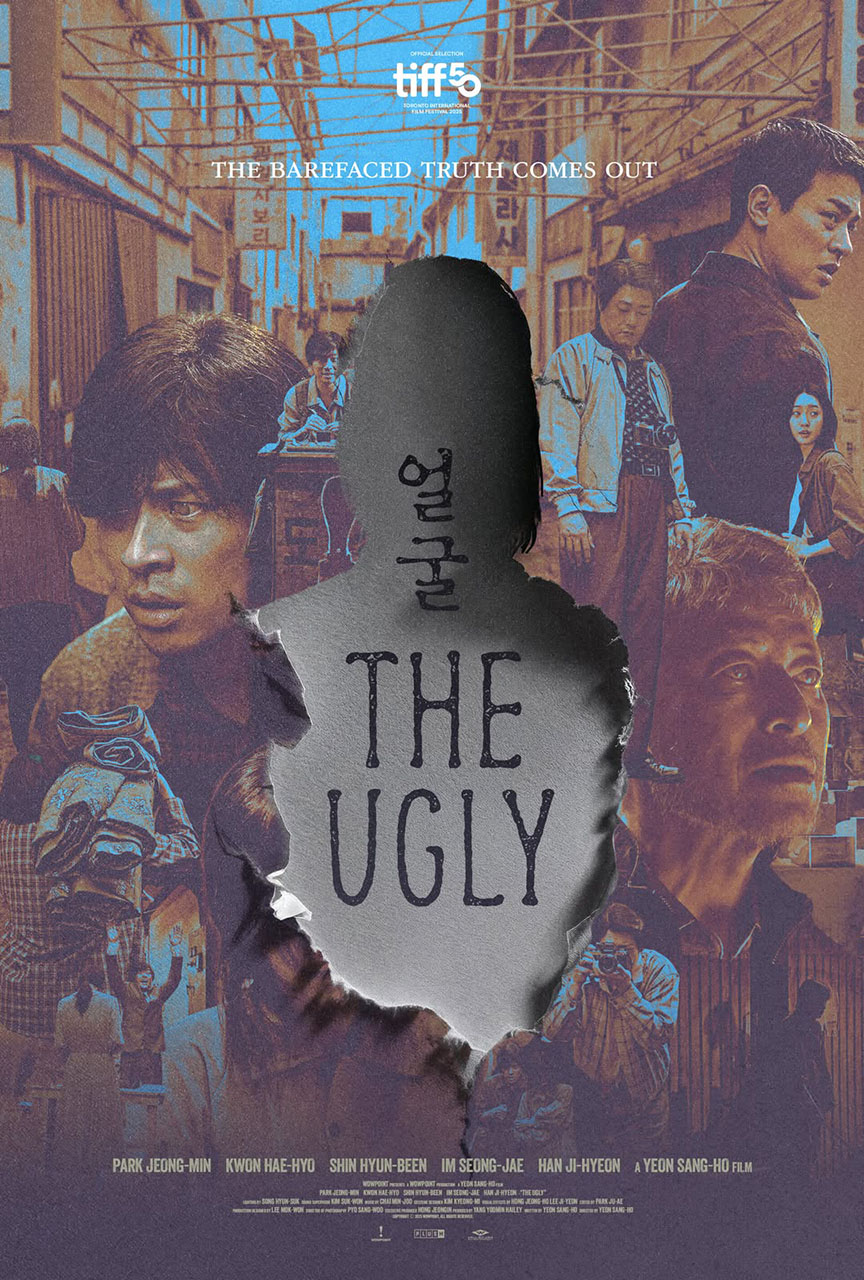
“The Ugly” Theatrical Poster
Director: Yeon Sang-ho
Cast: Park Jeong-min, Kwon Hae-hyo, Shin Hyun-been, Im Seong-jae, Han Ji-hyeon
Running Time: 102 min.
By Paul Bramhall
Back in 2020 the Korean film industry hedged its bets on director Yeon Sang-ho’s Train to Busan sequel, Peninsula, to bring back cinema audiences after the COVID-19 pandemic had forced filmmaking into a period of hibernation. While for the most part the bet paid off, whether it be because of the mixed reviews Peninsula received or Sang-ho’s own creative direction, as a director he’d have to wait 5 years to make a return to the big screen with 2025’s The Ugly.
What makes Sang-ho unique as a filmmaker, both as a director and a scriptwriter, is that far from those 5 years being spent off the radar, during them he’s arguably become one of, if not the, most active creative talent working in the Korean film industry today. Switching to debut almost exclusively on the streaming giant Netflix, the 2020’s have seen him direct and write movies (Jung_E, Revelations), series (Hellbound, Parayste: The Grey), and even lend his writing talents to a combination of both (Cursed: Dead Man’s Prey, The Bequeathed). Despite originally making a name for himself helming gritty social animations like King of Pigs and The Fake, post-Train to Busan Sang-ho has never gone back to the medium of animation, instead seeming to find more enjoyment in writing graphic novels. The Ugly is one such graphic novel that he wrote in 2018, and now he’s adapted it for the screen.
Despite not being an animation, thematically his latest is the closest he’s come to the grittiness of his work from the early to mid-2010’s (and yes, I’m guilty of also saying that about Revelations!). There’s no ravenous zombies, no telekinetic superheroes, no mercenary cyborgs, no head splitting aliens, no demonic beasts from hell, and definitely no delirious pastors descending into madness. Instead it introduces us to a blind “stamp engraving artisan” played by Sang-ho regular Kwon Hae-hyo (I, The Executioner, Tazza: One Eyed Jack), the stamps in question being the name stamps that are still accepted as signatures in parts of Korean society. Hae-hyo’s stamps are considered works of art, even more so considering he’s blind, and in the opening scene we meet him being interviewed by Han Ji-hyun (Sisterhood, Seobok), an investigative journalist working with a small crew to make a documentary about his life.
Always close-by is his son, played by Park Jeong-min (Harbin, Uprising), who Hae-hyo raised as a single father following his mother walking out on them when he was still a baby. However when Jeong-min receives a call out of the blue from the police, advising that they’ve found 40-year-old remains that they believe to be of his mother, Ji-hyun senses that there may be a bigger story worth exploring. Convincing Jeong-min that she can help him discover the mother he never knew, and hopefully uncover the cause of her death, he soon finds himself reluctantly tagging along as she delves into the past and begins to interview those who knew his mother back in the 1970’s.
Much like Revelations, Sang-ho sets up an intriguing premise that serves its purpose in grabbing the audience’s attention from the get-go, with the bomb shell news setting up a level of anticipation to see what unfolds. The unlikely pairing of an investigative journalist looking for a scoop, and a son looking for the truth behind a mother he thought had abandoned him, gives The Ugly its most interesting characters, so its unfortunate that in the end we don’t really spend a whole lot of time with them. Instead we follow them around, framed within chapter titles that literally read ‘The First Interview’, ‘The Second Interview’ etc., as Ji-hyun gets in contact with people who used to work with Jeong-min’s mother at a garment factory, outside of which Hae-hyo got his start running a small stall.
No matter who they meet though, the one recurring theme comes from comments describing his mother’s facial appearance (the Korean title literally translates to Face), which at its kindest is described as “ugly”, with the other end of the scale ranging from “monstrous” to that of an “ogre”. The more Ji-hyun tries to probe as to why – did she have a facial deformity, or suffer some kind of horrific accident – the more they’re met with a wall of silence, confounded by the fact there seems to be no existing photos of her. Once the pair begin their interviews, Sang-ho chooses to incorporate flashbacks to the 1970’s into the narrative, allowing the audience an insight into the era that our 2 protagonists in the present aren’t privy to.
The flashbacks are notable for giving Jeong-min a dual role, as he plays the younger version of Hae-hyo in the past as well as his son in the present. It’s Shin Hyun-been (Beasts Clawing at Straws, The Closet) who takes on what surely must have been the most difficult role to pitch in The Ugly. Playing Jeong-min’s mother in the flashback scenes, the camera is positioned in such a way that we never get to see her face, instead either following her around from behind, framing shots from her neck down, or having her hair obscure her features.
While the scenes set in the 1970’s invoke a fitting sense of the struggle many were going through during Korea’s rapid modernization, they also steer into somewhat cliched territory when it comes to the characters who populate it. Jeong-min is the pure of heart underdog trying to establish his stall, Hyun-been is poorly treated by her co-workers because of her looks, and the garment factory boss (play by Im Sung-jae – Nocturnal, The Anchor) isn’t averse to sexually assaulting the ladies who work for him. He also likes to carry a camera around his neck at all times, so if that isn’t subtle foreshadowing, I don’t know what is.
The biggest issue with the past and present structure though, is that the scenes in the present already give us just enough information for us to draw our own conclusions of what happened in the past. As a result, many of the flashback scenes simply serve to show what we’ve just heard in the interview. They say the number one rule of movies is ‘show, don’t tell’, so it’s interesting that Sang-ho has opted for a hybrid approach that’s best described as ‘tell, then show what you’ve just told’. The past and the present scenes fail to compliment each other, and it’s hard not to get the feeling that The Ugly should have either been a story that’s completely set in the present, or completely set in the past.
By far the worst crime The Ugly commits though is in its botched conclusion, which fails to land on every level. Who actually killed (because of course she didn’t die of natural causes) Hyun-been is obvious within the first 15 minutes, with Sang-ho telegraphing the direction of the story with a flashlight so strong that none of the corners and twists along the way do much to distract. The decisions a certain character makes to do the unthinkable though feel less than convincing, leaving The Ugly’s closing reels with a disconnect that it’s unable to recover from. While the message is obvious – how we treat others is what truly defines how ugly we are more than any physical appearance – the final reveal of what Jeong-min’s mother actually looked like lands with a resounding thud rather than one of cathartic revelation.
While it feels like it should be a positive to see Sang-ho take a break from his more fantastical flights of fancy that have dominated his Netflix output, The Ugly ultimately suffers from the same structural and pacing issues that plagued the likes of Jung_E and Revelations. An intriguing premise that runs out of steam long before the end credits seems to have become a Sang-ho signature, and The Ugly offers its stamp to confirm audiences can expect more of the same.
Paul Bramhall’s Rating: 5/10