




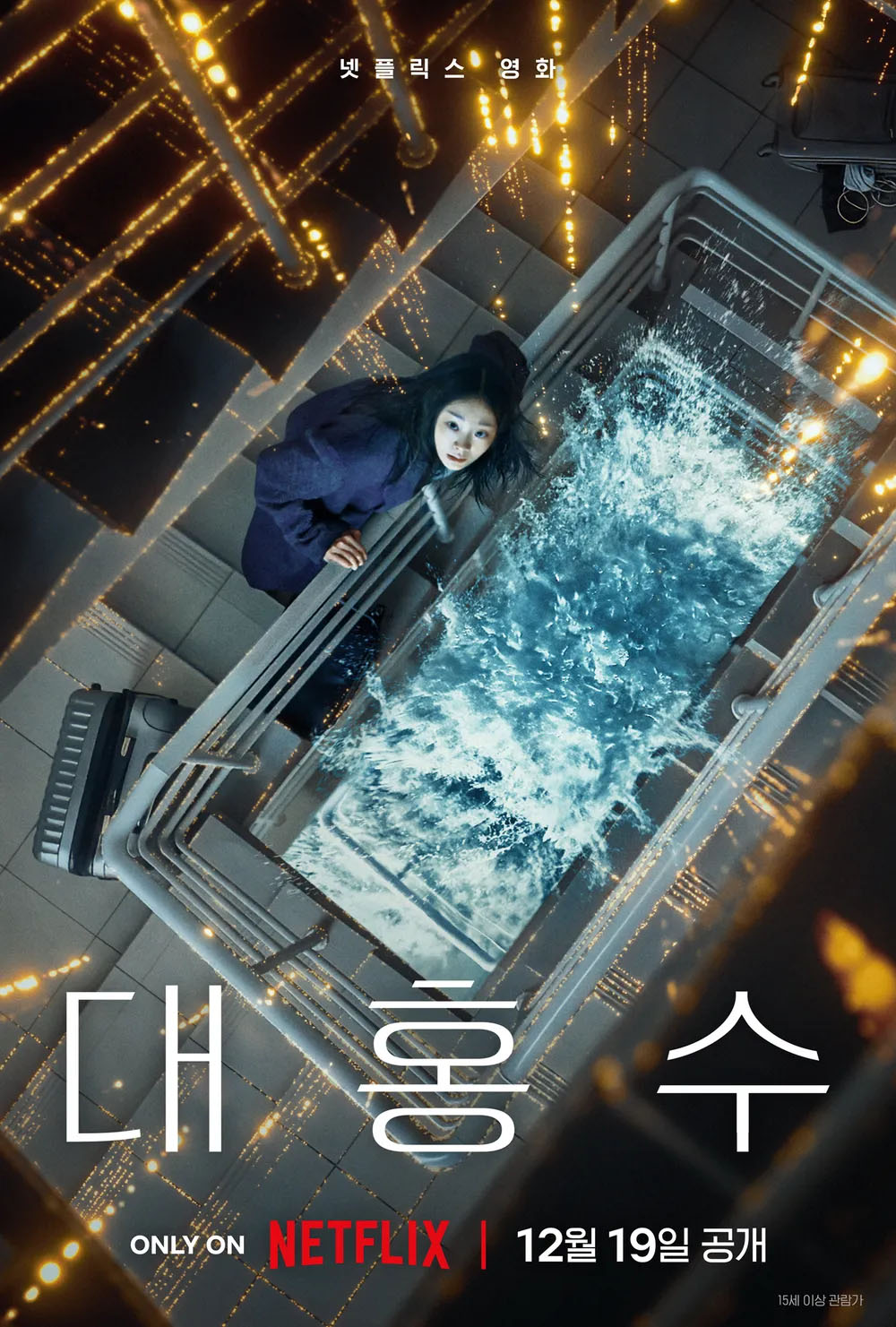
“The Great Flood” Netflix Poster
Director: Kim Byung-Woo
Cast: Kim Da-mi, Park Hae-soo, Kwon Eun-seong, Jeon Hye-Jin, Lee Hak-Joo, Yu-Na, Lee Dong-Chan, Kang Bin, Kim Dong-Yeong, Lee Jun-Hyeok
Running Time: 108 min.
By Paul Bramhall
The last time Korea had to face a cinematic tsunami threat was in 2009’s Hauendae, and technically it still stands true in 2025, since the latest addition to Korea’s disaster genre catalogue, The Great Flood, went directly to the streaming giant Netflix, skipping a theatrical release. As the 2nd movie from director Kim Byeong-woo to be released in the same year, it’s hard not to feel that, as a filmmaker, he must be feeling like he’s stuck between a rock and a hard place. With Korean cinema attendance going through its worst slump for more than 20 years, when his big budget webtoon adaptation Omniscient Reader hit cinemas in July he openly appealed for people to watch it in the cinema, candidly stating that the situation was “desperate”. It feels like a cruel irony then that, only 5 months later, his latest has Netflix to thank for its existence.
It’s also a shame since The Great Flood feels like it should be being watched on the big screen, with Kim Da-mi (The Witch: Part 1. The Subversion, Soulmate) playing a mother who lives in a 3rd floor apartment with her six-year-old son, played by Kwon Eun-seong (Concrete Utopia, Ransomed). Byeong-woo throws us almost straight into the action, with Da-mi looking out the window after stepping into water on her apartment floor, only to find the water level is already creeping up past the 3rd level. What follows is a disaster movie masterclass as she and her son attempt to make it to the rooftop of their 30+ floor apartment complex against a constantly rising water level. Thankfully help is at hand, with Da-mi’s status as an AI scientist being important enough for the organisation she works for to send an agent to retrieve her, played by Park Hae-soo (Phantom, Yaksha: Ruthless Operations).
While the concept on paper may sound like a riff on 2019’s Exit, just swap out the steadily rising toxic gas for water, onscreen it soon becomes clear that The Great Flood has a much grander scope. Hae-soo explains an asteroid has hit Antarctica, melting the ice caps and plunging most of the world underwater, providing as good a back story as any for a disaster movie of this nature. However the more time they spend together, the more the dialogue starts to drop hints that Byeong-woo’s latest may not be all it seems to be on the surface. There’s increasing talk of the Emotion Engine that Da-mi’s been working on, an AI program that contains human emotions, and before they reach the rooftop the conversation’s gotten as heavy as Hae-soo positioning Da-mi as the saviour of humanity, responsible for “creating the new human race.”
Despite the somewhat ambiguous dialogue, the narratives sense of urgency ensures the audiences main focus remains on the mission to stay alive, with the entire apartment complex escape sequence taking up 45 minutes of the 1 hour 45 minute runtime. Da-mi makes for an enjoyable protagonist, spending practically the entirety of the runtime soaked to the skin, and her performance helps to balance out the occasional bout of overacting from Eun-seong as her son. There’s the obligatory checklist of disaster movie characters and scenarios as they ascend through the floors – the kid trapped in an elevator, an elderly couple with one of them wheelchair bound, a husband and wife who’s gone into labour, and of course, the tearful last phone call with Da-mi’s own mother.
It’s only once they make it to the rooftop that The Great Flood shows its true colours – yes it’s a disaster movie, but not the typical ‘try and make it out alive’ slice of disaster genre filmmaking, which as an audience we discover we’ve been lulled into a false sense of security to expect. There will be some that say Byeong-woo jumps the shark with the direction he swerves the narrative towards, but personally I enjoyed the boldness of the move. From crafting the classic disaster movie structure that owes a debt to the likes of The Towering Inferno and The Poseidon Adventure, the last hour owes more of a debt to the likes of Christopher Nolan’s Interstellar and Doug Liman’s Edge of Tomorrow.
To discuss the rest of the plot would involve going into spoiler territory, so to give fair warning if you’ve yet to see The Great Flood, stop reading here and come back once you have! Whereas the likes of Mission: Impossible: Dead Reckoning and its sequel go to great lengths to portray the evil that AI could bring unto the human race, here it’s portrayed as having the ability to save it. From the safety of space Da-mi is tasked with utilising the Emotion Engine to create the ideal “mother and son” who’ll be able to re-populate Earth. With AI already able to create a physical human, the missing ingredient is the ability to imbue the creations with human emotion, so they need to find a way for the program to iteratively learn what it means to be a mother.
The answer? Put Da-mi’s consciousness and an existing AI creation – her son – into a simulation of the day the Earth was flooded, and have them be separated along the way. If Da-mi is able to find him and save them both by getting to the rooftop, then the AI will have gained enough experience to be qualified as a fully feeling human, and the clones can be sent back to Earth to start re-populating the human race. It sounds preposterous, and to be fair it is, but I have a soft spot for sci-fi that takes broad swings, and here Byeong-woo feels like he’s re-visiting a similar theme of identity as he did in his 2008 indie debut, Written (which involves a character discovering that they’re actually a character in an unfinished movie), only this time with a much bigger budget.
The switch to sci-fi territory also has its own awards, such as that obligatory checklist of disaster movie characters now carrying a very intentional purpose when it comes to how Da-mi interacts with them, and there’s a clever visual choice to show certain parts of the apartment complex as Matrix style code. Despite enjoying the bait and switch though, there are undeniably elements of The Great Flood that feel undercooked, confusing, or both. The flashbacks to how Da-mi lost her husband feel like they should carry some meaning, but are ultimately superfluous to the overall plot, and there’s a certain habit of the camera intentionally panning to Da-mi’s t-shirt that feels like a concession to the spoon-fed nature of Netflix content. I would have preferred if they left the detail its alluding to in the background for the audience to pick up on themselves, but instead it’s presented in a “hey, make sure you notice this!” kind of fashion.
The biggest question mark rests over Hae-soo’s character, as I went from thinking he was an AI creation created specifically to guide Da-mi and her son to safety, to later thinking that he’s actually the adult version of her son, who’s chosen the mission to heal his trauma of being abandoned when he was a kid. The last one carries a welcome emotional weight, but admittedly the more I thought about it, the more it didn’t make sense. The whole simulation of the flood is being handled by the Emotion Engine, so why would it send a grown-up version of its own creation back in? Elements like this, and the lack of explanation around them (I know, you’re probably thinking didn’t this guy just complain about being spoon fed literally in the previous paragraph!?), stop The Great Flood from fully realising its potential.
Perhaps being a less discerning sci-fi fan than most (and disaster movies for that matter), I found myself able to look past these issues, and as the credits rolled felt like it was the first time for Korea to successfully blend high concept sci-fi with its cinemas traditional tendency to lean into melodrama. Even Eun-seong’s performance ended up hitting home in the final reel. More Fallen than Jung_E, The Great Flood offers up a heady mix of disaster spectacle, conceptual sci-fi, and a message around AI that’s sure to generate discussion. Well worth checking out.
Paul Bramhall’s Rating: 7.5/10



Wow, such a positive review! I couldn’t stand this film. First, this is exactly where it belongs. I didn’t see anything that was worth to be seen in the cinema. Second, it’s a real drag to get into the story. As for the disaster / scifi combo. Sounds great on paper but takes away the inevitable dread and thrills. So what is even the point?