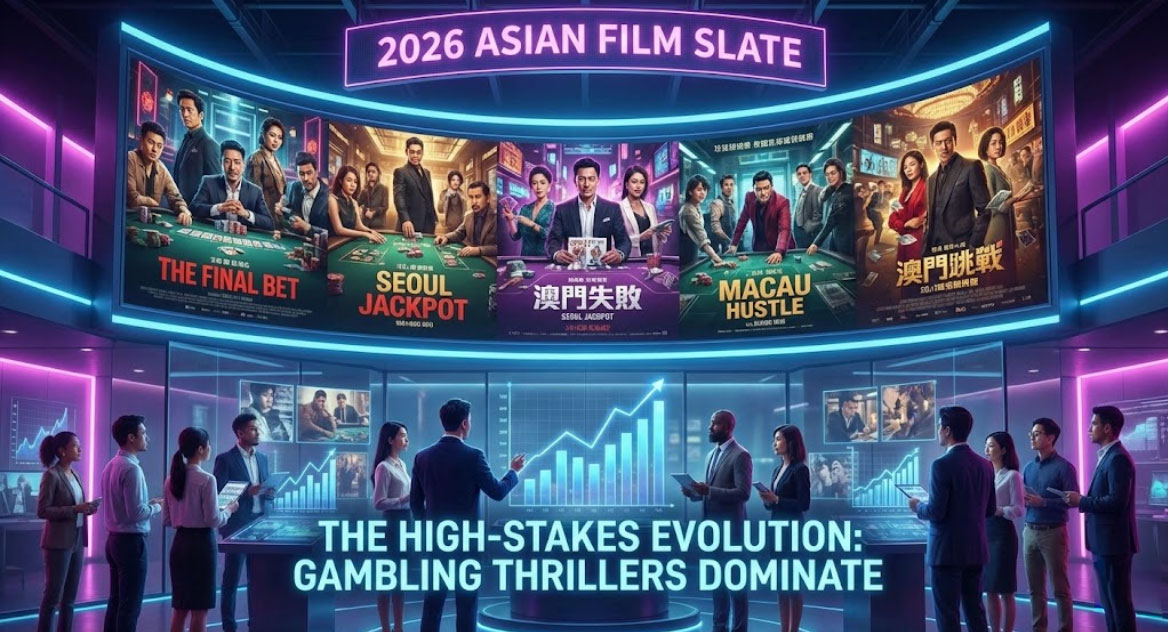
Image Credit – Gemini
2026 is a land-changing, pivotal year in Asian cinema. On the huge film lists of South Korea and Hong Kong, there is currently a complex and planned revival: the revival of the so-called Gambling Hero type. Nevertheless, this film renaissance, which industry analysts and Asia-focused film sites like Cityonfire have been busy following, is not just the nostalgic backlash to the high-adrenaline and smoke-filled cinematic aesthetic of the 1980s and 1990s. Rather, it is a very calculated development.
With the film industry taking a brash action in entering a new production cycle, there is an obvious synthesis happening. The classic God of Gamblers flair of the charismatic, larger-than-life is being combined with the gritty, psychological realism that has now become synonymous with modern South Korean thrillers by visionary directors. With the next wave of blockbusters coming in 2026, a lot of filmmakers are taking a chance and adding a futuristic roulette game to their movie sequences, in the quest to bring the elements of classic gambling with hyper-modern, high-tech designs. Such aesthetic turn is used to bring one genre, which has historically swivelled between comic melodrama and hard-boiled crime, into a post-modern visual language, a speculative one, which confronts the modern fears of technological domination, globalised finance, and the character of risk in an ever-more algorithmic world.
The Cultural Architecture of the Gambling Hero
In order to gain a clear idea as to why the gambling movies are taking over the Asian cinema 2026 schedule, it is necessary to examine the root cause of the situation, i.e., the 1989 Hong Kong masterpiece, God of Gamblers. Under the prolific directorship of Wong Jing, and the star of the movie, Chow Yun-fat, playing the legendary role of Ko Chun, the movie was much more than a mere commercial success; it was a cultural phenomenon that could not be overlooked.
God of Gamblers created an archetype of a Master, a person of unsurpassed prowess, with almost supernatural powers to control fortune and know his enemy. Ko Chun, his slicked-back pompadour, spotless tuxedo, and his fondness for such expensive chocolate made him the cinematic cool. He was an embodiment of ultimate agency in a world that seemed to be more chaotic and out of control.
The exceptional popularity of God of Gamblers presented the whole universe of cinema. It spawned direct sequels such as God of Gamblers Return (1994) and massively popular spin-offs such as God of Gamblers II (1990), where the “Saint of Gamblers” (portrayed by a comedy superstar Stephen Chow) introduced a comic, “Mo Lei Tau” (nonsense comedy) flavor to the high-stakes universe. These movies strongly represented popular fears of a Hong Kong populace that had to deal with quick economic development and the political unpredictability of the pre-handover period. The gambling table in this historical context could be considered a miniature of the city: a mean place where chance, prowess, and boldness could mean instant wealth or complete and utter destruction.
The Evolution of the Archetype: 1980s to 2026
The transformation between the hero of the 1980s and that of 2026 is characterized by a clear change in the type of hero from the Savant to the Technologist. The contemporary gambling hero is a critical character, whose skills lie in the complex fields of high mathematics, probability, and technology, whereas the skills used by the gambling hero of the film, Ko Chun, were more of an intuitive and savant nature.
Here is how the archetype has evolved over the decades:
- 1980s–1990s: The “God” / Savant – Defined by intuition, sleight of hand, and supernatural fortune. The visual tropes of this period were far-cut tuxedos, grandiose slow-motion access, and quirky peculiarities (eating chocolate).
- 2000s–2010s: The “Tajja” / Hustler – It is defined by mental manipulation, grit, and desperate survival. The aesthetic patterns changed to smoky backyard saloons, sweat, bodily violence, and the debt on a local scale.
- 2026 (Upcoming): The Technologist / Genius – They are defined by analytical mathematics, infrastructure hacking, and high-tech skills. The visual tropes prevail with neon-noir illumination, the digital overlay, and futuristic polished roulette.
This development is representative of a wider trend in the field of cinema where magic is substituted with mastery. In the 2026 production slate, the gambling hero may be an educational graduate of fine academic establishments, employing raw intellectual ability and coded skills to get around a world of artificial island casinos and highly digitized gaming floors.
The Hong Kong Legacy: 4K Restorations and Reinvention
The revival of the genre in 2026 will hugely rely on the fresh, enthusiastic fascination with the so-called Golden Age of Hong Kong gambling movies. This has been identified as a trending interest in casino films by major international distributors and smaller physical media labels, which results in a substantial, aggressive, and profitable restoration schedule in 2026. This revival of home media offers the cultural background of the new roster of films, which essentially seals the gap between the traditional period and the high-tech sequel versions.
88 Films and the Canto-Comedy Revival
God of Gamblers II is the most anticipated release of 2026 in the 4K Ultra HD and Blu-ray format by the Boutique label 88 Films. It is important due to the fact that this release brings out the hybridism of the genre, where the crazed Canto-comedy is mixed with high-stakes, sweat-inducing tension. The contrasting of the Knife, by Andy Lau (the serious pupil of the God of Gamblers), against the Sing, the Saint of Gamblers, comedy, made by Stephen Chow, the year before, created a film world that modern directors are now busy trying to remake with technological twists of their own.
The reason behind the restoration of these films has two sides: it serves the global audience, who have recently learned about these titles via streaming services, and it strengthens the so-called Gambling Master trope and proven commercial driver of the contemporary studios.
Shout Factory: The Gamblers & Gangsters Collection
Similar to single releases, the Hong Kong Gamblers & Gangsters collection coming out in the 2025 – 2026 cycle is a selection of the genre’s history. This lists are the seminal titles which trace the DNA of the new blockbuster:
- Casino Tycoon (1992): Directed by Andy Lau, this movie tells the story of a gambling tycoon, reflecting the real-life history of Macanese people and creating the theme of the casino as the empire.
- Challenge of the Gamesters (1981): One of the early attempts to investigate the trope was one that focused solely on skill and honor.
- The Conman (1998): An evolution of the gambler in the late ’90s that introduced some world-weary grit to the character.
These movies explain the perceived interest and excitement as the foundation of the 2026 lineup. They display the two-sidedness of the genre, high-stakes luxury and violent desperation, which 2026 directors are now deploying with a high-tech, cyberpunk approach.
South Korea’s 2026 Blockbuster Strategy: Tazza 4 Takes Center Stage
In the case of Hong Kong, it is offering the historical DNA and nostalgia, whereas South Korea is offering the narrative innovation, star power, and enormous production scale of 2026. The Korean film industry has boldly stepped out of the localized Korean house gambling (Hwatu) scenes, which were prevalent at the beginning of the 2000s, to a more globalized and technologically advanced dream of the casino world.
Tazza 4: The Song of Beelzebub is, by far, the most anticipated title of the Korean blockbusters’ 2026 slate. Following the direction of Choi Kook-hee, the great director of Default and No Way Out: The Roulette, this fourth installment is a colossal, unprecedented expansion of the franchise scope. Contrary to its predecessors, Tazza 4 is a sweeping worldwide revenge movie that is styled in the manner of The Count of Monte Cristo.
The movie is about two inseparable high school mates as well as KAIST (Korea Advanced Institute of Science and Technology) graduates, who are Jang Tae-young (portrayed by Byun Yo-han) and Park Tae-young (portrayed by Roh Jae-won). When a miserable betrayal brought the life of Jang Tae-young to an absolute ruin, he went out as a gambling legend of the world, under the alias of Oyama Yoshiaki, to take his revenge. This drastic change in location, from the poor backrooms in Busan to the extreme luxury of the casinos of Japan, Malaysia, and the United States, is the actual High-Stakes Evolution of the 2026 slate.
Pan-Asian Casting and Character Dynamics
The casting of Tazza 4 is a strategic amalgamation of the high acting pedigree and the modern-day cool element, which is meant to attract the traditional cinema world and the global Hallyu generation.
- Byun Yo-han (Jang Tae-young): Makes the hero look like a betrayed genius, the psychological cost of vengeance.
- Roh Jae-won (Park Tae-young): The enemy symbolizes the cold, business-like spin of the gambling industry.
- Ayaka Miyoshi (Kaneko): A young Japanese star (who has a character in Alice in Borderland), whose character is used as a ferocious ally.
- Lim Se-mi (Jang Tae-hee): The sister is the emotional and narrative catalyst of the protagonist.
The appearance of Ayaka Miyoshi highlights the pan-Asian desires of the 2026 slate. Her appearance marks a shift towards cross-border cooperation, which guarantees the popularity of the film in different international markets.
High-Tech Aesthetics: The Futuristic Roulette and Neon-Noir
One of the key features of the 2026 resurgence is the total change in the appearance of the gambling space. In 2026 movies, the scenes of the futuristic roulette use bright neon lights and blue neon wheels to form the effect of urban decadence in comparison with the futuristic high society. This aesthetic transition goes in line with the change of gritty realism to a more conjectural and edgy aesthetic inspired heavily by cyberpunk and neon-noir.
- Neon-Noir Lighting: The use of high contrast lighting with prominent shades of blue and red gives the feeling of futuristic and dangerous, a mixture of inconceivable luxury and deadly danger.
- Wearable Art: The 2026 gambling hero foregoes the classic tuxedo in favor of high-tech metallics and liquid fabrics, a natural blending of high-tech and high-fashion designs.
- Integrated Tech: In contrast to the 1989 period, when devices were inconspicuous (such as card scanners in fingertips), technology is reflected in the film as a part of the environment, as augmented reality interfaces fly over the gambling table and astronomical bets are tracked automatically in real time.
This futuristic visage is more evident in the second half of Tazza 4, which is set in an artificial island special tourism zone. This scene is the final reenactment of the gambling hero in power: the completely resolved, quality environment built to host the final high-stakes game.
The Socio-Economic Mirror: Gambling as a 2026 Metaphor
The prevalence of the gambling motif in 2026 is an extensive commentary on the socio-economic environment in the area. The heroes of Tazza 4 are graduates of KAIST, which is a particular element that rings profoundly with the environment of hyper-competition and high-pressure academic life in South Korea. Gambling in this context is an analogy of the win-takes-all aspect of contemporary professional and corporate life. The moral decay between friends over infrastructure business is a scathing social commentary about the need to achieve success by whatever means.
Moreover, the storyline about a Chinese government proposal to create a special tourism zone on an artificial island represents the actual projects to the real world, speculative ones, and geopolitical economic approaches in Asia. The sheer size of the gamble: tens of millions of dollars and international politics influence at a global scale is symbolic of the size of the development of international relations in the modern world. The gambling hero of 2026 is no longer a master of playing cards only; he plays a significant role in a far bigger geopolitical and economic game.
The Role of Global Streaming Platforms
The competitive nature of the global streaming is also a contributor to the dominance of the 2026 slate. Competition over the domination of K-content has taken place among such platforms as Disney+, Netflix, and MBC, which are pouring significant funds into films with high entertainment and action-packed genres with successful stories abroad.
The “Gambling Hero” trope fits perfectly into this modern distribution strategy. It offers vivid, charismatic leads and fast-paced, highly choreographed tension that transcends cultural boundaries. Since these films inherently are franchiseable, they are extremely appealing to streaming services seeking to get repeat, loyal customers.




















Be the 1st to Comment