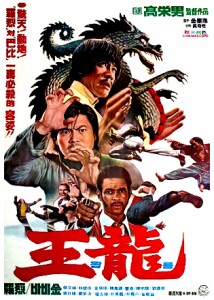
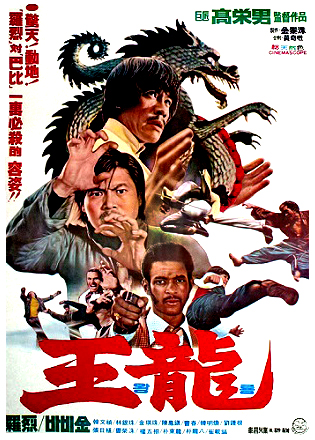
“The Deadly Kick” Korean Theatrical Poster
AKA: The Rival
Director: Go Yeong-nam
Co-director: Lo Lieh
Cast: Lo Lieh, Bobby Kim, Pearl Lin Yin Zhu, Han Mi-ja, Im Eun-ju, Kim Ki-ju, Jin Bong-jin, Gam Kei Chu, Bruce Cheung Mong, Chan Feng Chen, Chiu Chun
Running Time: 93 min.
By Paul Bramhall
In 1972 the Shaw Brothers production King Boxer was released in the US, under the title of Five Fingers of Death, and is largely considered to be the movie which kicked off the kung fu craze for western audiences. Starring popular thespian Lo Lieh, King Boxer was actually directed by a well-respected Korean filmmaker named Jeong Chang-hwa. Because of Chang-hwa’s popularity in Korea, not only did the movie travel stateside, but it also received a Korean dub and was released on his home soil. Perhaps because of this, Lo Lieh became a recognizable face in Korea, and 4 years later he’d go on to star and co-direct a pair of Korean movies alongside local taekwondo star Bobby Kim.
Bobby Kim was one of those Korean stars who, much like Han Yong-cheol, made his most popular movies in Korea during the 70’s, and never transitioned to Hong Kong productions like Casanova Wong, Hwang Jang Lee, and Kwon Yung Moon did to great effect in the later part of the decade. Kim eventually emigrated to Denver, where he setup a taekwondo school, and featured in a number of mostly no-budget local martial arts productions (Kill Line being a good example).
Lieh and Kim would pair up in both International Police and The Deadly Kick in 1976, and both movies contain almost identical casts and crew, so it’s safe to assume they were filmed at exactly the same time. In The Deadly Kick Lieh plays a sex crazed alcoholic, the self-proclaimed “king of the nether regions”, who’s just gotten out of a 5 year stint in prison. In flashback we learn that Lieh and Kim used to be students under the same martial arts master, however Lieh’s quick temper and jealousy led him to rape the master’s daughter, during which he uses his eagle claw technique to gauge her eyes and blind her. You may assume this makes Lieh the despicable villain of the piece, however, in a decision that’s beyond explanation, he’s actually the main character.
Through a series of muddled events, 15 minutes in we finally meet Bobby Kim, playing an Interpol agent on the trail of a stolen $100,000. A criminal organization are also after the money, who hire Lieh to track it down, and the pair form an uneasy partnership to try and locate it together. The Deadly Kick looks and feels like a sleazy incomprehensible mess, and it leaves a distinct impression that the dubbing has seriously flubbed some of the plot points. Random events simply pop up through abrupt scene changes, such as the master’s daughter suddenly showing up and announcing that, “even though I’m blind, I’ve practiced martial arts all day every day.” Her practice entails having a young girl (it’s never explained who she is) follow her around, who jangles a bell to signal were the daughter should attack. However when the confrontation with Lieh finally happens, he simply kills the little girl with one strike, and then wonders off back to resume his mission.
Lieh’s style of kung fu is also likely to draw looks of confusion. Clearly channelling his King Boxer stances, whenever he springs into action the camera cuts to directly in front of his face, as he busts out various tiger, eagle, and snake hand gestures, which for the uninitiated could well be mistaken for shadow puppetry. However best of all, is that each animal gesture is spliced with images and sounds of said animal. So we get brief glimpses of a tiger mask being thrust at the camera, complete with growls, a stuffed eagle being shaken about by a hand just off-screen while headache inducing squawks play over it, and a rubber snake held so close to the camera you can hardly make it out at all. Oh, and by the way apparently snakes don’t hiss, they squeak intermittently.
It’s difficult to tell what tone The Deadly Kick was really going for. At times it feels like an Asian version of 007, with Bobby Kim being captured and trapped in a gas chamber, disguising himself as a waiter to save Lieh from a guillotine trap that would make Blofeld proud, and even being chased by bad guys throwing grenades from a helicopter. However at other times it feels like a cheap basher, with a trio of henchmen (two of which are played by Korean kung fu luminaries Kwon Il-soo and Chiu Chun in early screen appearances) being a highlight. While two of them utilise a shuriken and blow dart respectively, the third member, played by Chun, uses a brick, which he smashes over his head and then throws the pieces at whoever he’s trying to kill. Who thought this would be a good idea!? That being said, the blow dart prop doesn’t fare much better, with the henchman unable to muster up enough breath to propel it more than a few inches in front of him. Thankfully, the editing would have us believe it lodged in a hapless victim’s skull several meters away.
You’d think a production that contains a scene in which a helicopter flies so low, it almost clips the person it’s chasing after, could afford a more effective blow dart mechanism. The actual martial arts action also mostly falls into the basher category. For over an hour, it’s frustratingly filmed in a way which has either Lieh or Kim striking at the camera, then cutting away to the person whom the strike is supposed to have connected with falling to the ground. However the fact that no physical connection is ever shown damages the impact of these scenes significantly. Essentially Lieh or Kim could have been filmed in one location, and the recipient of their blows might as well have been filmed in another. However at just over the hour mark Kim finally gets into a decent scuffle, which allows us to see his kicks physically interacting with his opponents. The action is filmed in a frantic style by the camera, very much reminiscent of the karate exploitation flicks coming out of Japan at the time, spearheaded by Sonny Chiba.
However what makes any basher worthy of its title is the sense of desperation conveyed in the fight scenes. The term ‘basher’ was mostly used for productions from the 70’s, which displayed more of a ‘punch and block’ style of fighting, as compared to the more intricate choreography style which would come a few years later, popularly known as ‘shapes’. The style was particularly effective in modern day set action movies of the time, and names like Jimmy Wang Yu, Chan Sing, and Yasuaki Kurata would become synonymous with the genre. The final 30 minutes of The Deadly Kick cranks out some worthy basher action, particularly when Lieh has to fight his way through a series of sliding door rooms to get to the main Japanese villain, reminiscent of a similar scene that would take place 30 years later in Ryoo Seung-wan’s City of Violence (only Seung-wan’s production was minus the animal sounds).
Bobby Kim also gets some worthy kicks in, with one shot in particular standing out which has the camera positioned on the floor, some distance away from the fight action. Kim then kicks one of the henchmen, who proceeds to slide across the floor face first straight into the camera lens. The image of the henchman looking directly into the camera is one that will linger for a while after watching. Indeed The Deadly Kick manages to remain watchable mainly due to these constantly random moments, seemingly played completely poker faced, popping up with frequent regularity. The white haired villain of the piece lives behind a fake wall, with only a stuffed owl to keep him company, and the wall slides back whenever he has to dish out orders to his henchman. Exactly what he’s sitting there staring at whenever the wall is closed is a mystery.
Other worthy mentions include the inclusion of 3 shirtless bodybuilder thugs, who must have been given the direction to laugh while flexing their pecks at the same time, which was clearly a lot harder to do than it sounds. My favorite scene of randomness though occurs when Lieh thrusts his fist into a henchman’s stomach, and rips out their intestines. These aren’t just some cheaply made prosthetic intestines though, they’re fresh, sloppy, very real animal intestines, which he then proceeds to throw into the face of poor Park Dong-yong, before grabbing them and strangling him to death with them. I can only imagine the conversation that took place between the director and Dong-yong before the scene – “So you just need to stand there, and Lo Lieh is going to throw the animal innards into your face, ok?” Kudos to him for being so game, and the scene pre-dates the same intestine strangulation technique used in The Story of Ricky by 16 years.
That being said, the sexual violence won’t appeal to everyone, and rightfully so. When Lieh’s crime syndicate love interest is captured by the Japanese, she’s stripped naked and tied up in front of a room comprising only of men. The main Japanese villain then proceeds to repeatedly stab her between the legs with a fencing sword, set to her ear piercing screams. Even though no nudity is shown, it’s an uncomfortable scene. To keep with the exploitative nature of the situation, every scene which then takes place within the room, including the fights, is awkwardly framed from between her thighs. If the preceding torture hadn’t been so cruel, such a technique would have been bizarrely entertaining, but as it is, the scene leaves a bad taste.
For those who are wondering, the plot is coherent enough to have Kim remember what Lieh did to their master’s daughter, and the finale delivers a Bobby Kim vs Lo Lieh showdown. Keeping with the bizarre nature of the production, it becomes an almost mystical confrontation, with Lieh calling on what I can only presume is the God of Eagle Claw, and Kim channelling the powers of the Buddha. Onscreen, this translates to lots of blowing leaves, and spliced scenes of the stuffed eagle facing a statue of the Buddha. As a fight, I challenge anyone who’s seen it to explain exactly what happens, but as an exercise in 70’s kung fu oddities, The Deadly Kick certainly qualifies as a contender.
Paul Bramhall’s Rating: 5/10






Be the 1st to Comment