
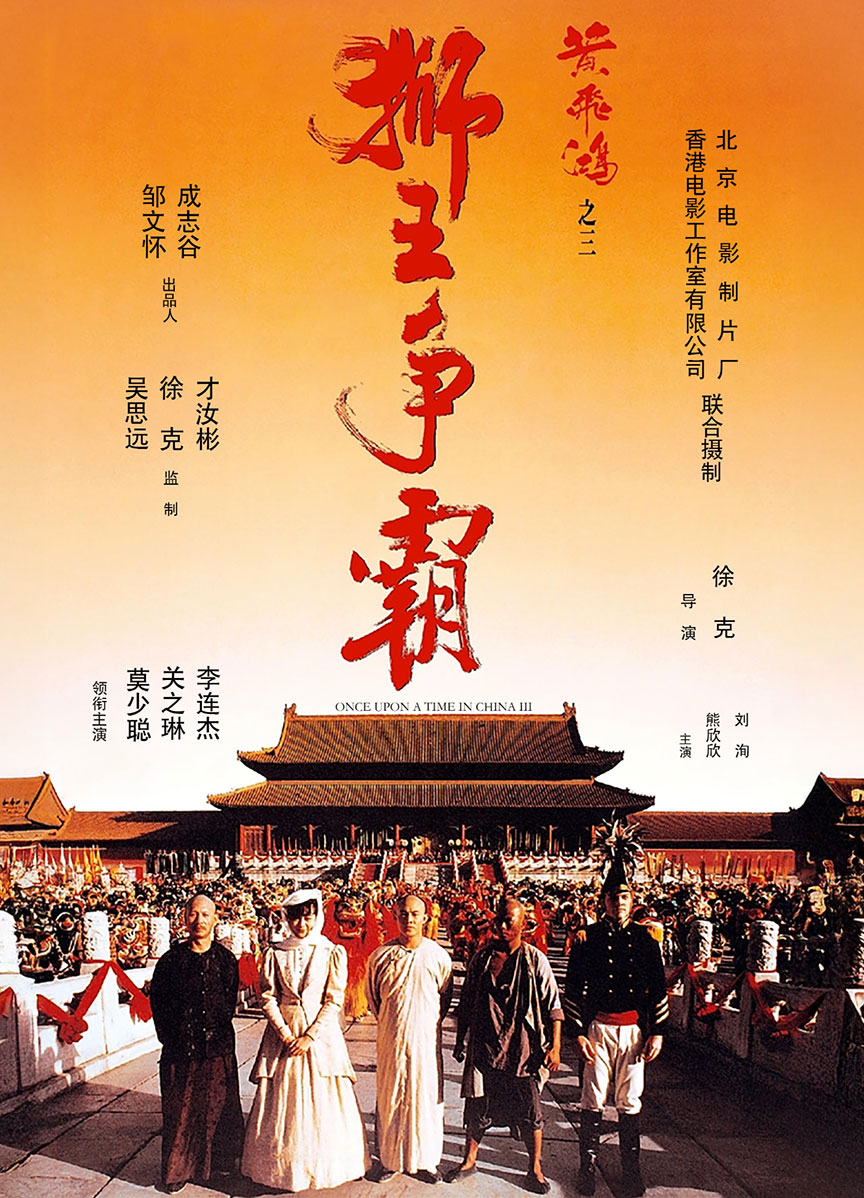
“Once Upon a Time in China III” Poster
Director: Tsui Hark
Cast: Jet Li, Rosamund Kwan Chi-Lam, Max Mok Siu-Chung, Xiong Xinxin, Lau Shun, John Wakefield, Chiu Chin, Ge Cunzhuang, Meng Chin
Running Time: 105 min.
By Z Ravas
Once Upon a Time in China is a film that convinced you it was telling the story of an entire nation. Tsui Hark’s widescreen canvas depicted a large array of characters, including master martial artist and doctor Wong Fei-hung, who were caught up in the tide of history as foreign interests pulled at the social fabric of late 19th century China. In comparison, Once Upon a Time in China Parts II & III feel like they’re largely about…the awkward ‘will they or won’t they?’ romance between Wong Fei-Hung and his aunt. (Don’t worry, they’re not related by blood.)
The series’ diminishing complexity is also illustrated by the villains in each picture: in the original, Iron Vest Yim was a formidable but ultimately sympathetic opponent, someone who had lost sight of the true meaning of martial arts due to his dire poverty. Wong Fei-Hung fought him to a standstill, but you could sense Fei-hung’s respect for his opponent; he recognized Iron Vest was a once great man brought low by circumstance. In the sequel, Donnie Yen’s Manchurian enforcer was single-mindedly devoted to hunting down dissidents for the government—Yen was a great physical threat, no doubt, but there wasn’t much there for Wong Fei-hung to reason with or admire. By the time we arrive at Once Upon a Time in China III, the villains of this story are about as deep as a leather-clad biker gang you’d see terrorizing a small town in an old Hollywood exploitation flick.
The film opens with Wong Fei-hung and company traveling to Beijing, where both a high-stakes Lion Dance competition and a political assassination are brewing in the background. You may recall that Wong Fei-hung and Lion Dances were a major part of the plot of Lau Kar-Leung’s 1981 Shaw Brothers classic Martial Club, and I was reminded of that movie quite a bit while watching Once Upon a Time in China III. Of course, the material feels updated for a new decade, and a major part of that is owing to Andrew Lau, who takes over Director of Photography duties here and brings a very slick and stylish visual language to the film that still feels fresh today.
While the villains that Wong Fei-hung faces this time around—a wealthy oil baron who leads a rowdy club of martial artists—may disappoint, there are aspects of this third installment that are arguably an upgrade over its immediate predecessor. Whereas the first movie had a wide array of supporting characters who added to the story, including Kent Cheng’s Porky and Jacky Cheung’s Buck Teeth So, Part II severely narrowed the focus down to just the core trio of Wong Fei-Hung (Jet Li), 13th Aunt (Rosamund Kwan), and Foon (Max Mok stepping in for Yuen Biao). This set the stage for a clumsy love triangle that rarely showed Wong Fei-hung in his best light since he was frequently bickering with Foon. Part III course-corrects by expanding the cast of characters once again: we’re introduced to Wong Fei-hung’s doting father (played by Lau Shun), as well as a complex anti-hero of sorts named Clubfoot (Xiong Xinxin).
In fact, the only disappointing thing about Clubfoot’s redemption is that his transition from lethal henchmen to devoted student means that he’s not available to have a big showdown against Wong Fei-hung. In contrast to the first two movies, which built to a climactic final fight scene, the finale here is a much larger setpiece involving a Lion Dance competition. The spectacle that Tsui Hark offers during this sequence is impressive in its own right, but it’s a bit of a letdown that Wong Fei-hung doesn’t face anyone worthy of his martial arts skills during the third act. Perhaps it was too much to hope that the Russian spy played by John Wakefield would be a secret asskicker, then again, the gweilos in this series usually know how to fight…!
Trilogy cappers are notoriously difficult to pull off. Even if most fans feel that Tsui Hark ended this beloved trilogy on its weakest note, this third outing is far from a blemish on the series, and there remains plenty to enjoy: the location shooting in Beijing, Clubfoot and his wicked fighting skills, not to mention a scene where Wong Fei-hung has to fend off sword-wielding attackers while sliding all over a floor covered in oil. Put another way—did you really think Tsui Hark and Jet Li could get together in the early 90’s and make anything less than a totally watchable martial arts flick?
(Err, well, let’s maybe not talk about The Master…)
Z Ravas’s Rating: 7.5/10


I should revisit China III. I do wish there were big one-on-one fight scenes here, but the aforementioned oil-floor fight (Which Tsui would revisit in Knock Off and which The Transporter referenced) was great stuff, and I liked how elaborate the battle of the lions was with the inventive use of weapons.