



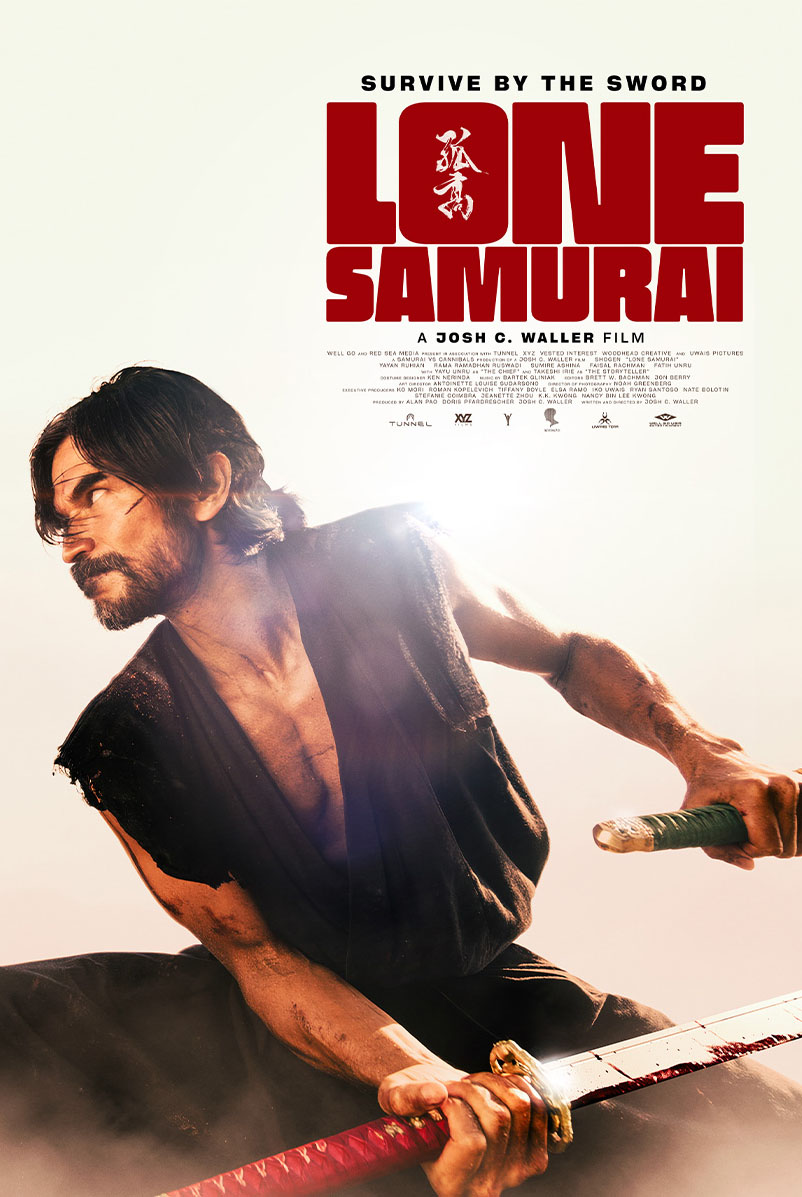
“Lone Samurai” Theatrical Poster
Director: Josh C. Waller
Cast: Shogen, Yayan Ruhian, Sumire Ashina, Rama Ramadhan, Faisal Rachman, Fatih Unru
Running Time: 95 min.
By Paul Bramhall
The release of Lone Samurai marks the first significant production to see Iko Uwais at work behind the camera – it’s presented by his production company Uwais Team, he’s one of the executive producers, and the Uwais Stunt Team are there to deliver on the action. The one place where his presence isn’t felt is in front of the camera, instead opting for a take on the chambara genre, with the samurai of the title washing up on a remote island, having been ravaged by a typhoon while fending off a Mongolian invasion in the 14th century.
Played by the singularly named Shogen (Gensan Punch, Hero’s Island), after onscreen text provides a background as to how the Mongolians repeatedly attempted to invade Japan (only to be thwarted by typhoons!), we meet his washed up (literally and metaphorically) samurai with a wooden pole impaled through his leg, and sword broken in two. It’s a compelling opening, and those who are clocking into Lone Samurai expecting an action fest (a fair assumption based on the credentials of those involved!) may be confused by the tone the production takes on. Indeed for a third of its runtime we simply follow Shogen around the island, watching as he attempts to find a way to survive the remote surroundings he finds himself in, complimented by minimal dialogue and the occasional flashback.
It’s a bold move by director and screenwriter Josh C. Waller, whose previous directorial endeavours have seen him frequently pair up with stuntwoman Zoë Bell, providing her with starring roles in the likes of 2013’s Raze (his first feature length production as a director) and 2015’s Camino (which also happens to be the last feature length production he directed). Waller’s penchant for mixing in martial arts in unexpected genres is clear, and despite it being 10 years since he sat in the director’s chair, the same penchant remains with Lone Samurai – the tagline offering the promise of ‘Samurai vs. Cannibals’. The production certainly delivers on its promise, however audiences may be surprised by the route it takes to get there.
The experience of watching Lone Samurai is a bit like watching 3 movies for the price of 1, the dealbreaker being if you’re a fan of all 3, or if you were only clocking in for 1 of them. In that regard Waller’s latest can feel like it has somewhat of an identity crisis. The biggest issue with the serenity of the first third, which consists of Shogen traipsing around the island, dabbling in some poetry, and suffering from hallucinations of his wife, is that it lacks any kind of narrative thrust. That may be the point, but spending more than 30 minutes to watch his leg heal, the remainder of his sword get sharpened, and a makeshift shrine be constructed may have been better suited to a montage. Lucky for the audience, just as he’s spouting some pretentious nonsense (there’s an argument that it could have been a better movie if Shogen remained dialogue free throughout) before committing seppuku, a cannibal shows up and knocks him unconscious.
The 2nd third is essentially a horror movie, as Shogen finds himself tied up and bound in a cave that’s home to a cannibal tribe, one which includes the most recognizable face in modern Indonesian action cinema – Yayan Ruhian (Wiro Sableng 212, Legend of Gatotkaca). The transition from the contemplative tone of Shogen’s isolation, to watching a bunch of cave dwelling cannibals chop off a captive’s legs, feels like it doesn’t quite gel, almost like we’re now watching a different movie. While any long-time fan of Asian cinema will have had some experience with tonal whiplash, in most cases the context behind the tone remains consistent, but here it doesn’t quite connect.
Shogen’s performance is partly to blame, with the script hinting at a character who gradually descends into madness, however for the most part he chooses to play it stoic and emotionless, hardly seeming phased at his predicament of being alone on an uninhabited island, let alone being captured by cannibals. Luckily the final third does its best to distract, offering up one continuous action scene for almost a full half hour, as he gets back in touch with his primal side and recalls how he longs “for the days of rotting skulls”. His sword soon resumes its true purpose as it goes up against a small army of cannibal cannon fodder, it’s just a shame that the lack of any real characterisation makes the motives behind it feel perfunctory rather than cathartic. The violence is driven by a need to escape becoming that days’ dinner, so while its warranted, it lacks any kind of emotional investment to connect with the audience watching.
Again, if perhaps Lone Samurai wore its pulpy ambitions on its sleeve from the start the sequence would have worked much better, but as it is, the events of the first hour don’t hold much weight over the final slaughter. Still, the beachside setting is a welcome one, recalling the opening scenes of 2018’s Revenger, a Korean slice of action that also opted for a remote Indonesian island setting and successfully utilised the local stunt talent. Once Shogen decides to take himself off the menu, it’s not long before heads start to roll, and arrows are lodged into eyeballs. After cutting down practically entire tribe, we do eventually get to the stuff most will be clocking in for. Like many of the productions he’s featured in since finding fame in the 2011 classic The Raid, Yayan Ruhian is there as the fearsome righthand man of the main bad guy, who here takes the form of the cannibal tribe leader played by Uwais regular Rama Ramadhan.
A stuntman who here makes his front of camera debut (look out for him in another Uwais production next year, Ikatan Darah), Ramadhan also makes up 1 of a trio of fight choreographers, joined by Yandi Sutisna (stunt work on The Night Comes for Us) and Erik Rukmanila (stunt work on Beyond Skyline). Overseeing them is fight coordinator Faisal Rachman, who also gets his licks in by going up against Shogen, cast as one of the few cannibals that doesn’t immediately get struck down. It’s only after his defeat that Ruhian is summoned to the fray, armed with a staff that doubles up as a club. It’s a serviceable fight, however is a far cry from the intensity of the movies that made him famous, part of the curse when one of your early screen appearances sets the bar for the rest of your career (Tony Jaa suffered a similar fate). If it was anyone else in the fight, chances are it’d be considered underwhelming.
Thankfully Ramadhan makes good on his first screen appearance, providing the final opponent for Shogen to go up against, and offering up the first chance for the audience to feel that the protagonist is actually in danger. Considering the relative inexperience of Ramadhan and his trio of colleagues when it comes to fight choreography, it feels like Uwais may be using productions like this to develop a new pipeline of talent in Indonesian action cinema, and the decision to group them as a team is an admirable one. There’s some promising stuff on display in the action department, but equally there’s no real stand out moments, with the overall quality not quite reaching the heights of contemporaries like Muhammad Irfan (The Shadow Strays).
It’s highly likely that Lone Samurai will draw in a diverse range of viewers with its unique selling point. Fans of Indonesian action cinema, chambara genre aficionados, and even horror enthusiasts will all find something to appeal in what Waller’s latest promises, whether it fully delivers on any of them is a different question. One-part meditative drama, one-part schlocky horror, and one part slice and dice samurai goodness, there’s a clear ambition behind Lone Samurai, the disjointed tonal inconsistencies just make it fall short.
Paul Bramhall ‘s Rating: 6/10