



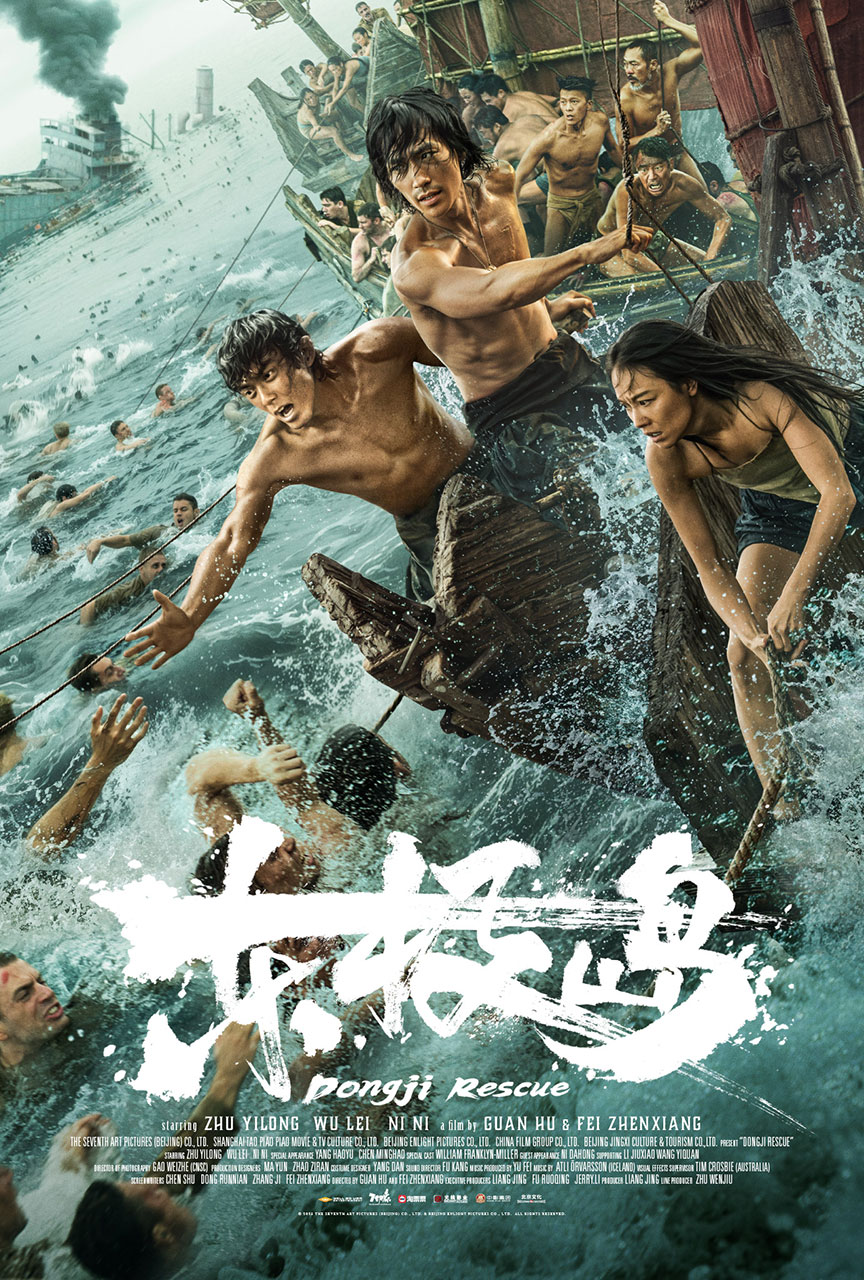
“Dongji Rescue” Poster
Director: Guan Hu
Co-director: Zhenxiang Fei
Cast: Zhu Yi Long, Leo Wu, Ni Ni, William Franklyn-Miller, Yang Haoyu, Chen Minghao
Running Time: 135 min.
By Paul Bramhall
The latest blockbuster from China, Dongji Rescue, tells the story of the 1942 sinking of the Lisbon Maru. The freighter was being used by the Japanese military to transport over 1800 British prisoners of war captured during the Battle of Hong Kong in December of the previous year, however was hit by a torpedo from a U.S. submarine in the East China Sea, causing it to slowly sink over the course of several hours. While the Japanese evacuated the ship, the POW’s had the hatches battened down in the cargo holds they were being kept in, left to drown or be shot on sight for those who found a way to escape. It was thanks to Chinese fisherman from a local island that almost 400 of them were able to be saved, when after noticing smoke rising up from the vessel, they made the decision to sail out and rescue any survivors.
It’s a compelling and relatively unknown piece of history, initially brought back into the spotlight thanks to the 2024 Chinese documentary The Sinking of the Lisbon Maru, which was followed a year later by Dongji Rescue, adapting the incident for the big screen. At the helm are co-directors Guan Hu and his protégé Fei Zhen Xiang. Hu is one of the sixth generation of Chinese directors, having previously directed the likes of Mr. Six and The Eight Hundred, while for Zhen Xiang it marks his first time to work on a feature length production as co-director after cutting his teeth on Chinese dramas for the last decade.
China has been refining its historical blockbuster for a number of years now, replacing the tawdry and exposition heavy snooze fests of the late 2000’s like The Founding of a Republic with more bombastic outings, leaning heavily into grand scale spectacle and jingoism in equal measure. The Battle of Lake Changjin and its sequel are perfect examples, and Dongji Rescue looks to continue the trend, with a cast and crew of thousands ensuring that the production values bring the period detail and the sinking itself fully to life onscreen, all gloriously shot on IMAX cameras.
The plot revolves around a pair of orphaned brothers played by Zhu Yi Long (Only the River Flows, Lost in the Stars) and Leo Wu (Shadow, S.M.A.R.T. Chase). Believed to be the offspring of pirates, the villager’s outcast them to the islands north, where they’ve grown up to be a pair of floppy haired fisherman whose chiselled torsos rarely require clothing. Apparently they also sport more lung capacity than Aquaman, so can spend a lifetime underwater at any one time. It proves to be a useful trait for Wu when, during one of his dives in the opening scenes, a submarine appears out of the blue, passing above the wreckage he’s exploring. The torpedo it fires hits the Lisbon Maru, framing the narrative around the 15 hours it would take for it to sink.
The hit sends a POW overboard who Wu comes to the rescue of, despite his brother’s insistence that harbouring a foreigner on their Japan occupied island would only bring them trouble. Played by William Franklyn-Miller (Four Kids and It), his presence serves to convey the relationship between Yi Long and Wu – with the former being the older and more cautious, while the latter more instinctive and spontaneous. As with most of these productions (dating back to the kung-fu movies of the 70’s), the Japanese are portrayed as one dimensional villains, ensuring that what they lack in characterisation is compensated by how much you’ll want to see them get their comeuppance. It’s not too long before they start to indiscriminately murder the islanders once they hear word a prisoner of war is in their midst – with children bayonetted (evidently the sound effects guy was told to make it as squelchy as possible) and village elders burnt alive.
Keen to ensure the villagers don’t rebel, the Japanese decide to take a number of them back to the gradually sinking ship as hostages, Wu amongst them. The event seems to trigger Hu and Zhen Xiang to momentarily forget they’re making a historical disaster flick, and temporarily switch to what feels like a Korean revenge thriller, as Yi Long goes on a Japanese soldier throat stabbing spree, his body increasingly covered in their blood. For most movies it would probably be the finale, but here Yi Long’s rampage acts as an exclamation point to a 90-minute build up, with the final third of Dongji Rescue’s 135-minute runtime essentially being one thrilling action sequence. One that could be best described as Beach of the War Gods meets Titanic (here’s hoping that makes the cover for its western release).
The sheer technical proficiency of the last 45 minutes serves as the equivalent of that breathtaking final fight in a kung-fu movie that makes any issues that came before it worth sitting through. The first 90 minutes here isn’t a slog by any means, however the characterisation of Yi Long and Wu never feels particularly deep, and most of the supporting characters who time is invested in will have been forgotten about long before the end credits roll. Ni Ni (Savage, The Thousand Faces of Dunjia) is cast as Yi Long’s girlfriend and daughter of the village elder, but apart from bringing a welcome physicality to her screen presence her character doesn’t add much to the mix. Where the setup does succeed is in building up the world of Dongji, an island that’s lifestyle is still mostly steeped in the past, and the contrast with the modern war ships that soon appear on its horizon is an effective one.
The decision to kill off some unexpected characters also delivers the intended narrative punch, before the heavy lifting is handed over to the action and effects teams to do what they do best. It’s actually co-director Zhen Xiang who’s on action director duty, and he executes the role with aplomb. Underwater action sequences have come into their own in recent years, with the likes of Korea’s Smugglers and Hollywood’s Mission: Impossible – The Final Reckoning being superlative examples, and Dongji Rescue can easily stand (or tread water) next to them.
As the damaged ship begins to list and everyone’s forced to jump overboard, the narrative concocts the perfect storm of elements working against them. From the Japanese commandeering the lifeboats and machine gunning down anyone who has their head above water, to the ship itself gradually coming apart, and most deadly of all the powerful whirlpool created by a vessel of its size succumbing to the sea. It’s the kind of extended disaster sequence that’s designed to get the adrenaline pumping, and it’s safe to say that if it doesn’t you may want to check your pulse. It also brings Dongji Rescue back to its historical roots, with the fishermen (and women) of the island deciding to risk their own lives and set sail to rescue as many as they can.
A fittingly epic finish to a state sponsored blockbuster, the approach Dongji Rescue takes by anchoring the narrative through a couple of main characters is one that works in its favour, moving away from the kind of ‘teamwork achieves everything’ ensemble piece that was the mandate for a while (does anyone really remember any of the characters from Operation Red Sea?). Who knows, the pivot may even mean we get the 3rd instalment of the Wolf Warrior franchise promised at the end of the sequel, that I remain convinced never arrived exactly because of the shift away from narratives that celebrate the individual. I digress!
If you have the chance to check out Dongji Rescue on an IMAX screen then I’d recommend it without hesitation, and failing that a cinema screen would be a more than worthwhile second best. The historical accuracy may be played with fast and loose (and there’s the occasional cringe worthy line), but then if Michael Bay can give us Pearl Harbor, there’s no reason why Guan Hu and Fei Zhen Xiang can’t give us their latest. Make sure to stick around for the end credits that play alongside interviews with relatives of the survivors, both from the Chinese and the British sides.
Paul Bramhall’s Rating: 7.5/10